Property Management Cybersecurity

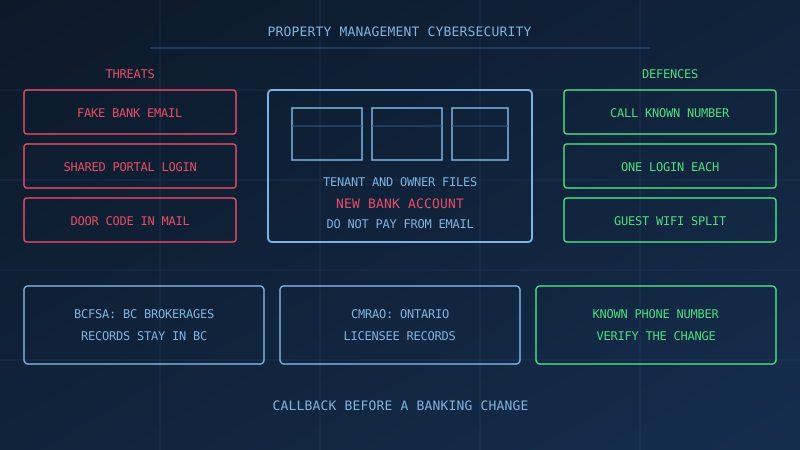
Cybersecurity for property management companies in Canada means calling a known phone number before staff change a banking or payment instruction. The Canadian Centre for Cyber Security's National Cyber Threat Assessment 2025-2026, based on information available as of September 20, 2024, says ransomware actors "are almost certainly opportunistic and do not target specific industries." This is informational context (not legal or regulatory advice).
Why are Canadian property management companies targeted?
The baseline controls page says cyber threat actors target Canadian businesses "for their data about customers, partners and suppliers, financial information and payment systems, and proprietary information." The National Cyber Threat Assessment 2025-2026, based on information available as of September 20, 2024, says financially motivated and opportunistic cybercrime "continues to be the cyber threat activity that is most likely to affect Canadians and Canadian organizations."
A manager holds applications, copies of identification, banking details for pre-authorized rent, owner distribution instructions and contractor invoices. The Office of the Privacy Commissioner of Canada says that, under PIPEDA, personal information includes "name, date of birth, banking information and other financial records." That page is about landlords. It says PIPEDA sets ground rules "for how businesses, including landlords, must handle personal information in the course of commercial activity." The same page says landlords "are responsible for ensuring the personal information is protected by appropriate safeguards."
Sales brokerages are a different business. Our guide to real estate cybersecurity in Canada states that it covers "the deposits, closing funds, client identification records and transaction data that brokerages, teams and agents handle every day."
Which named Canadian rental company reported a cyber incident?
On May 21, 2024, Mainstreet Equity Corp. was the target of a cybersecurity incident that affected its internal systems, according to a Business Wire release issued from Calgary. The Calgary Herald, published May 24, 2024, reported that the company said the attack occurred Tuesday and that it then had "no reason to believe that its operating platform has been affected."
On August 20, 2024, Mainstreet's notice said it discovered on May 21, 2024 that "an unauthorized third party gained access to a portion of our IT infrastructure." The notice says the incident "may have impacted some personal information belonging to tenants (e.g., roommates or primary renters) or guarantors" who paid rent or a security deposit between April 2023 and June 2024, and that "The scope of personal information relating to you may include your name and banking information." The Winnipeg Free Press, on August 27, 2024, reported the same window and said the breach "includes names and banking information." The notice says there is "no evidence suggesting that any individual's personal information was or is being used" for fraud or identity theft. The Free Press reported that statement in a story about one Winnipeg building, the former Lions Place.
What do B.C. and Ontario pages say about records?
The B.C. Financial Services Authority's Document Retention Guidelines, published on 4 May 2021, are for real estate professionals under the Real Estate Services Act. The page says a brokerage "is required to maintain client confidentiality" and that "RESA requires that all documents, including electronic records, be stored in the province of B.C."
BCFSA's Document Retention Information page, also published on 4 May 2021, says electronic records must sit on servers "in the province of B.C." For rental property management it says keep the service agreement, tenancy agreements, accounting statements and invoices, plus "The tenants at each rental property managed by the brokerage" and "The security, pet damage or any other deposits paid by each tenant." Tenancy and deposit documents are kept "for no less than seven years after the earlier of" the end of the tenancy agreement or the end of the rental management agreement. That is for a B.C. brokerage, not an unlicensed landlord elsewhere.
In Ontario, the CMRAO page on what to expect from a condo manager says "licensed condo managers must meet specific legal and ethical obligations under the Condominium Management Services Act, 2015 (CMSA)." That page says: "Under the CMSA Code of Ethics, licensees are legally required to protect this information and only share it with third parties if they have written consent or are required to by law." The CMRAO complaint questionnaire says: "Condo managers are responsible for maintaining corporation records securely, accurately, and in compliance with legislative requirements, including making them available upon request." It also says: "Upon termination of a contract, all records must be transferred to the corporation within 15 days or within 30 days if the records need to be created." Those pages are about Ontario licensees.
What does PIPEDA say when tenant information is exposed?
PIPEDA Schedule 1, Principle 4.7, states: "Personal information shall be protected by security safeguards appropriate to the sensitivity of the information." Principle 4.7.1 says those safeguards "shall protect personal information against loss or theft, as well as unauthorized access, disclosure, copying, use, or modification."
The OPC page on how private-sector laws fit together says: "PIPEDA applies to the collection, use and disclosure of personal information in the course of a commercial activity and across borders." It says that if an organization "operates in a province with substantially similar provincial legislation (B.C., Alberta and Quebec) and has to follow that law, PIPEDA only applies to interprovincial and international transactions." It also says "PIPEDA does not apply to employee information in provincially-regulated organizations." The landlord page says "British Columbia, Alberta and Quebec have provincial private sector laws that apply to landlords in those provinces." This article does not set those statutes out. Our guide to Canada's privacy landscape states that if a business operates in those provinces, "the provincial law applies to activities within the province, while PIPEDA applies to interprovincial and international activities."
Where PIPEDA applies, the OPC breach guidance says organizations report breaches of security safeguards that pose a real risk of significant harm, notify affected individuals, and keep records of all breaches. The page says: "The law requires you to keep breach records of all breaches of security safeguards for two years." The Breach of Security Safeguards Regulations, current to 2026-10-29, say an organization "must maintain a record of every breach of security safeguards for 24 months after the day on which the organization determines that the breach has occurred."
Significant harm on that page includes "financial loss" and "identity theft." The reporting obligation "rests with an organization in control of the personal information implicated in the breach." If a portal vendor holds the file, the page says the organization "remains responsible for the personal information it has transferred to a third party for processing." That is the OPC's reading where PIPEDA applies, not legal advice.
What payment, portal and building risks show up first?
The Canadian Anti-Fraud Centre says an attack "may look like an email from existing contractor providing new payment directions and requesting payment of an invoice." Its July 24, 2025 news release says: "Contact the sender using a trusted phone number, not the one provided in the email." The business-fraud page also says fraudsters may "create a rule to send copies of incoming emails to one of their own accounts."
Use the same check before changing an owner distribution account. The CAFC spear phishing page, with a fraud alert dated March 15, 2023, says fraudsters "will spoof the name of a person's landlord" and ask tenants to send rent "through e-transfer or another payment method that is different from your usual arrangement." It says to "contact your landlord using the information you already have for them." Our guide to business email compromise states: "Criminals impersonate a real supplier your company already pays, claim the supplier changed banks, and redirect your next payment to a fraudulent account." Our guide to construction cybersecurity in Canada states that the Canadian Anti-Fraud Centre's May 2026 advisory says "businesses in the construction and contracting industry, and real estate sector are common targets" for payment redirection fraud.
Our Interac e-Transfer guide states that, before any change to payment details, you should "call the supplier or client at a phone number you already have on file, not one provided in the request."
A shared portal login cannot be removed for one person. The baseline controls say to "give all users unique individual accounts and minimize or eliminate the use of shared or shared-use accounts." Our employee offboarding checklist states that "Access should be disabled the same day the employee departs."
The Cyber Centre's operational technology bulletin, based on information available as of 1 November 2021, says operational technology "is being used to automate many other sectors like building management." BC.2.1 says "enable automatic patching for all software and hardware OR establish full vulnerability and patch management solutions." BC.2.2 says to have "a business process to ensure regular manual updates" where automatic updates are not available. BC.4.1 says change "all default passwords." For guest Wi-Fi, BC.9.5 says: "Organizations should never connect public Wi-Fi networks to their corporate networks."
Which controls should cybersecurity for property management companies in Canada put first?
The Baseline Cyber Security Controls V1.2 are intended for "organizations that have less than 500 employees." Our guide to the baseline controls describes them as "13 cyber security practices that the Canadian Centre for Cyber Security (CCCS) recommends for small and medium organizations."
- Call a known number (BC.6). The callback is Canadian Anti-Fraud Centre guidance, not a numbered control. BC.6.1 says "invest in cyber security awareness and training for their employees." The CAFC business page says to use "verbal authentication for any urgent requests or changes in payment details." If the known number does not confirm, hold the payment.
- Two-factor authentication (BC.5). BC.5.1 says require it for "financial accounts, system administrators, cloud administration, privileged users, and senior executives." Add email and the portal admin role.
- One login per person (BC.12). BC.12.3 says "remove accounts and/or functionality when employees no longer require these for their tasks." Change a shared door code when that person leaves.
- Separate networks, then patch (BC.9, BC.2, BC.4). Use BC.9.5 and the patching lines above. Our guide to vendor and third-party risk states that "Your managed service provider likely has administrative access to your network."
- Offline copies and a printed plan (BC.7 and BC.1). BC.7.2 says "Long term backups (e.g. weekly backups) must be stored offline." BC.1.2 says keep "an up-to-date hard copy version of this plan."
BC.10.5 says cloud admin accounts should "use two-factor authentication and differ from internal administrator accounts." BC.10.2 says to "evaluate their comfort level with how their outsourced IT providers handle and access their sensitive information."
What should staff do after a suspected incident?
If money may have moved, call the financial institution from a number already on file. The CAFC business page says report to the police of jurisdiction and to the Centre, online or at 1-888-495-8501. The July 24, 2025 release says to contact your bank, local police and the CAFC.
Check the portfolio against the baseline controls
The free cybersecurity assessment for Canadian businesses states: "Evaluate your organization's security posture against the Canadian Centre for Cyber Security's Baseline Controls. 50 questions, under 30 minutes, completely confidential." It also states: "Your answers stay in your browser and are never transmitted. Progress is saved locally for 48 hours."
The same page says "No signup or email required," and that the information "does not constitute professional cybersecurity, legal, IT, compliance, or risk management advice."
How prepared is your business?
Find out where you stand against Canada's 13 Baseline Cyber Security Controls. The assessment takes under 30 minutes and your answers stay in your browser.
Check Your ScoreFrequently Asked Questions
Why are property management companies targeted in Canada?
The Canadian Centre for Cyber Security's baseline controls page says cyber threat actors target Canadian businesses for their data about customers, partners and suppliers, financial information and payment systems, and proprietary information. The National Cyber Threat Assessment 2025-2026, based on information available as of September 20, 2024, says financially motivated and opportunistic cybercrime continues to be the cyber threat activity that is most likely to affect Canadians and Canadian organizations, and that ransomware actors are almost certainly opportunistic and do not target specific industries. Property managers hold tenant and owner files, rent payment details, and contractor invoices. This is general information, not legal advice.
Does BCFSA or CMRAO wording apply to every property manager?
No. The B.C. Financial Services Authority's document retention pages are for brokerages providing real estate services under British Columbia's Real Estate Services Act, including rental property management services. The Condominium Management Regulatory Authority of Ontario's page on what to expect from a condo manager says that, in Ontario, licensed condo managers must meet specific legal and ethical obligations under the Condominium Management Services Act, 2015 (CMSA). Each quote in this article covers only the people that page names. This is general information, not legal advice.
What does PIPEDA say when tenant information is exposed?
PIPEDA Schedule 1, Principle 4.7, states that personal information shall be protected by security safeguards appropriate to the sensitivity of the information. Where PIPEDA applies, the Office of the Privacy Commissioner says organizations report breaches of security safeguards that pose a real risk of significant harm, notify affected individuals, and keep records of every breach. The OPC says two years. The Breach of Security Safeguards Regulations say 24 months after the day the organization determines the breach occurred. Quebec, Alberta and British Columbia have their own private-sector privacy statutes. This article does not set those statutes out.
What should staff do with an email that changes banking details?
Do not change the payment from the email alone. The Canadian Anti-Fraud Centre says to put in place detailed payment procedures including verbal authentication for any urgent requests or changes in payment details. A July 24, 2025 CAFC news release says to contact the sender using a trusted phone number, not the one provided in the email. Use a number already on file. The same centre's spear phishing page says that if a tenant gets a landlord-spoof email about a new rent payment method, the tenant should contact the landlord using information they already have.
Which baseline controls should a small property manager put first?
The Baseline Cyber Security Controls for Small and Medium Organizations V1.2 are intended for organizations that have less than 500 employees. BC.6.1 says invest in cyber security awareness and training. BC.5.1 says implement two-factor authentication wherever possible, including financial accounts. BC.9.5 says never connect public Wi-Fi networks to corporate networks. BC.12.3 says remove accounts when employees no longer need them. BC.7.2 says long term backups must be stored offline. BC.1.2 says keep a written incident response plan and an up-to-date hard copy. The callback itself is Canadian Anti-Fraud Centre guidance, not a numbered baseline control.
Cite This Page
Suggested citation:
Cybersecurity Canada (2026). Property Management Cybersecurity. Retrieved from https://cybersecuritycanada.ca/news/posts/property-management-cybersecurity-canada/
Permanent URL: https://cybersecuritycanada.ca/news/posts/property-management-cybersecurity-canada/ · Published November 19, 2026
Disclaimer: This article is intended for general informational purposes only and does not constitute professional cybersecurity, legal, IT, or compliance advice. While we strive to ensure accuracy, the cybersecurity landscape changes rapidly and information may become outdated. Organizations should consult with qualified cybersecurity professionals and legal counsel to assess their specific situation and develop appropriate security policies. Use of this information is at your own risk. See our Privacy Policy for more information.
Cybersecurity Canada is an independent resource and is not affiliated with, endorsed by, or connected to the Canadian Centre for Cyber Security, the Communications Security Establishment, or the Government of Canada.
How does your organization measure up?
Take our free cybersecurity assessment based on the Canadian Centre for Cyber Security's Baseline Controls. 50 questions, under 30 minutes, 100% confidential. Your answers never leave your browser.
Take the Free Assessment