Holiday Scams: A Business Checklist

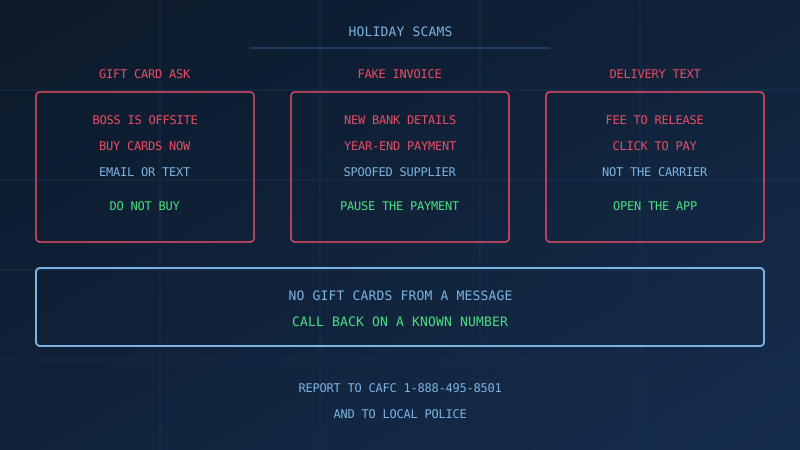
Holiday scams aimed at a Canadian small business usually ask someone to buy gift cards for a person who sounds like the owner, pay a courier fee from a text, or send a supplier payment to new banking details. The Canadian Anti-Fraud Centre's page, Top 10 frauds in 2025, states that in 2025 the CAFC received over 112,000 fraud reports involving more than $704 million in reported losses. Black Friday is November 27, 2026.
What holiday scams should a Canadian business plan for?
Holiday scams before Black Friday are the frauds the Canadian Anti-Fraud Centre already names, landing while staff are busy. On November 28, 2024, the Communications Security Establishment, the CAFC and the RCMP warned about cyber scams ahead of Black Friday and Cyber Monday. That release said: "In 2023, the CAFC received, 116,408 reports of fraud with over $575 million in associated losses. Online merchandise frauds accounted for $12 million of these losses."
The Cyber Centre's Don't take the bait (ITSAP.00.101), November 2025, says phishing appears legitimate and is meant to reveal information, open a malicious site, deliver a malicious attachment, or transfer money. Messages often look like a bank, an online retailer, a courier, or a utility. Get Cyber Safe's small-business phishing page adds the staff example: an unexpected request, "like your boss asking you for gift cards that weren't previously discussed."
How does a gift card scam reach staff?
The CAFC spear phishing page describes a gift card variation aimed at a business. An email appears to come from the owner, the president, or another high-ranking employee. The boss is supposedly offsite and needs gift cards for employee rewards or birthday gifts. A sample on the page reads: "I need you to make a purchase of 7 Visa gift cards at $200 face value each."
The same page describes a head office spoof. The caller says there are problems with a product "such as gift cards or money transfer services," then asks staff "to select some prepaid cards, activate them, and provide them to the fraudster." The 12 frauds of the holidays page states: "Legitimate businesses and organizations will not request gift cards as payments; especially under pressure." The Financial Literacy Month 2025 page says: "Never pay unexpected fees or bills with cryptocurrency, gift cards or e-transfers."
If you are unsure, the spear phishing page says to look up the person's email or phone number in the work directory and ask whether they sent the message. Our guide to IT help desk impersonation in Canada notes that the Cyber Centre's ITSAP.00.102 (July 2026) says caller ID can be spoofed. For a store, our retail cybersecurity in Canada guide states that a written policy should say the owner will never ask for gift card purchases via email or text.
What should staff do with a delivery text?
The CAFC holiday page describes shipping frauds as unsolicited texts or emails that impersonate a shipping company and demand personal or payment details. The usual story is an incomplete address, a failed delivery, or a parcel held for payment. Canada Post's fraud page gives the matching example: a text saying a delivery is on hold for unpaid fees, with a link to pay. Canada Post says that message "is NOT from Canada Post and should be deleted."
Canada Post states it will never text you to request credit card or banking info, account login details, or payments for deliveries or tracking. A real delivery attempt leaves a notice card at the door or in the mailbox. Canada Post does not email you unless you asked it to. Legitimate SMS tracking shows the sender as 272727 or 55555, and only if you signed up. The page says Canada Post will not charge you to track or release a delivery.
Open canadapost-postescanada.ca or the Canada Post app and search the tracking number from the order. Do not use the link in the text. The CAFC phishing page says opening that kind of link or attachment can infect the computer with a virus or malware.
How do you check a supplier's new banking details?
The CAFC spear phishing page calls one pattern a supplier or contractor swindle. Fraudsters choose a business that already pays a supplier, wholesaler, or contractor. A spoofed email announces a change in payment details, gives new banking information, and asks that future payments go to that "new" account. The Financial Literacy Month 2025 page says to "Confirm requests for money using verified contact information."
Our guide to Interac e-Transfer fraud and payment redirection states that before any change to payment details, call the supplier or client at a phone number you already have on file, not one provided in the request. Use that guide for the rest of the payment-redirection pattern. Do not edit the vendor record, and do not send the money, until that call confirms the new details. ITSAP.00.101 says artificial intelligence is making poor spelling harder to detect. Our guide to AI-powered phishing states that awkward phrasing, misspellings, and unnatural language are increasingly absent.
What frauds hit customers of a small seller?
The CAFC's October 2025 article, Check twice, pay once, says criminals send fake payment notices by email or text "to convince sellers that funds were sent when no money was actually transferred." The merchandise page describes a fake "etransfer" used to steal banking credentials, and it says the fraud targets businesses as well as individuals. Ship only after the money is in the account you already use.
Shopping online safely (ITSAP.00.071), October 2026, says criminals copy "the names, logos, and designs of real retailers or delivery companies." A padlock icon and a familiar brand do not prove a site is real. The November 28, 2024 joint release gave Go0gle.com as an example of a letter-swap address. Search your brand from a browser that is not signed into the store admin.
ITSAP.00.071 also says to watch requests to leave checkout and pay by e-transfer, gift card, or cryptocurrency. Answer those from your own order system. The October 2025 article gives 80% off as an example of a blowout price to treat with caution.
A discount you advertise is a different rule. The Competition Bureau's November 25, 2025 release states that a made-up "regular price" is illegal, and that this often appears at Black Friday. The ordinary selling price page says a business cannot advertise "$100, now $50" if the item never sold at $100. Both pages say to keep records of dates, discounts, and regular prices. This article does not apply those tests to your prices, and it is not legal advice.
What rule stops gift cards and surprise banking changes?
Put one rule in front of everyone who can spend or change a vendor, including people hired for the rush. No gift cards for a request that arrived by email, text, or an inbound call. No banking change without a call back on a number already on file. That instruction follows the CAFC holiday page and the Financial Literacy Month 2025 page.
Get Cyber Safe says to enable multi-factor authentication (MFA) whenever possible. BC.5.1 in the Baseline Cyber Security Controls for Small and Medium Organizations V1.2 says to require two-factor authentication for financial accounts, system administrators, cloud administration, privileged users, and senior executives. Our authentication guidance says to "Enable MFA on email first," and that email "is often used as the recovery mechanism for other services."
Seasonal staff need their own logins and an end date. BC.12.3 says to "remove accounts and/or functionality when employees no longer require these for their tasks." ITSM.10.094 says to disable temporary accounts when they are no longer required. Our employee offboarding checklist states that the same BC.12.3 principle applies to contractor engagements ending.
What belongs on a pre-holiday checklist?
Use this list before November 27, and put a copy where people pay bills. The CAFC holiday page says to recognize the red flag, reject the request, and report it. These steps are that instruction for a week when temporary staff are on the till.
- Refuse gift card purchases that arrive by email, text, or an inbound call.
- Call a number you already have before you change any vendor banking details.
- Turn on MFA for email, the bank, accounting software, and the store admin.
- Create a separate login for each seasonal person, and set the date it will be disabled.
- Check tracking on the carrier's site or app. Delete unpaid-fee texts. Canada Post says those texts are not from Canada Post.
- Ship an order only after the payment is in your account, not because an email says it is.
- Search for sites using your name. ITSAP.00.071 says criminals copy real retailers.
- If an ad cites a "regular price," keep the dates and prices the Competition Bureau pages say to keep.
- Post 1-888-495-8501 where people pay bills. The CAFC report page says that line is open Monday to Friday, 10 am to 4:45 pm Eastern time, and closed on holidays.
- Name who may pause a payment.
What if an employee already bought gift cards?
Act the same day. The CAFC page What to do if you're a victim of fraud says to gather documents, receipts, and copies of emails and texts, and to "Report the incident to the financial institution that transferred the money." If a company card paid the store, use a number you already have for that issuer. The page does not say the charge will be reversed.
Then call local police and get a file number. The report fraud and cybercrime page says local police investigate and the CAFC keeps the reports. File at reportcyberandfraud.canada.ca or call 1-888-495-8501. Our guide to how to report a cyber attack in Canada says to file there and then contact local police to create a file number.
Keep the cards and the message. Do not buy more cards because someone offers to fix the refund. The victim page says fraudsters often return "with the promise of recovering money," and "never send recovery money." If the purchase was for the organization, ITSAP.00.071 says to tell management and reset the affected accounts. If anyone is in immediate danger, that page says to call 911.
Where do you report a holiday scam you only spotted?
Report the attempt when no money moved. The CAFC report page says to report whether or not you are a victim. ITSAP.00.071 (October 2026) says an attempt is still worth reporting, because it helps protect other people. Call 1-888-495-8501, Monday to Friday, 10 am to 4:45 pm Eastern time. The line is closed on holidays.
Canada Post says you do not need to report a suspicious text to Canada Post. Forward spam texts to 7726. Call the CAFC if you believe you were defrauded.
After the rule is written down, evaluate your organization's security posture against the Canadian Centre for Cyber Security's Baseline Controls. The assessment page states that this review is "50 questions, under 30 minutes, completely confidential." It says: "It is for Canadian small and medium businesses. It is free, with no signup and no email. It runs entirely in your browser. Your answers are never sent to a server. The browser saves your progress locally for 48 hours so you can stop and resume, and then deletes it."
How prepared is your business?
Find out where you stand against Canada's 13 Baseline Cyber Security Controls. The assessment takes under 30 minutes and your answers stay in your browser.
Check Your ScoreFrequently Asked Questions
What holiday scams target a Canadian small business?
Holiday scams, as this article uses the term, are frauds the Canadian Anti-Fraud Centre describes around the shopping season: a message that appears to come from an owner asking an employee to buy gift cards, an unsolicited courier text about a delivery fee, or a spoofed supplier email with new banking details. The CAFC page The 12 frauds of the holidays says fraudsters are just as active this time of year. This is general information, not legal advice.
Does Canada Post text a business to pay a delivery fee?
Canada Post's page on fraudulent emails and text messages says a text claiming a delivery is on hold for unpaid shipping fees, and asking you to click a link to pay, is not from Canada Post and should be deleted. Canada Post says it will never text you to request credit card or banking info, account login details, or payments for deliveries or tracking. Legitimate SMS tracking shows the sender as 272727 or 55555, and only if you signed up.
Should staff buy gift cards because an email looks like the owner?
Not from the email alone. The Canadian Anti-Fraud Centre's spear phishing page describes this gift card variation: the message appears to come from the owner, the president, or another high-ranking employee and asks for gift cards while that person is supposedly offsite. The CAFC says if you are unsure, look the person up in your work directory and verify that they sent the message. Its holiday page says legitimate businesses and organizations will not request gift cards as payments, especially under pressure.
What if an employee already bought the gift cards?
The CAFC victim page says to gather receipts and copies of the emails or texts, report the incident to the financial institution that transferred the money, contact local police and get a file number, and report to the CAFC at reportcyberandfraud.canada.ca or at 1-888-495-8501. The CAFC does not promise the money will be returned. It also says never send recovery money if someone offers to get the funds back.
Where should a Canadian business report an attempted holiday scam?
The CAFC report page says victims and witnesses can report at reportcyberandfraud.canada.ca, anonymously if they wish, and by phone at 1-888-495-8501, Monday to Friday, 10 am to 4:45 pm Eastern time, closed on holidays. It says victims should also contact local police as soon as possible, because local police investigate. The Cyber Centre's October 2026 shopping guidance says to report attempts even when no money was lost.
Cite This Page
Suggested citation:
Cybersecurity Canada (2026). Holiday Scams: A Business Checklist. Retrieved from https://cybersecuritycanada.ca/news/posts/holiday-scams-a-business-checklist/
Permanent URL: https://cybersecuritycanada.ca/news/posts/holiday-scams-a-business-checklist/ · Published November 22, 2026
Disclaimer: This article is intended for general informational purposes only and does not constitute professional cybersecurity, legal, IT, or compliance advice. While we strive to ensure accuracy, the cybersecurity landscape changes rapidly and information may become outdated. Organizations should consult with qualified cybersecurity professionals and legal counsel to assess their specific situation and develop appropriate security policies. Use of this information is at your own risk. See our Privacy Policy for more information.
Cybersecurity Canada is an independent resource and is not affiliated with, endorsed by, or connected to the Canadian Centre for Cyber Security, the Communications Security Establishment, or the Government of Canada.
How does your organization measure up?
Take our free cybersecurity assessment based on the Canadian Centre for Cyber Security's Baseline Controls. 50 questions, under 30 minutes, 100% confidential. Your answers never leave your browser.
Take the Free Assessment