Retail Cybersecurity in Canada

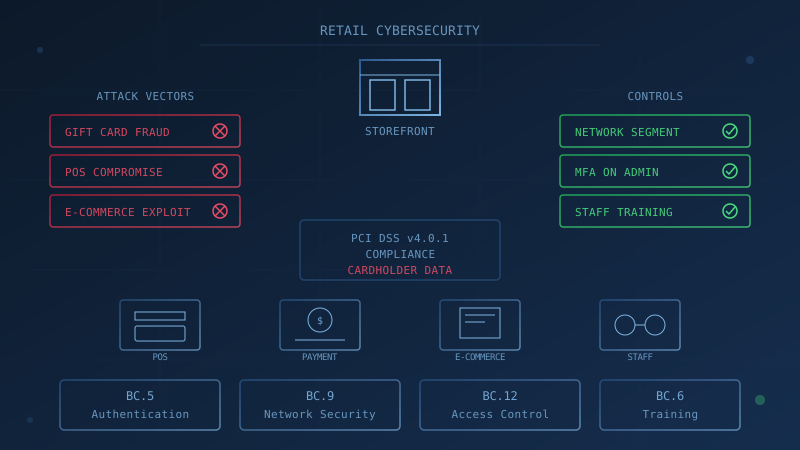
Retail cybersecurity in Canada means protecting the payment systems, customer data and e-commerce platforms that independent shops and small retail chains depend on. Retailers face payment card fraud, gift card scams, POS system compromises and phishing attacks targeting staff. The Canadian Anti-Fraud Centre's spear phishing page describes gift card fraud schemes where fraudsters impersonate executives to trick employees into purchasing gift cards. The Canadian Centre for Cyber Security's Baseline Controls state that organizations should "isolate point-of-sale systems from the Internet and other areas of the corporate network with a firewall" (BC.9.6). This guide covers why retailers are targeted, what controls apply, and which practical steps protect against the threats that matter most. This is informational context (not legal advice).
Why Are Small Retail Stores Targeted by Cybercriminals?
Retailers hold exactly what criminals want: payment card data, customer personal information and cash-equivalent assets like gift cards. Three patterns make the industry attractive.
Payment Card Data and POS Systems: Every card transaction involves cardholder data that criminals can monetize. The CCCS Baseline Controls state that organizations "should consider following the Payment Card Industry Data Security Standard (PCI DSS)" and "should isolate point-of-sale systems from the Internet and other areas of the corporate network." A POS system on the same network segment as employee workstations with internet access creates a pathway for attackers who compromise one system to reach payment data.
E-commerce Storefronts and Plugins: Small retailers running online stores face web application risks. The CCCS Baseline Controls state that "organizations should ensure that their websites address the OWASP top 10 vulnerabilities" (BC.11.1). E-commerce platforms with unpatched plugins or misconfigured checkout pages can expose customer payment information.
Gift Card Fraud and Staff Turnover: The CAFC's spear phishing page describes a "gift card variation" where "a fraudster sends an employee an email that appears to come from the owner, the president or another high-ranking employee" requesting gift card purchases. The CAFC also describes "head office spoof" calls where fraudsters "ask the employee to select some prepaid cards, activate them, and provide them to the fraudster." Retail staff turnover means new employees may not recognize these tactics, and shared logins make it harder to trace who did what.
What Is PCI DSS and How Does It Apply to Retailers?
The PCI Security Standards Council states that PCI DSS is intended for "Entities that store, process, or transmit cardholder data (CHD) and/or sensitive authentication data (SAD) or could impact the security of the cardholder data environment (CDE)." This includes "all entities involved in payment card processing," including merchants. If your store accepts Visa, Mastercard, American Express, Discover or JCB, you must comply.
PCI DSS is not a Canadian statute. It is a contractual requirement: the card brands require compliance through their agreements with acquirers and payment processors. PCI DSS v4.0.1 was released as a limited revision in June 2024. The PCI SSC blog states that the currently active versions are PCI DSS v4.0 and v4.0.1, and that of the 64 new requirements introduced in v4.0, 51 were future-dated and became effective as of 31 March 2025.
Most small retailers validate compliance through a Self-Assessment Questionnaire (SAQ). Which SAQ applies depends on how your business accepts payments. A retailer using a standalone chip terminal connected via IP would typically use SAQ B-IP. An e-commerce store using a hosted payment page may qualify for SAQ A. Your acquirer or payment processor can confirm your merchant level and validation requirements.
For a detailed breakdown, see our guide to PCI DSS for small business in Canada.
How Can Retailers Reduce PCI DSS Scope?
The most effective way to reduce compliance burden is to minimize contact with cardholder data.
Point-to-Point Encryption (P2PE): A PCI-validated P2PE solution encrypts card data at the terminal. Clear-text card data never enters your systems, which significantly reduces the systems in scope for PCI DSS.
Hosted Payment Pages: For e-commerce, using your payment processor's hosted checkout page means card numbers never touch your server. The customer enters payment details on the processor's secure page, not yours.
Tokenization: For recurring transactions or stored customer payment preferences, tokenization replaces the actual card number with a token that has no value if stolen.
Your payment processor can explain which scope-reduction options they offer and how to implement them.
Which Security Controls Should a Retail Store Implement?
The Baseline Cyber Security Controls for Small and Medium Organizations provide a practical framework. Several controls directly address the threats facing retailers.
POS Network Segmentation (BC.9): BC.9.6 states that "organizations should isolate point-of-sale systems from the Internet and other areas of the corporate network with a firewall." A POS terminal should not be on the same network segment as employee computers that browse the web or check email. If an employee clicks a malicious link, the compromise should not give attackers a path to payment systems.
Multi-Factor Authentication (BC.5): BC.5.1 states that "organizations should implement two-factor authentication wherever possible" with priority on "financial accounts, system administrators, cloud administration, privileged users, and senior executives." For a retailer, that means MFA on e-commerce admin panels, email accounts, accounting software and any remote access. Shared logins defeat this control; each staff member needs their own account.
Backup and Encryption (BC.7): BC.7.1 states that organizations should "back up systems that contain essential business information, and ensure that recovery mechanisms effectively and efficiently restore these systems from back-ups." BC.7.2 requires that "long term backups (e.g. weekly backups) must be stored offline." Inventory data, customer records and transaction history must be included. Tested, offline backups are the last line of defence against ransomware.
Access Control (BC.12): BC.12.3 states that "organizations should remove accounts and/or functionality when employees no longer require these for their tasks." Retail has high staff turnover. When an employee leaves, their access to POS systems, inventory management, email and e-commerce admin panels must end immediately.
Security Awareness (BC.6): BC.6.1 states that "organizations should invest in cyber security awareness and training for their employees." For retail staff, training should cover how to recognize gift card fraud requests, fake delivery notifications during busy seasons, and the verification procedures described below.
How Does Gift Card and Payment Fraud Target Retailers?
Gift card fraud exploits the trust between employees and management. The CAFC's spear phishing page describes how fraudsters send emails "that appear to come from the owner, the president or another high-ranking employee" asking employees to purchase gift cards. The page includes a screenshot example: "I need you to make a purchase of 7 Visa gift cards at $200 face value each."
The CAFC also describes a "head office spoof" where fraudsters call franchise locations claiming to be from corporate, tell employees "there are problems with one of the financial products offered, such as gift cards or money transfer services," and ask them "to select some prepaid cards, activate them, and provide them to the fraudster."
Business email compromise uses similar tactics to redirect payments. A fraudster impersonating a supplier might claim banking details have changed and request future payments go to a new account.
The defence is verification. Train staff that any request involving gift cards, payment changes or wire transfers must be verified through a separate channel (a phone call to a known number, not one provided in the request). Written policy should state that the owner will never ask for gift card purchases via email or text.
What Privacy Obligations Apply to Retail Stores?
The Office of the Privacy Commissioner of Canada states that organizations subject to PIPEDA must report breaches of security safeguards involving personal information "that pose a real risk of significant harm to individuals," notify affected individuals, and keep records of all breaches. The OPC confirms this applies to small businesses.
The OPC explains that "significant harm includes bodily harm, humiliation, damage to reputation or relationships, loss of employment, business or professional opportunities, financial loss, identity theft, negative effects on the credit record and damage to or loss of property."
The law requires organizations to keep records of all breaches of security safeguards for two years, whether or not the breach was reported to the OPC. This applies to every breach, not just those meeting the reporting threshold.
In Alberta, British Columbia and Quebec, provincial private-sector privacy laws generally apply instead of PIPEDA for provincially regulated commercial activities within those provinces. Federally regulated organizations, and some interprovincial or international activities, may still be subject to PIPEDA. Alberta's PIPA and Quebec's Law 25 have their own mandatory breach notification requirements. British Columbia's PIPA does not currently mandate breach notification, although the BC OIPC recommends voluntary reporting and notification where a breach could cause significant harm. Check with the relevant provincial privacy commissioner for specific requirements.
Retailers collect customer names, contact details, purchase history and sometimes loyalty program data. A breach exposing this information could require assessment of whether notification is needed.
How Can Retailers Handle Seasonal Risks?
Holiday shopping seasons bring increased transaction volumes, temporary staff and heightened fraud attempts.
Fake Delivery and Order Scams: During peak seasons, customers expect shipping notifications. Fraudsters send fake delivery failure emails or texts with malicious links. Staff handling customer service inquiries should verify delivery issues through official carrier websites, not links in emails.
Temporary Staff Access: Seasonal employees need only the access required for their role. Create time-limited accounts where possible and remove access when the seasonal period ends.
Holiday Fraud Activity: The CAFC's 12 frauds of the holidays page notes that "fraudsters are just as active this time of year," and describes holiday shipping frauds in which messages "impersonate legitimate shipping companies" and "inform you of delivery failures." Staff training before peak season reinforces how to recognize and report suspicious requests.
What Should a Retail Store Do After a Suspected Attack?
Time matters. If you suspect a payment system compromise or your systems have been breached:
- Contact your payment processor and bank immediately. They may need to disable card processing or initiate fraud monitoring.
- Isolate affected systems to prevent further spread while preserving evidence.
- Report to the Canadian Anti-Fraud Centre online at reportcyberandfraud.canada.ca or by phone at 1-888-495-8501.
- Contact local police to create a file number your bank or insurer may require.
- Assess whether personal information was exposed and determine if notification to the privacy commissioner and affected individuals is required under PIPEDA or provincial law.
- Follow your incident response plan for additional steps specific to your business.
For detailed reporting guidance, see our guide to how to report a cyber attack in Canada.
Practical Checklist for Retail Cybersecurity
These steps address the threats most relevant to retail stores:
- Segment POS systems from the rest of your network so employee computers cannot reach payment terminals
- Enable MFA on e-commerce admin panels, email and accounting software to prevent account takeover
- Use hosted payment pages or P2PE to minimize contact with cardholder data
- Train staff to verify any request for gift cards, payment changes or wire transfers by phone to a known number
- Establish a written policy that management will never request gift card purchases via email or text
- Remove access promptly when employees leave or seasonal positions end
- Test backups regularly by restoring files to confirm recovery works before you need it
- Review your PCI DSS requirements with your payment processor to confirm which SAQ applies
One Question to Ask Your IT Provider
"Is multi-factor authentication enabled on our e-commerce admin panel and email, and are our POS terminals on a separate network segment from employee workstations?"
If your IT lead or managed service provider cannot answer this question, that conversation is where your cybersecurity review should start.
Assess Your Store's Cybersecurity Posture
Our free cybersecurity assessment evaluates your organization against the Canadian Centre for Cyber Security's 13 Baseline Control areas. The assessment covers 50 questions, takes under 30 minutes, and is completely confidential. Progress is saved locally for 48 hours. No signup is required. The results show which control areas need attention, so you know where to focus your cybersecurity investment. The assessment is not a PCI DSS assessment, compliance audit or legal advice; for those questions, consult qualified professionals.
How prepared is your business?
Find out where you stand against Canada's 13 Baseline Cyber Security Controls. The assessment takes under 30 minutes and your answers stay in your browser.
Check Your ScoreFrequently Asked Questions
Why are small retail stores targeted by cybercriminals?
Retailers handle payment card data, operate POS systems, and run e-commerce storefronts, all of which attract cybercriminals. The Canadian Anti-Fraud Centre describes gift card fraud and spear phishing schemes that target businesses. Staff turnover and shared logins create additional risk. POS terminals connected to networks that also have internet access can be exploited if not properly segmented.
Does PCI DSS apply to small retail stores in Canada?
Yes. The PCI Security Standards Council states that PCI DSS is intended for entities that store, process, or transmit cardholder data, including merchants. It is a contractual requirement from the card brands, not a Canadian law. Most small merchants validate compliance through a Self-Assessment Questionnaire. Your acquirer or payment processor determines your specific validation requirements.
What cybersecurity controls should a retail store implement?
The Canadian Centre for Cyber Security's Baseline Controls for Small and Medium Organizations recommend multi-factor authentication wherever possible (BC.5), tested offline backups (BC.7), a written incident response plan (BC.1), and access controls that remove accounts when employees leave (BC.12). For retailers, this means MFA on e-commerce admin panels and email, network segmentation for POS systems, and verification procedures for payment instruction changes.
Does PIPEDA apply to retail stores in Canada?
PIPEDA applies to private-sector organizations that collect, use or disclose personal information in the course of commercial activity, except where a substantially similar provincial law applies. The Office of the Privacy Commissioner states that organizations subject to PIPEDA must report breaches of security safeguards that pose a real risk of significant harm and keep records of all breaches for two years. In Alberta, British Columbia and Quebec, provincial private-sector privacy laws generally apply instead of PIPEDA for provincially regulated activities within those provinces.
What should a retail store do after a suspected cyber attack?
Contact your bank and payment processor immediately. Report the incident to the Canadian Anti-Fraud Centre online at reportcyberandfraud.canada.ca or by phone at 1-888-495-8501, and contact your local police. If personal information was exposed and the breach creates a real risk of significant harm, organizations subject to PIPEDA must report to the Office of the Privacy Commissioner and notify affected individuals. Provincial law may impose different requirements.
Cite This Page
Suggested citation:
Cybersecurity Canada (2026). Retail Cybersecurity in Canada. Retrieved from https://cybersecuritycanada.ca/news/posts/retail-cybersecurity-canada/
Permanent URL: https://cybersecuritycanada.ca/news/posts/retail-cybersecurity-canada/ · Published November 11, 2026
Disclaimer: This article is intended for general informational purposes only and does not constitute professional cybersecurity, legal, IT, or compliance advice. While we strive to ensure accuracy, the cybersecurity landscape changes rapidly and information may become outdated. Organizations should consult with qualified cybersecurity professionals and legal counsel to assess their specific situation and develop appropriate security policies. Use of this information is at your own risk. See our Privacy Policy for more information.
Cybersecurity Canada is an independent resource and is not affiliated with, endorsed by, or connected to the Canadian Centre for Cyber Security, the Communications Security Establishment, or the Government of Canada.
How does your organization measure up?
Take our free cybersecurity assessment based on the Canadian Centre for Cyber Security's Baseline Controls. 50 questions, under 30 minutes, 100% confidential. Your answers never leave your browser.
Take the Free Assessment