Trucking Cybersecurity in Canada

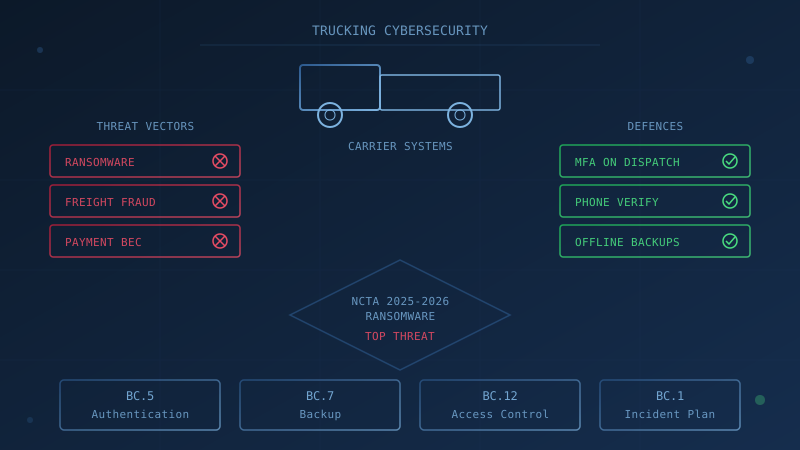
Trucking cybersecurity in Canada means protecting the dispatch systems, driver information and payment processes that carriers, freight brokers, couriers and warehousing operations depend on. The Canadian Centre for Cyber Security's National Cyber Threat Assessment 2025-2026 states that "ransomware is the top cybercrime threat facing Canada's critical infrastructure." This guide covers why transportation and logistics businesses are targeted, what the Baseline Controls recommend, and which practical steps matter most. This is informational context (not legal advice).
Why Are Trucking Companies Targeted by Cybercriminals?
Trucking and logistics firms combine frequent payments, time-sensitive operations and connected technology in ways that attract both ransomware operators and fraud schemes.
Ransomware and Operational Pressure: A carrier that cannot access dispatch systems or driver schedules cannot move freight. That urgency creates pressure to pay ransoms. The CCCS National Cyber Threat Assessment 2025-2026 states that "ransomware directly disrupts critical infrastructure entities' ability to deliver critical services." Canadian carriers Len Dubois Trucking (BianLian, April 2024), Delmar International (Rhysida, November 2024), Galaxy Freightline (Play, August 2025) and Fast Freight (Play, October 2025) have all been listed by ransomware groups.
Freight Fraud and Identity Theft: Criminals exploit load boards, email and phone to impersonate legitimate brokers or carriers. Peel Regional Police in Ontario announced in early 2025 that a scheme using the name "All Days Trucking" allegedly stole over $5 million in cargo between December 2024 and January 2025. Industry data from CargoNet shows cargo theft in Canada and the United States rose 59% in 2023.
Business Email Compromise on Payments: The Canadian Anti-Fraud Centre's spear phishing page describes supplier/contractor swindles where fraudsters "send a spoofed email informing the business of a change in payment details." See our guide to business email compromise.
What Are the Common Cyber Risks in Trucking and Logistics?
Phishing Targeting Dispatch and Accounts Payable: Attackers send emails impersonating brokers, shippers or fuel card providers. The CAFC's spear phishing guidance describes how fraudsters send emails that appear to come from known contacts requesting payment to new accounts.
Shared Devices and Yard Access: Many trucking operations have shared computers in the dispatch office or yard trailers. The CCCS Baseline Controls recommend "unique individual accounts" (BC.12). A shared login makes it impossible to trace who did what.
ELD and Telematics Account Security: Electronic logging devices and fleet management platforms contain real-time location data and driver hours. If an attacker compromises these accounts, they can track shipments or use the information for cargo theft.
Driver Personal Information: Trucking companies hold driver licences, social insurance numbers, medical certificates and payroll records. The Office of the Privacy Commissioner states that "significant harm includes bodily harm, humiliation, damage to reputation or relationships, loss of employment, business or professional opportunities, financial loss [and] identity theft."
Which CCCS Baseline Controls Apply to Trucking Companies?
The Canadian Centre for Cyber Security's Baseline Cyber Security Controls for Small and Medium Organizations provide a practical framework.
Multi-Factor Authentication (BC.5): BC.5.1 states that "organizations should implement two-factor authentication wherever possible" with priority on financial accounts, system administrators and privileged users. For a trucking company, this means MFA on email, dispatch software, ELD portals and accounting software.
Backup and Encryption (BC.7): BC.7.1 requires backup of essential business systems, and BC.7.2 requires that "long term backups (e.g. weekly backups) must be stored offline." Tested, offline backups are the last line of defence against ransomware.
Access Control (BC.12): BC.12.3 states that "organizations should remove accounts and/or functionality when employees no longer require these for their tasks."
Incident Response Plan (BC.1): BC.1.2 states that "organizations should have a written incident response plan that details who is responsible for handling incidents." See our guide to building an incident response plan.
Mobile Devices (BC.8): BC.8.2 states that "organizations should enforce separation between work and personal data on mobile devices with access to corporate IT resources."
What Privacy Obligations Apply to Trucking Companies?
The Office of the Privacy Commissioner of Canada states that organizations subject to PIPEDA must report breaches involving personal information "that pose a real risk of significant harm to individuals," notify affected individuals, and keep records of all breaches for two years.
Trucking companies typically hold driver personal information, customer shipping records, payroll data and vendor payment records. A ransomware attack that exfiltrates this information before encryption could trigger PIPEDA's breach reporting requirements.
Provincial laws: In Alberta, British Columbia and Quebec, provincial private-sector privacy laws may apply instead of PIPEDA for activities within those provinces. For federally regulated trucking operations (interprovincial and international carriers), PIPEDA generally applies. Check with the relevant privacy commissioner for specific requirements.
Does Bill C-8 Apply to Trucking Companies?
Bill C-8, the Critical Cyber Systems Protection Act, received Royal Assent in June 2026 and creates mandatory cybersecurity requirements for designated operators in federally regulated critical infrastructure sectors. However, the Act applies only to designated operators listed in Schedule 2, and as of late 2026, most trucking SMBs are not designated.
The indirect effect matters more for smaller carriers. Designated operators must mitigate cyber risks in their supply chains. If your trucking company provides services to a designated operator, you may face new contract requirements for security controls. The practical response is the same: implement the Baseline Controls and document your practices.
How Can Trucking Companies Protect Against Freight Fraud?
Payment verification is the single most effective defence against fraud. Before processing any request to change banking details, call the broker, carrier or vendor at a phone number you already have on file.
For load board activity:
- Check unfamiliar carriers through the Commercial Vehicle Operator's Registration (CVOR) system in Ontario or the equivalent provincial carrier safety record before booking or subcontracting a load
- Verify brokers directly through known contacts and references before tendering loads
- Confirm carrier MC/DOT numbers and insurance directly with the issuing authority, not just the load board profile
- Be cautious of rates significantly above market for a lane
- Watch for contact information that does not match official company records
For payment requests:
- Treat any request to update payment details as suspicious until verified by phone
- Establish a written policy that payment changes require verbal confirmation to a known number
Our guide to vendor and third-party risk covers supplier verification in more detail.
What Should a Trucking Company Do After a Suspected Attack?
Time matters. If you suspect a ransomware attack, payment fraud or data breach:
- Isolate affected systems from the network but do not power off machines (forensic evidence in memory may be lost).
- Contact your bank immediately and request a recall of any fraudulent transfer.
- Report to the Canadian Anti-Fraud Centre online at reportcyberandfraud.canada.ca or by phone at 1-888-495-8501, and file a report with local police.
- Notify your cyber insurer since most policies require prompt notification. See our guide to cyber insurance.
- Follow your incident response plan for next steps.
Practical Checklist for Trucking Cybersecurity
- Verify payment changes by phone to a number you already have on file
- Enable MFA on email, dispatch software and ELD portals
- Give each user their own login for dispatch systems and yard computers
- Remove access promptly when drivers, owner-operators or office staff leave
- Set mobile device policies for driver phones accessing ELD apps
- Test backups regularly by restoring files to confirm recovery works
- Train dispatch and accounts payable on freight fraud patterns and verification procedures
One Question to Ask Your IT Provider
"Is MFA enabled on our email and dispatch systems, and when did we last test restoring from backup?" If your IT provider cannot answer, that conversation is where your cybersecurity review should start.
Assess Your Trucking Company's Cybersecurity
Our free cybersecurity assessment evaluates your organization against the Canadian Centre for Cyber Security's 13 Baseline Control areas. The assessment covers 50 questions, takes under 30 minutes, and is completely confidential. No signup is required. The results show which control areas need attention. The assessment is not a compliance audit or legal advice; for those questions, consult a qualified professional.
How prepared is your business?
Find out where you stand against Canada's 13 Baseline Cyber Security Controls. The assessment takes under 30 minutes and your answers stay in your browser.
Check Your ScoreFrequently Asked Questions
Why are trucking companies targeted by cybercriminals?
Trucking firms process frequent payments to multiple parties, rely on dispatch and load board platforms, and operate under time pressure that makes ransomware disruption costly. The Canadian Centre for Cyber Security's National Cyber Threat Assessment 2025-2026 states that ransomware is the top cybercrime threat facing Canada's critical infrastructure. Canadian carriers including Len Dubois Trucking (BianLian, April 2024) and Delmar International (Rhysida, November 2024) have been listed by ransomware groups.
What is double brokering fraud and how does it affect Canadian carriers?
Double brokering fraud occurs when a criminal impersonates a legitimate broker or carrier on a load board, accepts freight, and then redirects cargo or disappears with payment. Peel Regional Police in Ontario investigated a scheme using the name 'All Days Trucking' that allegedly stole over $5 million in cargo between December 2024 and January 2025. Businesses booking or subcontracting freight should check unfamiliar carriers through the Commercial Vehicle Operator's Registration (CVOR) system in Ontario or the equivalent provincial carrier safety record, verify brokers directly through known contacts and references before tendering loads, and confirm payment information by phone to a known number.
What cybersecurity controls should a trucking company implement?
The Canadian Centre for Cyber Security's Baseline Controls for Small and Medium Organizations recommend multi-factor authentication wherever possible (BC.5), tested offline backups (BC.7), a written incident response plan (BC.1), and access controls that remove accounts when employees leave (BC.12). For trucking firms, this means MFA on email, dispatch software, ELD portals and accounting systems, plus policies for shared yard devices and driver tablets.
Does PIPEDA apply to trucking companies in Canada?
PIPEDA applies to private-sector organizations that collect, use or disclose personal information in the course of commercial activity, which includes trucking firms handling driver records, customer shipping information and HR data. The Office of the Privacy Commissioner states that organizations must report breaches of security safeguards that pose a real risk of significant harm, notify affected individuals, and keep records of all breaches for two years. Provincial private-sector privacy laws in Quebec, Alberta and British Columbia may apply instead of PIPEDA for activities within those provinces.
What should a trucking company do after a suspected cyber attack?
Contact your bank immediately if payments may have been misdirected. Report the incident to the Canadian Anti-Fraud Centre online at reportcyberandfraud.canada.ca or by phone at 1-888-495-8501, and file a report with local police. If personal information was exposed and the breach creates a real risk of significant harm, organizations subject to PIPEDA must report to the Office of the Privacy Commissioner and notify affected individuals.
Cite This Page
Suggested citation:
Cybersecurity Canada (2026). Trucking Cybersecurity in Canada. Retrieved from https://cybersecuritycanada.ca/news/posts/trucking-cybersecurity-canada/
Permanent URL: https://cybersecuritycanada.ca/news/posts/trucking-cybersecurity-canada/ · Published November 13, 2026
Disclaimer: This article is intended for general informational purposes only and does not constitute professional cybersecurity, legal, IT, or compliance advice. While we strive to ensure accuracy, the cybersecurity landscape changes rapidly and information may become outdated. Organizations should consult with qualified cybersecurity professionals and legal counsel to assess their specific situation and develop appropriate security policies. Use of this information is at your own risk. See our Privacy Policy for more information.
Cybersecurity Canada is an independent resource and is not affiliated with, endorsed by, or connected to the Canadian Centre for Cyber Security, the Communications Security Establishment, or the Government of Canada.
How does your organization measure up?
Take our free cybersecurity assessment based on the Canadian Centre for Cyber Security's Baseline Controls. 50 questions, under 30 minutes, 100% confidential. Your answers never leave your browser.
Take the Free Assessment