Cybersecurity for Engineering Firms

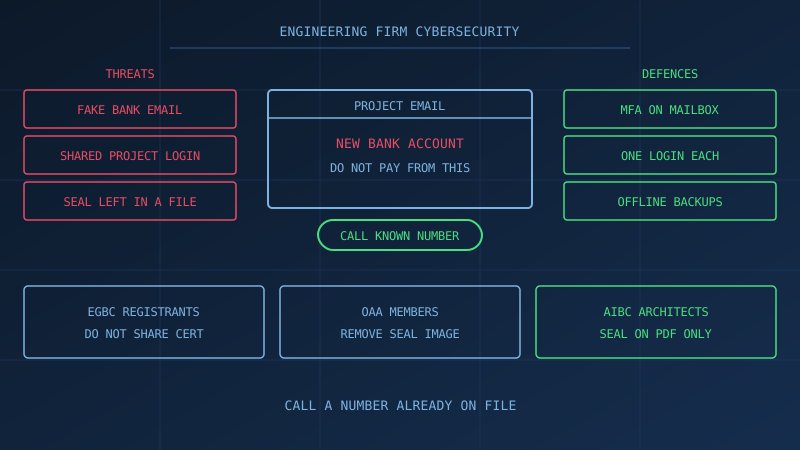
Cybersecurity for engineering firms in Canada starts with protecting project email, files and payments, beginning with a callback on a known phone number before anyone changes banking or payment details. The Canadian Centre for Cyber Security's National Cyber Threat Assessment 2025-2026, based on information available as of September 20, 2024, lists Professional services at 112% and Construction at 133% among ransomware-incident increases by sector from 2022 to 2023. It publishes no separate engineering or architecture figure. This is informational context (not legal or regulatory advice).
Why are Canadian engineering and architecture firms targeted?
The Cyber Centre's National Cyber Threat Assessment 2025-2026, based on information available as of September 20, 2024, says ransomware actors "are almost certainly opportunistic and do not target specific industries." It also says ransomware "is almost certainly the top cybercrime threat facing Canada's critical infrastructure." Figure 12 lists Professional services at 112% and Construction at 133% for the increase observed from 2022 to 2023.
The baseline controls page says cyber threat actors target Canadian businesses "for their data about customers, partners and suppliers, financial information and payment systems, and proprietary information." The Canadian Anti-Fraud Centre says an attack "may look like an email from existing contractor providing new payment directions," and that fraudsters "will infiltrate or spoof a business or individual's email account."
Our construction cybersecurity guide states that the Canadian Anti-Fraud Centre's May 2026 advisory says "businesses in the construction and contracting industry, and real estate sector are common targets" for payment redirection fraud. Our guide to business email compromise states: "Criminals impersonate a real supplier your company already pays, claim the supplier changed banks, and redirect your next payment to a fraudulent account."
What did the Black & McDonald ransomware reports show?
The Canadian Press reported on March 8, 2023 that "a Canadian engineering giant whose work involves critical military, power and transportation infrastructure" had been hit with a ransomware attack, and named Toronto-based Black & McDonald. It said the company "has so far refused to publicly comment." The Record on March 9, 2023 said National Defence was notified on February 10. The Canadian Press reported 5,500 employees. This was a large contractor.
The Canadian Press quoted National Defence: "Once DCC was informed of the incident, it blocked all incoming emails from Black & McDonald out of an abundance of caution and conducted business by phone or in person." The Record quoted: "there is no evidence of any effects on DCC systems or files, nor on DND/CAF operations or security," and said: "For most of these types of contracts, the contractor does not have any direct access to DND networks and sites." A client stopped trusting the mailbox. Our guide to cybersecurity for law firms in Canada states: "A compromised email account or a convincing impersonation can redirect those funds to a criminal's account."
What do architecture regulators say about digital seals?
The Ontario Association of Architects Regulatory Notice RN.01, Version 7.0, January 1, 2025, says its digital authentication section "is applicable to all OAA members and holders of a certificate of practice issued by the OAA." The Architectural Institute of British Columbia, on November 4, 2025, says an Architect's digital Seal "should never be applied to CAD files" and "is only applied to PDF files." Neither page binds engineers, land surveyors, or architects outside that regulator. This is not legal advice.
The OAA notice says "The seal should be kept safely secured." Before files go to consultants, owners or contractors, "ensure the files no longer contain the seal image." Members "are responsible for controlling their digital authentication tools and the OAA-issued seal to prevent unauthorized use."
The AIBC review says "Portage CyberTech (formerly Notarius) provides this service to the AIBC; it is the only provider of digital seals for Architects AIBC. No other form of authentication of the Seal is acceptable." That sentence covers Architects AIBC only.
What do engineering regulators say about records and confidentiality?
Engineers and Geoscientists BC's authentication guide, Version 5.0, published September 1, 2026, says a Professional Registrant must not let another person apply their Digital Certificate. Professional Engineers Ontario says a practitioner's duty includes "regarding client information as confidential." Each sentence covers only the people that page names. This is not legal advice.
The EGBC authentication guide states: "A Professional Registrant Digitally Authenticating Documents must not, under any circumstances, allow another person to apply their Digital Certificate or gain access to the Digital Certificate or to any password, PIN, or other factor used to secure access to or control of the Professional Registrant's Digital Certificate."
EGBC's Guide to the Code of Ethics, Version 2.0, March 12, 2021, says: "All information received from a client or employer is considered confidential and should not be used without their permission, unless it is already in the public domain, a legal duty requires disclosure (e.g., duty of a witness at trial), or the duty to report is engaged (Principle 9 of the Code of Ethics)." It also says registrants "should not supply anyone with documents or information gained through previous employment."
EGBC's retention guide, Version 4.0, September 1, 2026, says authenticity means "being able to show, through security and access control, the origin of the Document and the identity of those who created and revised it." A documentation policy should include "rules related to confidentiality and security considerations."
What does PIPEDA require when project files include personal information?
PIPEDA Schedule 1, Principle 4.7 states: "Personal information shall be protected by security safeguards appropriate to the sensitivity of the information." The Office of the Privacy Commissioner says PIPEDA applies to personal information "in the course of a commercial activity and across borders." This article does not decide whether a given drawing is personal information. This is not legal advice.
The same OPC page says that if an organization "operates in a province with substantially similar provincial legislation (B.C., Alberta and Quebec) and has to follow that law, PIPEDA only applies to interprovincial and international transactions." It also says "PIPEDA does not apply to employee information in provincially-regulated organizations." Quebec, Alberta and British Columbia have their own private-sector statutes. This article does not set those statutes out.
Where PIPEDA applies, the OPC breach guidance says organizations report breaches that pose a real risk of significant harm, notify affected individuals, and keep records of all breaches. The page says records are kept "for two years." The Breach of Security Safeguards Regulations say an organization "must maintain a record of every breach of security safeguards for 24 months after the day on which the organization determines that the breach has occurred."
Which government contract rules apply, and to whom?
Public Services and Procurement Canada says an organization bidding on a Government of Canada or foreign government solicitation with security requirements must be screened, "whether a single-person consulting firm or a large corporation," through the Contract Security Program. The cyber certification overview separately says Level 1 "launched in April 2026" for an official certification "for defence suppliers."
The organization screening page requires at least one listed criterion, such as having "responded to a solicitation that will result in a federal contract with security requirements" or being "awarded a subcontract with security requirements." The organization must be formed or incorporated in Canada, physically located in Canada, and registered to do business in Canada.
The program overview says requirements "are organized into 3 levels, with Level 1 launched in April 2026," and that level 1 is "an annual cyber security self-assessment (13 controls)." Those 13 controls are not Baseline Controls BC.1 to BC.13. The Level 1 page says: "Beginning in summer 2026, suppliers bidding on select defence contracts may need to obtain Level 1 certification." It says "Not all defence contracts will require a Level 1 cyber security certification," and that self-assessment "will be required at contract award, and not during the bidding process." The two pages do not use the same start date.
What should a practice do about shared folders, departing staff and remote access?
The baseline controls say organizations should "give all users unique individual accounts and minimize or eliminate the use of shared or shared-use accounts," with "only the minimal functionality required to perform their tasks." BC.12.3 says to "remove accounts and/or functionality when employees no longer require these for their tasks." Our employee offboarding checklist states: "Access should be disabled the same day the employee departs."
BC.2.2 says that if software cannot update automatically, the organization "should have a business process to ensure regular manual updates." The Canadian Anti-Fraud Centre says most ransomware incidents start with a phishing email that contains an attachment or a link. BC.9.3 says to "require VPN connectivity with two-factor authentication for all remote access into corporate networks." BC.8.2 says to "enforce separation between work and personal data on mobile devices with access to corporate IT resources." Organizations should "encrypt all sensitive information stored outside the premises of the organization, and ensure secure access to data stored in the cloud."
Which controls should engineering firms in Canada put first?
The Baseline Cyber Security Controls for Small and Medium Organizations V1.2 are intended for "organizations that have less than 500 employees." Our guide to the baseline controls describes them as "13 cyber security practices that the Canadian Centre for Cyber Security (CCCS) recommends for small and medium organizations."
- Call a known number. BC.6.1 says to "invest in cyber security awareness and training for their employees." The July 24, 2025 CAFC news release says: "Contact the sender using a trusted phone number, not the one provided in the email." Our Interac e-Transfer guide states that you should "call the supplier or client at a phone number you already have on file, not one provided in the request."
- Two-factor authentication (BC.5). BC.5.1 says to "implement two-factor authentication wherever possible," including "financial accounts, system administrators, cloud administration, privileged users, and senior executives."
- One login per person (BC.12). Apply BC.12.3 the day someone no longer needs the folder.
- Offline copies (BC.7). BC.7.2 says "Long term backups (e.g. weekly backups) must be stored offline," including drawings and the bid workbook.
- A printed plan (BC.1). BC.1.2 says to keep a written incident response plan and "an up-to-date hard copy version of this plan."
- Patch and remote access. Follow BC.2.2 and BC.9.3, quoted above.
What should staff do after a suspected incident?
If money may have moved, call the financial institution from a number already on file. The Canadian Anti-Fraud Centre says a business that believes it was targeted should report to police and to the Centre, online or at 1-888-495-8501. Where PIPEDA applies and there is a real risk of significant harm, use the test above. This is general information, not legal advice.
If the mailbox may be in someone else's hands, stop sending new drawing links from it. Tell clients, on a number already on file, to treat payment changes and file links from that mailbox as untrusted until you say otherwise.
Check the practice against the baseline controls
The free cybersecurity assessment for Canadian businesses states: "Evaluate your organization's security posture against the Canadian Centre for Cyber Security's Baseline Controls. 50 questions, under 30 minutes, completely confidential." It also states: "Your answers stay in your browser and are never transmitted. Progress is saved locally for 48 hours."
The same page says "No signup or email required," and that the information "does not constitute professional cybersecurity, legal, IT, compliance, or risk management advice."
How prepared is your business?
Find out where you stand against Canada's 13 Baseline Cyber Security Controls. The assessment takes under 30 minutes and your answers stay in your browser.
Check Your ScoreFrequently Asked Questions
Why are engineering and architecture firms targeted in Canada?
The Canadian Centre for Cyber Security's National Cyber Threat Assessment 2025-2026, based on information available as of September 20, 2024, lists Professional services at 112% and Construction at 133% among increases in ransomware incidents by sector from 2022 to 2023. It does not publish a separate engineering or architecture figure. The assessment says ransomware actors are almost certainly opportunistic and do not target specific industries. The baseline controls page says cyber threat actors target Canadian businesses for customer, partner and supplier data, financial information and payment systems, and proprietary information. The Canadian Anti-Fraud Centre says an attack may look like an email from existing contractor providing new payment directions.
Does a government cyber certification apply to every design practice?
No. Public Services and Procurement Canada says an organization bidding on a Government of Canada or foreign government solicitation with security requirements must be security screened through the Contract Security Program, whether it is a single-person consulting firm or a large corporation. The Canadian Program for Cyber Security Certification is described on its program overview as an official cyber security certification for defence suppliers. That overview says Level 1 launched in April 2026. The Level 1 page says that beginning in summer 2026, suppliers bidding on select defence contracts may need Level 1 certification, and that not all defence contracts will require it. A private project with no such clause is outside those sentences. This is general information, not legal advice.
What does PIPEDA require when personal information is exposed?
PIPEDA Schedule 1, Principle 4.7, states that personal information shall be protected by security safeguards appropriate to the sensitivity of the information. Where PIPEDA applies, the Office of the Privacy Commissioner says organizations must report breaches of security safeguards that pose a real risk of significant harm, notify affected individuals, and keep records of every breach. The OPC says two years. The Breach of Security Safeguards Regulations say 24 months after the day the organization determines the breach occurred. Quebec, Alberta and British Columbia have their own private-sector privacy statutes. This article does not set those statutes out.
What should staff do with an email that changes banking details?
Do not change the payment from the email alone. The Canadian Anti-Fraud Centre says to put in place detailed payment procedures including verbal authentication for any urgent requests or changes in payment details. A July 24, 2025 CAFC news release says to contact the sender using a trusted phone number, not the one provided in the email. Use a number already on file for the client, subconsultant or contractor.
Which baseline controls should a small practice put first?
The Baseline Cyber Security Controls for Small and Medium Organizations V1.2 are intended for organizations that have less than 500 employees. BC.6.1 says invest in cyber security awareness and training. BC.5.1 says implement two-factor authentication wherever possible, including financial accounts. BC.7.2 says long term backups must be stored offline. BC.1.2 says keep a written incident response plan and an up-to-date hard copy. BC.12.3 says remove accounts when employees no longer need them. BC.2.1 covers automatic patching, with BC.2.2 for software that cannot update automatically. The callback itself is Canadian Anti-Fraud Centre guidance, not a numbered baseline control.
Cite This Page
Suggested citation:
Cybersecurity Canada (2026). Cybersecurity for Engineering Firms. Retrieved from https://cybersecuritycanada.ca/news/posts/cybersecurity-for-engineering-firms-canada/
Permanent URL: https://cybersecuritycanada.ca/news/posts/cybersecurity-for-engineering-firms-canada/ · Published November 17, 2026
Disclaimer: This article is intended for general informational purposes only and does not constitute professional cybersecurity, legal, IT, or compliance advice. While we strive to ensure accuracy, the cybersecurity landscape changes rapidly and information may become outdated. Organizations should consult with qualified cybersecurity professionals and legal counsel to assess their specific situation and develop appropriate security policies. Use of this information is at your own risk. See our Privacy Policy for more information.
Cybersecurity Canada is an independent resource and is not affiliated with, endorsed by, or connected to the Canadian Centre for Cyber Security, the Communications Security Establishment, or the Government of Canada.
How does your organization measure up?
Take our free cybersecurity assessment based on the Canadian Centre for Cyber Security's Baseline Controls. 50 questions, under 30 minutes, 100% confidential. Your answers never leave your browser.
Take the Free Assessment