Veterinary Clinic Cybersecurity

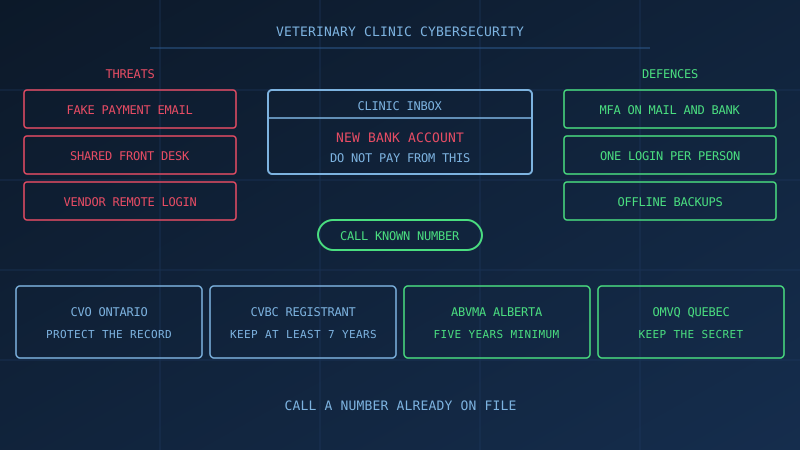
Veterinary clinic cybersecurity in Canada starts with a callback on a known phone number before anyone changes a supplier, laboratory, or client payment detail. The Canadian Centre for Cyber Security's National Cyber Threat Assessment 2025-2026, based on information available as of September 20, 2024, lists Healthcare at 75% among increases in ransomware incidents by sector from 2022 to 2023. It publishes no veterinary-clinic figure. This is informational context (not legal or regulatory advice).
Why are Canadian veterinary clinics targeted?
The Cyber Centre's National Cyber Threat Assessment 2025-2026, based on information available as of September 20, 2024, says ransomware actors "are almost certainly opportunistic and do not target specific industries." Figure 12 lists Healthcare at 75% for the increase from 2022 to 2023. Sector labels are "partially derived from the North American Industry Classification System." The assessment publishes no veterinary-clinic figure.
The baseline controls page says cyber threat actors target Canadian businesses "for their data about customers, partners and suppliers, financial information and payment systems, and proprietary information." A clinic holds client names, phone numbers, and card payments, plus the practice file, images, and supplier invoices. The Canadian Anti-Fraud Centre says fraudsters "will infiltrate or spoof a business or individual's email account," and that an attack "may look like an email from existing contractor providing new payment directions."
Our guide to business email compromise states: "Criminals impersonate a real supplier your company already pays, claim the supplier changed banks, and redirect your next payment to a fraudulent account." Use that test when a laboratory, wholesaler, or landlord appears to change banks. The assessment says ransomware can "immobilize critical business operations."
What did the April 2024 CVS Group notice show?
On 8 April 2024, CVS Group plc announced that it had "detected and intercepted a cyber incident which had involved unauthorised external access to a limited number of its IT systems." The company notice says the group took its IT systems temporarily offline. The BBC reported the same day that the group "runs about 500 veterinary practices globally with 450 in the UK." This was a large United Kingdom group, not a Canadian clinic.
The notice says the response "caused considerable operational disruption over the past week," while clinical care continued "at the majority of our practices." The company informed the Information Commissioner's Office "due to the risk of malicious access to personal information." Neither page calls the incident ransomware or says appointments were cancelled. The notice says the group was moving "its practice management system and related IT infrastructure."
What do provincial regulators say about records and confidentiality?
Record rules differ by province, and each sentence covers only the people named on that page. The College of Veterinarians of Ontario's Medical Records standard, revised November 2015, says it "applies to all veterinarians and all record systems (e.g., electronic, paper or combination of both)." A veterinarian meets it when they "establish procedures and protocols to protect client confidentiality and safeguard records against loss, damage, unauthorized access or disclosure." This is not legal advice.
The same Ontario standard says they "maintain records for five (5) years after the last entry is made." Ontario Regulation 1093, section 22(5), says those records shall be "retained for a period of at least five years after the date of the last entry in the record or until two years after the member ceases to practise veterinary medicine, whichever occurs first." Section 22(6) says an electronic system includes "a password and other reasonable methods of protecting against unauthorized access."
The College's privacy page states that "veterinarians are legally responsible, under the Personal Information Protection and Electronic Documents Act (PIPEDA), for protecting the privacy of the personal information they receive." It also says: "While not all information contained in an animal's medical record is considered personal information by PIPEDA standards," and that "all information contained in an animal's medical record is subject to confidentiality and requires informed client consent before it can be disclosed."
In British Columbia, the College of Veterinarians of British Columbia bylaws, Part 4, November 2023 version, section 246(1), say the designated registrant "must retain an original medical record for a period of at least 7 years after the last service provided to the patient, unless the record has been transferred to another facility on closure of the original facility." Section 247 says that registrant must ensure that "a client's personal information and a patient's information in a medical record is collected, used, disclosed and protected in accordance with the Personal Information Protection Act," and that "the information in a medical record is secure and the confidentiality of that information is maintained, except where disclosure of such information is required or authorized by law."
In Alberta, the Practice Inspection and Practice Standards Bylaw, March 2026, says: "Medical records are maintained for a minimum of five years after the most recent patient visit." Destruction "must respect the confidential nature of the record." The November 2024 standard says: "Veterinary professionals and permit holders must not disclose information concerning a client, an animal(s) or group of animals, or any professional service performed for an animal(s) or group of animals to a person other than the client or another member treating the animal(s) or group of animals without the client's consent, except when doing so is required or authorized by law." It sets standards "expected of all regulated members registered in Alberta."
In Quebec, the Ordre des médecins vétérinaires du Québec page dated 15 August 2021 states: "Le professionnel doit respecter le secret de tout renseignement de nature confidentielle qui vient à sa connaissance dans l'exercice de sa profession." The next sentence on that page allows release only with the client's authorization, or when the law orders or authorizes it by an express provision. The page includes email and the medical file. It is for members of the Quebec order.
What does PIPEDA require when client information is exposed?
PIPEDA Schedule 1, Principle 4.7 states: "Personal information shall be protected by security safeguards appropriate to the sensitivity of the information." The Office of the Privacy Commissioner says PIPEDA applies to personal information "in the course of a commercial activity and across borders." This article does not decide whether PIPEDA applies to a given clinic.
The same page says: "If your organization operates in a province with substantially similar provincial legislation (B.C., Alberta and Quebec) and has to follow that law, PIPEDA only applies to interprovincial and international transactions." It also says "PIPEDA does not apply to employee information in provincially-regulated organizations." Another sentence names Quebec, British Columbia, Alberta, and, "in matters relating to health care, Ontario." This article does not decide whether that phrase covers a veterinary clinic. Our guide to Canada's privacy landscape states: "Three provinces have their own private-sector privacy legislation that has been deemed substantially similar to PIPEDA," and names Alberta, British Columbia, and Quebec.
Where PIPEDA applies, the OPC breach guidance says organizations report breaches that pose a real risk of significant harm, notify affected individuals, and keep records of all breaches "for two years." The Breach of Security Safeguards Regulations say an organization "must maintain a record of every breach of security safeguards for 24 months after the day on which the organization determines that the breach has occurred." The OPC says significant harm includes financial loss and identity theft.
Which controls should veterinary clinic cybersecurity in Canada put first?
The Baseline Cyber Security Controls for Small and Medium Organizations V1.2 are intended for "organizations that have less than 500 employees." Our guide to the baseline controls describes them as "13 cyber security practices that the Canadian Centre for Cyber Security (CCCS) recommends for small and medium organizations." The callback is Canadian Anti-Fraud Centre guidance, not a numbered control.
- Call a known number. BC.6.1 says to "invest in cyber security awareness and training for their employees." The July 24, 2025 CAFC news release says: "Contact the sender using a trusted phone number, not the one provided in the email." The business-fraud page includes "verbal authentication for any urgent requests or changes in payment details." Our Interac e-Transfer guide states that you should "call the supplier or client at a phone number you already have on file, not one provided in the request." Read back both account numbers.
- Two-factor authentication (BC.5). BC.5.1 names "financial accounts, system administrators, cloud administration, privileged users, and senior executives." Start with the bank, the invoice mailbox, and the practice-system administrator.
- One login per person (BC.12). The controls say to "give all users unique individual accounts and minimize or eliminate the use of shared or shared-use accounts." Our dental clinic cybersecurity guide states: "Shared front-desk logins undermine both security and accountability." BC.12.3 says to "remove accounts and/or functionality when employees no longer require these for their tasks." Our employee offboarding checklist states: "Access should be disabled the same day the employee departs," including a locum.
- Offline copies (BC.7). BC.7.2 says "Long term backups (e.g. weekly backups) must be stored offline." Include the practice file, images, and the next morning's book. BC.7.1 says recovery mechanisms should "effectively and efficiently restore these systems from back-ups."
- A printed plan (BC.1). BC.1.2 says to keep a written plan that details "who is responsible for handling incidents," plus "an up-to-date hard copy version of this plan."
- Imaging computers, vendors, guest Wi-Fi, and card terminals. If software cannot update automatically, BC.2.2 says to have "a business process to ensure regular manual updates." BC.9.3 says to "require VPN connectivity with two-factor authentication for all remote access into corporate networks." BC.10.2 says to "evaluate their comfort level with how their outsourced IT providers handle and access their sensitive information." The Ontario College says the veterinarian "is responsible for ensuring" a records provider "upholds the same level of privacy protection expected of veterinarians." BC.9.6 says to "isolate point-of-sale systems from the Internet and other areas of the corporate network with a firewall." BC.9.5 says "should never connect public Wi-Fi networks to their corporate networks." Keep client Wi-Fi off the practice computers, and use a second factor on booking and pharmacy portals.
What should staff do after a suspected incident?
If money may have moved, call the financial institution from a number already on file, not from the email that announced the new account. The Canadian Anti-Fraud Centre says a business that believes it was targeted should report to police and to the Centre, online or at 1-888-495-8501. The July 24, 2025 release says to contact the bank as well.
If the mailbox may be in someone else's hands, stop sending payment instructions from it. Tell clients and suppliers, on a number already on file, to treat payment changes from that mailbox as untrusted. Where PIPEDA applies and there is a real risk of significant harm, report to the OPC, notify affected individuals, and keep the record. This is general information, not legal advice.
Check the clinic against the baseline controls
The free cybersecurity assessment for Canadian businesses states: "Evaluate your organization's security posture against the Canadian Centre for Cyber Security's Baseline Controls. 50 questions, under 30 minutes, completely confidential." It also states: "Your answers stay in your browser and are never transmitted. Progress is saved locally for 48 hours." The same page says "No signup or email required."
The page adds that the information "does not constitute professional cybersecurity, legal, IT, compliance, or risk management advice."
How prepared is your business?
Find out where you stand against Canada's 13 Baseline Cyber Security Controls. The assessment takes under 30 minutes and your answers stay in your browser.
Check Your ScoreFrequently Asked Questions
Why are veterinary clinics targeted in Canada?
The Canadian Centre for Cyber Security's National Cyber Threat Assessment 2025-2026, based on information available as of September 20, 2024, says ransomware actors are almost certainly opportunistic and do not target specific industries. It publishes no veterinary-clinic figure. Figure 12 lists Healthcare at 75% for the increase in Canadian ransomware incidents by sector from 2022 to 2023. The baseline controls page says cyber threat actors target Canadian businesses for customer, partner and supplier data, financial information and payment systems, and proprietary information. The Canadian Anti-Fraud Centre says an attack may look like an email from an existing contractor providing new payment directions.
What did the April 2024 CVS Group notice show?
On 8 April 2024, CVS Group plc announced that it had detected and intercepted a cyber incident involving unauthorised external access to a limited number of its IT systems. The company said it took those systems temporarily offline and that the response caused considerable operational disruption, while clinical care continued at the majority of its practices. The BBC reported the same day that the group runs about 500 veterinary practices globally, with 450 in the UK, and that operations outside the UK remained operationally unaffected. This was a large group based in the United Kingdom, not a Canadian clinic. Neither source calls the incident ransomware.
What do provincial regulators say about veterinary records?
Each sentence covers only the people that page names. Ontario Regulation 1093 says records required under that section are retained for at least five years after the last entry or until two years after the member ceases to practise veterinary medicine, whichever occurs first. The College of Veterinarians of British Columbia bylaws, November 2023 version, say a designated registrant must retain an original medical record for at least 7 years after the last service, unless it was transferred when the facility closed. The Alberta Veterinary Medical Association Practice Inspection and Practice Standards Bylaw, March 2026, says medical records are maintained for a minimum of five years after the most recent patient visit. The Ordre des médecins vétérinaires du Québec says a professional must respect the secrecy of confidential information learned in practice. This is general information, not legal advice.
What does PIPEDA require when client information is exposed?
PIPEDA Schedule 1, Principle 4.7, states that personal information shall be protected by security safeguards appropriate to the sensitivity of the information. The Office of the Privacy Commissioner says PIPEDA applies to personal information in the course of a commercial activity and across borders. Where PIPEDA applies, the OPC says organizations must report breaches of security safeguards that pose a real risk of significant harm, notify affected individuals, and keep records of every breach. The OPC says two years. The Breach of Security Safeguards Regulations say 24 months after the day the organization determines the breach occurred. Quebec, Alberta and British Columbia have their own private-sector privacy statutes. This article does not set those statutes out and does not decide which statute applies to a given clinic.
Which baseline controls should a small clinic put first?
The Baseline Cyber Security Controls for Small and Medium Organizations V1.2 are intended for organizations that have less than 500 employees. BC.6.1 says invest in cyber security awareness and training. BC.5.1 says implement two-factor authentication wherever possible, including financial accounts. BC.7.2 says long term backups must be stored offline. BC.1.2 says keep a written incident response plan and an up-to-date hard copy. BC.12.3 says remove accounts when employees no longer need them. BC.9.3 says require VPN connectivity with two-factor authentication for remote access. BC.9.6 says isolate point-of-sale systems. The callback itself is Canadian Anti-Fraud Centre guidance, not a numbered baseline control.
Cite This Page
Suggested citation:
Cybersecurity Canada (2026). Veterinary Clinic Cybersecurity. Retrieved from https://cybersecuritycanada.ca/news/posts/veterinary-clinic-cybersecurity-canada/
Permanent URL: https://cybersecuritycanada.ca/news/posts/veterinary-clinic-cybersecurity-canada/ · Published November 18, 2026
Disclaimer: This article is intended for general informational purposes only and does not constitute professional cybersecurity, legal, IT, or compliance advice. While we strive to ensure accuracy, the cybersecurity landscape changes rapidly and information may become outdated. Organizations should consult with qualified cybersecurity professionals and legal counsel to assess their specific situation and develop appropriate security policies. Use of this information is at your own risk. See our Privacy Policy for more information.
Cybersecurity Canada is an independent resource and is not affiliated with, endorsed by, or connected to the Canadian Centre for Cyber Security, the Communications Security Establishment, or the Government of Canada.
How does your organization measure up?
Take our free cybersecurity assessment based on the Canadian Centre for Cyber Security's Baseline Controls. 50 questions, under 30 minutes, 100% confidential. Your answers never leave your browser.
Take the Free Assessment