Dental Clinic Cybersecurity in Canada

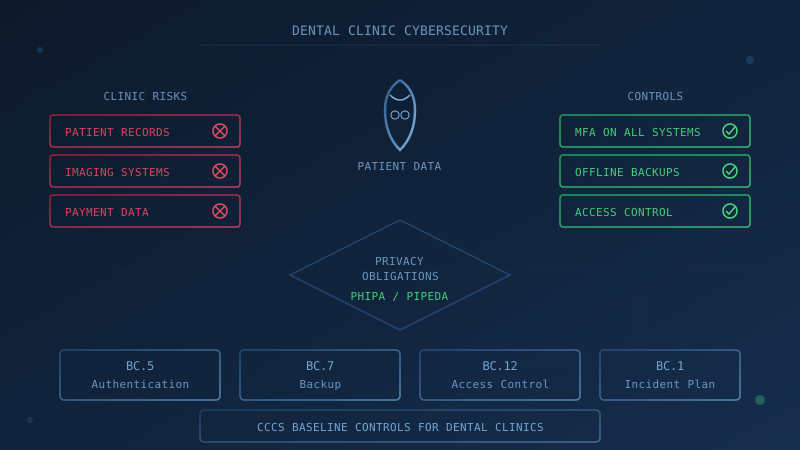
Dental clinic cybersecurity in Canada means implementing safeguards that protect patient charts, digital imaging, insurance billing records, and payment systems under the privacy laws that apply to your practice. Depending on your province, dental clinics may be subject to provincial health privacy legislation (such as Ontario PHIPA, Alberta HIA, or Saskatchewan HIPA), provincial private sector privacy law (such as BC PIPA), Quebec health information law (Law 5), or the federal PIPEDA. The Canadian Centre for Cyber Security's Baseline Controls provide a practical framework for the security measures that matter most. This guide covers which privacy laws typically apply to dental practices, what safeguards regulators expect, and which controls to implement first. This is informational context (not legal advice); consult your provincial privacy commissioner and your dental regulatory college for specific requirements.
Why Do Cybercriminals Target Dental Clinics?
Dental practices hold exactly what cybercriminals want: sensitive personal health information, insurance details, and payment card data. Three patterns make private dental clinics attractive targets.
Sensitive Data in Digital Systems: Patient records contain names, dates of birth, health card numbers, medical histories, allergies, and treatment plans. Dental imaging (X-rays, panoramic scans, intraoral photos) is stored digitally. Insurance billing records include policy numbers and employer information. Unlike a credit card, health information cannot be reissued or changed.
Limited IT Resources: Private dental practices may not have dedicated IT staff. Practice management software, digital imaging systems, and payment terminals are networked and often internet-connected. Security monitoring and patching may be inconsistent. This matches the profile the CCCS Baseline Controls were designed for: organizations under 500 employees facing cybercrime as their primary threat.
Multiple Entry Points: A typical dental clinic handles email, online appointment booking, insurance claims submission, payment processing, and practice management access. Each is a potential entry point. Business email compromise and phishing remain common attack methods, and clinic staff may receive fraudulent requests that appear to come from patients, insurers, or suppliers.
Which Privacy Law Applies to Your Dental Clinic?
The privacy law that applies depends on your province and the type of information you handle. The Office of the Privacy Commissioner of Canada states that "determining which law applies must be done on a case-by-case basis."
Ontario: The Personal Health Information Protection Act, 2004 (PHIPA) applies to health information custodians. Under section 3(1) of PHIPA, health information custodians include "a health care practitioner or a person who operates a group practice of health care practitioners." Dentists are health care practitioners and therefore custodians under PHIPA. Section 12(1) of PHIPA requires custodians to take "steps that are reasonable in the circumstances to ensure that personal health information in the custodian's custody or control is protected against theft, loss and unauthorized use or disclosure."
Alberta: The Health Information Act (HIA) applies to custodians of health information. The OIPC Alberta states that custodians include "regulated members of 13 designated health profession colleges," which explicitly includes dentists, dental hygienists, and denturists. Section 60(1) of HIA requires custodians to "take reasonable steps in accordance with the regulations to maintain administrative, technical and physical safeguards" that protect the confidentiality of health information.
Saskatchewan: The Health Information Protection Act (HIPA) applies to trustees who have custody or control of personal health information. The Government of Saskatchewan states that examples of trustees include "dentists" and other "regulated health professionals." Section 16 of HIPA requires trustees to establish safeguards that protect the integrity, accuracy and confidentiality of personal health information.
Manitoba: The Personal Health Information Act (PHIA) applies to trustees who collect or maintain personal health information. Section 18 requires trustees to establish security safeguards. Dental clinics collecting personal health information may be trustees under PHIA depending on their circumstances.
British Columbia: The Personal Information Protection Act (PIPA) applies to private organizations, including dental clinics. PIPA covers personal information, including personal health information, held by private sector organizations. Section 34 of PIPA requires organizations to protect personal information by making reasonable security arrangements.
Quebec: Since July 2024, patient health information in Quebec is governed by the Act respecting health and social services information (Law 5), not Law 25. Law 25 continues to apply to non-health personal information such as employee records. Dentists' private practices (a "private professional practice" under the Act) must comply with Law 5 for patient health information.
Other Provinces: The OPC states that New Brunswick, Newfoundland and Labrador, Nova Scotia, and Ontario have health information laws deemed substantially similar to PIPEDA. PEI also has its own Health Information Act. In provinces without a health-specific law that covers dental clinics, PIPEDA may apply to commercial activity involving personal information, including interprovincial and international transactions. See our guide to Canada's privacy landscape.
What Breach Reporting Do Ontario, Alberta, and PIPEDA Require?
Breach reporting obligations vary by jurisdiction. The following summarizes requirements under Ontario PHIPA, Alberta HIA, and federal PIPEDA. Dental clinics in other provinces should check with their provincial privacy commissioner for specific obligations.
Ontario: The IPC Ontario requires notification of certain breaches "at the first reasonable opportunity" under PHIPA. The IPC lists seven categories requiring notification, including unauthorized use or disclosure where the person "knew or should have known" the action was not permitted, stolen information (including ransomware attacks), and significant breaches. All health information custodians must submit annual breach statistics to the IPC by March 1 each year.
PIPEDA: Where PIPEDA applies, the Office of the Privacy Commissioner states that organizations must report breaches of security safeguards involving personal information that pose a "real risk of significant harm" to individuals. For reportable breaches, organizations must also notify affected individuals. Organizations must keep records of all breaches for at least two years, whether or not they meet the reporting threshold. See our guide to how to report a cyber attack in Canada.
Alberta: Under the Health Information Act, custodians must notify the OIPC Alberta, the Minister, and affected individuals "as soon as practicable" when a breach creates a risk of harm.
Which Security Controls Should a Dental Clinic Implement?
The Canadian Centre for Cyber Security's Baseline Cyber Security Controls for Small and Medium Organizations provides a practical framework. Several controls directly address the threats facing dental practices.
Multi-Factor Authentication (BC.5): BC.5.1 states that "organizations should implement two-factor authentication wherever possible" with particular priority on "financial accounts, system administrators, cloud administration, privileged users, and senior executives." For a dental clinic, that means MFA on email, practice management software, cloud storage, and any remote access. Each staff member should have their own login with MFA enabled. Shared front-desk logins undermine both security and accountability.
Access Control (BC.12): BC.12.1 states that "organizations should provision accounts with the minimum functionality necessary for tasks." BC.12.3 states that "organizations should remove accounts and/or functionality when employees no longer require these for their tasks." For a dental clinic, this means reception staff should not have the same practice management access as dentists and hygienists, and accounts should be revoked promptly when staff leave. See our employee offboarding checklist.
Backup and Encryption (BC.7): BC.7.1 states that "organizations should back up systems that contain essential business information, and ensure that recovery mechanisms effectively and efficiently restore these systems from back-ups." BC.7.2 requires that "long term backups (e.g. weekly backups) must be stored offline." Patient records, imaging files, and billing data must be included. Tested, offline backups are the last line of defence against ransomware. If your backups are only on a network-connected drive, ransomware can encrypt them too.
Incident Response Plan (BC.1): BC.1.2 states that "organizations should have a written incident response plan that details who is responsible for handling incidents including any relevant contact information for communicating to external parties, stakeholders and regulators." For a dental clinic, the plan should address how to notify the privacy commissioner, affected patients, insurers, and your dental regulatory college if required. See our guide to building an incident response plan. For an overview of all 13 controls, see our guide to cybersecurity for small businesses in Canada.
What Questions Should You Ask Your Practice Management Vendor?
Your practice management and imaging systems are critical infrastructure. The CCCS Baseline Control BC.10 addresses cloud and outsourced IT services. Questions to ask your software vendor:
- Does the system require multi-factor authentication for all users?
- How are backups performed, and can we restore from them if needed?
- Where is patient data stored, and who has access?
- What is the notification process if the vendor experiences a breach?
- Does the vendor provide a SOC 2 or SOC 3 report demonstrating security practices?
These questions apply whether your practice management system is cloud-hosted or installed locally with vendor support.
What Staff Training Does a Dental Clinic Need?
BC.6.1 of the Baseline Controls states that "organizations should invest in cyber security awareness and training for their employees." For dental clinic staff, training should cover:
- How to recognize phishing emails and fraudulent requests
- Why shared passwords create risk (and why each staff member needs their own login)
- What to do if they suspect a breach or receive a suspicious message
- How to handle patient information securely when sending records or insurance claims
Staff awareness directly reduces the risk of social engineering attacks that target dental clinics.
What About Payment Card Security?
Dental clinics that accept payment cards handle cardholder data. BC.9.6 of the Baseline Controls states that "organizations should isolate point-of-sale systems from the Internet and other areas of the corporate network with a firewall" and that organizations "should consider following the Payment Card Industry Data Security Standard (PCI DSS)." PCI DSS is an industry standard established by payment card brands; compliance is typically a contractual requirement with payment processors rather than a statutory obligation. Isolating payment terminals on a separate network segment from your practice management system where patient records are stored is a security best practice regardless of compliance status.
The Canadian Anti-Fraud Centre provides a reporting system for fraud and cybercrime. If your clinic experiences a payment fraud incident, file a report there and contact your local police.
One Question to Ask Your IT Provider
"Is multi-factor authentication enabled on our email and practice management system, and when was our last backup restoration test?"
If your IT lead or managed service provider cannot answer this question, that conversation is where your cybersecurity review should start. The controls that matter most for a dental clinic are the ones that protect patient data and keep your practice running.
Assess Your Clinic's Cybersecurity Posture
Our free cybersecurity assessment evaluates your organization against the Canadian Centre for Cyber Security's 13 Baseline Control areas. The assessment covers 50 questions, takes under 30 minutes, and is completely confidential. Progress is saved locally for 48 hours. No signup is required. The results show which control areas need attention, so you know where to focus your cybersecurity investment. The assessment is not a privacy impact assessment or a regulatory compliance audit; for those questions, consult your provincial privacy commissioner and your dental regulatory college.
How prepared is your business?
Find out where you stand against Canada's 13 Baseline Cyber Security Controls. The assessment takes under 30 minutes and your answers stay in your browser.
Check Your ScoreFrequently Asked Questions
What privacy law applies to dental clinics in Canada?
It depends on the province. In Ontario, regulated health professionals (including dentists) are health information custodians under the Personal Health Information Protection Act (PHIPA). In Alberta, dentists are custodians under the Health Information Act (HIA). In Saskatchewan, dentists are trustees under the Health Information Protection Act (HIPA). In Manitoba, dental clinics collecting personal health information may be trustees under The Personal Health Information Act (PHIA). In British Columbia, the Personal Information Protection Act (PIPA) applies to private dental clinics. In Quebec, patient health information is governed by the Act respecting health and social services information (Law 5) since July 2024. The Office of the Privacy Commissioner of Canada also recognizes health information laws in New Brunswick, Newfoundland and Labrador, and Nova Scotia as substantially similar to PIPEDA. Where no substantially similar provincial law exists, PIPEDA applies to commercial activity involving personal information.
What does PHIPA require for dental clinic security in Ontario?
Section 12(1) of PHIPA states that a health information custodian shall take steps that are reasonable in the circumstances to ensure that personal health information in the custodian's custody or control is protected against theft, loss and unauthorized use or disclosure. Regulated health professionals, including dentists, are health information custodians under PHIPA. Custodians must notify the IPC Ontario of certain privacy breaches and submit annual breach statistics.
What cybersecurity controls should a dental clinic implement?
The Canadian Centre for Cyber Security's Baseline Controls for Small and Medium Organizations recommend multi-factor authentication wherever possible (BC.5), tested offline backups (BC.7), a written incident response plan (BC.1), and access controls that remove accounts when employees leave (BC.12). For dental clinics, this means MFA on email and practice management software, backups of patient charts and imaging, individual staff logins, and revoking access promptly when staff depart.
Why are dental clinics targeted by cybercriminals?
Dental clinics hold sensitive patient information including health histories, insurance details, and payment card data. Practice management systems store patient charts, X-rays, and billing records in digital format. Clinics may have limited IT resources and rely on networked systems for scheduling, imaging, and insurance claims. Ransomware attackers know that a clinic unable to access patient records cannot operate, which creates pressure to pay.
Do dental clinics need to report data breaches in Canada?
It depends on the applicable law. Under PIPEDA, organizations must report breaches creating a real risk of significant harm to the Office of the Privacy Commissioner of Canada and notify affected individuals. In Ontario, PHIPA requires health information custodians to notify the IPC Ontario of certain breaches and submit annual breach statistics by March 1. In Alberta, the Health Information Act requires custodians to notify the OIPC Alberta, the Minister, and affected individuals when a breach creates a risk of harm. Check with your provincial privacy commissioner for your specific obligations.
Cite This Page
Suggested citation:
Cybersecurity Canada (2026). Dental Clinic Cybersecurity in Canada. Retrieved from https://cybersecuritycanada.ca/news/posts/dental-clinic-cybersecurity-in-canada/
Permanent URL: https://cybersecuritycanada.ca/news/posts/dental-clinic-cybersecurity-in-canada/ · Published November 7, 2026
Disclaimer: This article is intended for general informational purposes only and does not constitute professional cybersecurity, legal, IT, or compliance advice. While we strive to ensure accuracy, the cybersecurity landscape changes rapidly and information may become outdated. Organizations should consult with qualified cybersecurity professionals and legal counsel to assess their specific situation and develop appropriate security policies. Use of this information is at your own risk. See our Privacy Policy for more information.
Cybersecurity Canada is an independent resource and is not affiliated with, endorsed by, or connected to the Canadian Centre for Cyber Security, the Communications Security Establishment, or the Government of Canada.
How does your organization measure up?
Take our free cybersecurity assessment based on the Canadian Centre for Cyber Security's Baseline Controls. 50 questions, under 30 minutes, 100% confidential. Your answers never leave your browser.
Take the Free Assessment