Cybersecurity for Law Firms in Canada: A Guide

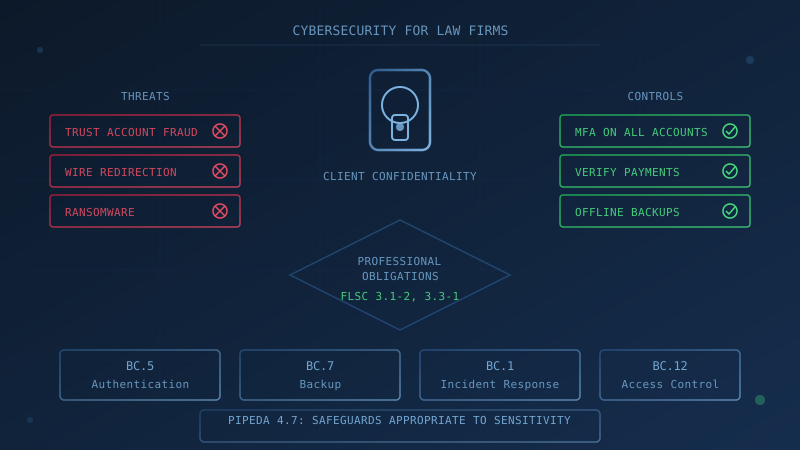
Canadian lawyers have a professional obligation to understand technology risks and protect client confidentiality. The Federation of Law Societies of Canada Model Code of Professional Conduct expects lawyers to understand relevant technology, and Canadian privacy law requires security safeguards appropriate to the sensitivity of information. For cybersecurity for law firms in Canada, that means implementing controls that address both professional duties and the specific threats facing legal practices: trust account fraud, wire transfer redirection, and ransomware attacks that can expose confidential client files. This guide covers what law societies require, what attackers target, and which controls to implement first. This is informational context (not legal advice); check your own law society's current rules.
What Do Canadian Law Societies Require for Cybersecurity?
Canadian law societies require lawyers to be technologically competent and to protect client confidentiality. The Federation of Law Societies of Canada (FLSC) Model Code of Professional Conduct provides the foundation that provincial law societies have adopted with variations.
Technological Competence (Rule 3.1-2 Commentary): The FLSC Model Code commentary [4A] on competence states: "To maintain the required level of competence, a lawyer should develop an understanding of, and ability to use, technology relevant to the nature and area of the lawyer's practice and responsibilities. A lawyer should understand the benefits and risks associated with relevant technology, recognizing the lawyer's duty to protect confidential information set out in section 3.3."
Confidentiality (Rule 3.3-1): The Model Code states: "A lawyer at all times must hold in strict confidence all information concerning the business and affairs of a client acquired in the course of the professional relationship and must not divulge any such information" unless authorized by the client, required by law or a court, or otherwise permitted by the Model Code. Commentary [2] notes this ethical duty "is wider" than solicitor-client privilege and "applies without regard to the nature or source of the information."
Provincial law societies have published specific guidance on how to meet these obligations in practice:
Law Society of Ontario: The LSO Technology Practice Management Guideline under "Confidentiality" states that lawyers using electronic communications "shall ensure that they comply with the legal requirements of confidentiality or privilege" and recommends using firewalls, security software, encryption, and taking "appropriate measures to secure confidential information when using cloud-based services." Under "Security Measures," the guideline recommends that lawyers "be familiar with the security risks inherent in any of the information technologies used in their practices" and "adopt adequate measures to protect against security threats."
Law Society of British Columbia: The LSBC Cloud Computing Checklist raises questions law firms should consider, including who is responsible for data security, whether encryption is used, and whether remedies are adequate in case of a breach.
Why Are Law Firms Targets for Cyberattacks?
Law firms hold exactly what criminals want: confidential client information, access to trust accounts, and involvement in high-value transactions. Three patterns make legal practices attractive targets.
Trust Account Access: Law firms hold client funds in trust, often with authority to wire substantial amounts on short notice. A compromised email account or a convincing impersonation can redirect those funds to a criminal's account. According to LAWPRO's 2026 cybersecurity materials, "multiple successful cyberattacks on Ontario law firms over the last several months" resulted in "unauthorized withdrawals of several million dollars."
Payment Redirection Fraud: The Canadian Anti-Fraud Centre reported in May 2026 on a payment redirection fraud targeting a Quebec business, in which it helped recover approximately $3.5 million. The advisory notes that "businesses in the construction and contracting industry, and real estate sector are common targets." The CAFC says fraudsters "may impersonate suppliers, contractors, financial institutions or legal representatives to redirect payments or change banking information," and advises businesses to "independently verify payment instructions before sending funds" and confirm banking changes using trusted contact information.
Confidential Files: Client files contain sensitive personal and financial information that has value on criminal markets and leverage in ransomware demands. A ransomware attack that encrypts a law firm's files and threatens to publish them creates pressure that goes beyond the firm itself; it affects every client whose matters are in those files.
What Does PIPEDA Require for Law Firm Security?
Law firms handling personal information in the course of commercial activity are generally subject to PIPEDA. The exception is where a substantially similar provincial law applies instead: Alberta and British Columbia each have a Personal Information Protection Act, and Quebec has its Act Respecting the Protection of Personal Information in the Private Sector. Those laws contain the same 10 fair information principles, so the PIPEDA safeguards principle is a useful baseline in every province. Principle 4.7 states: "Personal information shall be protected by security safeguards appropriate to the sensitivity of the information."
Principle 4.7.1 specifies that "the security safeguards shall protect personal information against loss or theft, as well as unauthorized access, disclosure, copying, use, or modification. Organizations shall protect personal information regardless of the format in which it is held."
Principle 4.7.3 states the methods of protection "should include (a) physical measures, for example, locked filing cabinets and restricted access to offices; (b) organizational measures, for example, security clearances and limiting access on a 'need-to-know' basis; and (c) technological measures, for example, the use of passwords and encryption."
The breach notification requirements under PIPEDA require organizations to report breaches creating a "real risk of significant harm" to the Office of the Privacy Commissioner, notify affected individuals, and keep records of all breaches for two years. For law firms, a breach affecting client information could require notification both to the regulator and to clients whose confidential information was exposed.
In Quebec, Law 25 amended the private sector privacy act. According to the Commission d'accès à l'information, organizations must notify the Commission and the affected individuals of any confidentiality incident involving personal information that presents a risk of serious injury, and must keep a register of confidentiality incidents.
Which Security Controls Should a Law Firm Implement?
The Canadian Centre for Cyber Security's Baseline Cyber Security Controls for Small and Medium Organizations provides a practical framework. Several controls directly address the threats facing law firms.
Multi-Factor Authentication (BC.5): BC.5.1 states that "organizations should implement two-factor authentication wherever possible" with particular priority on "financial accounts, system administrators, cloud administration, privileged users, and senior executives." For a law firm, that means MFA on email, practice management systems, banking platforms, and any remote access. The LSO cybersecurity checklist recommends requiring "two-factor authentication (2FA) or multi-factor authentication (MFA) wherever possible."
Payment Verification Procedures: No baseline control replaces the procedural safeguard of verifying payment instructions through a trusted contact before executing wire transfers. The CAFC advisory warns against "requests to change or update banking or payment information" and "pressure to act quickly or bypass normal procedures." LAWPRO notes that "many of these frauds could have been easily prevented" and that "active frauds can be stopped if lawyers and law firm staff recognize the red flags of a fraud in progress."
Backup and Encryption (BC.7): BC.7.1 states that "organizations should back up systems that contain essential business information, and ensure that recovery mechanisms effectively and efficiently restore these systems from back-ups." BC.7.2 requires that "long term backups (e.g. weekly backups) must be stored offline." The LSO Technology Guideline under "Back-up and Disaster Management" recommends "storing back-up disks or tapes in a secure off-site location" and "performing routine checks to ensure data can be restored." Tested, offline backups are the last line of defence against ransomware. See our guide to backup and recovery.
Access Control (BC.12): BC.12.3 states that "organizations should remove accounts and/or functionality when employees no longer require these for their tasks." When staff leave a law firm, their access to files, email, and systems must be revoked promptly. Our employee offboarding checklist covers the process in detail.
Incident Response Plan (BC.1): BC.1.2 states that "organizations should have a written incident response plan that details who is responsible for handling incidents including any relevant contact information for communicating to external parties, stakeholders and regulators." For a law firm, the plan should address how to notify affected clients, the law society, insurers, and the OPC if required. The LSO cybersecurity checklist recommends creating "a simple plan that names key contacts, outlines first steps and includes regulator and insurance reporting requirements."
What Should a Law Firm Do After a Cyber Incident?
The LSO's post-attack checklist sets out the steps: contain the threat by isolating impacted systems, preserve evidence, assess the impact on trust accounts and client information, review professional obligations, notify your insurer, report to the law society, and notify affected clients promptly.
For a breach involving personal information, PIPEDA requires notification to the OPC and affected individuals when there is a real risk of significant harm. The law society may also require a report under practice rules.
If trust account fraud is suspected, contact your bank immediately to attempt recovery. Our guide to reporting a cyber attack in Canada covers which agencies to contact and in what order.
One Question to Ask Your IT Provider
"Is multi-factor authentication enabled on our email, practice management system, and trust account access, and what is our procedure for verifying changed payment instructions before a wire transfer?"
If your IT lead or managed service provider cannot answer this question, that conversation is where your cybersecurity review should start. The controls that matter most for a law firm are the ones that protect client trust accounts and confidential files.
Assess Your Firm's Cybersecurity Posture
Our free cybersecurity assessment evaluates your organization against the Canadian Centre for Cyber Security's 13 Baseline Control areas. The assessment covers 50 questions, takes under 30 minutes, and your answers stay in your browser. Progress is saved locally for 48 hours. No signup is required. The results show which control areas need attention, so you know where to focus your cybersecurity investment.
How prepared is your business?
Find out where you stand against Canada's 13 Baseline Cyber Security Controls. The assessment takes under 30 minutes and your answers stay in your browser.
Check Your ScoreFrequently Asked Questions
Are Canadian lawyers required to understand cybersecurity?
Yes. The Federation of Law Societies of Canada Model Code of Professional Conduct commentary on rule 3.1-2 states that to maintain competence, a lawyer should develop an understanding of, and ability to use, technology relevant to the lawyer's practice and responsibilities. A lawyer should understand the benefits and risks associated with relevant technology, recognizing the duty to protect confidential information.
What does PIPEDA require for law firm cybersecurity?
PIPEDA Principle 4.7 states that personal information shall be protected by security safeguards appropriate to the sensitivity of the information. Principle 4.7.1 requires safeguards to protect personal information against loss or theft, as well as unauthorized access, disclosure, copying, use, or modification. Organizations must report breaches creating a real risk of significant harm to the OPC and notify affected individuals. Firms in Alberta, British Columbia and Quebec are generally covered by their provincial private sector privacy law instead.
Why are law firms targeted by cybercriminals?
Law firms hold highly sensitive client information, handle large financial transactions through trust accounts, and are involved in high-value transactions. According to the Canadian Anti-Fraud Centre, recent reporting suggests that businesses in the real estate sector are common targets for payment redirection fraud. Fraudsters may impersonate suppliers, contractors, financial institutions, or legal representatives to redirect payments or change banking information.
What cybersecurity controls should a Canadian law firm implement?
The Canadian Centre for Cyber Security's Baseline Controls for Small and Medium Organizations recommend multi-factor authentication (BC.5), tested backups stored offline (BC.7), an incident response plan (BC.1), and access control that removes accounts when employees leave (BC.12). The Canadian Anti-Fraud Centre also advises independently verifying payment instructions before sending funds.
Does the Law Society of Ontario have cybersecurity guidance?
Yes. The LSO's Technology Practice Management Guideline recommends that lawyers use firewalls and security software, use encryption to maintain confidentiality, take appropriate measures to secure confidential information when using cloud services, and have backup and disaster recovery plans. The LSO also publishes a cybersecurity checklist for legal professionals.
Cite This Page
Suggested citation:
Cybersecurity Canada (2026). Cybersecurity for Law Firms in Canada: A Guide. Retrieved from https://cybersecuritycanada.ca/news/posts/cybersecurity-for-law-firms-in-canada/
Permanent URL: https://cybersecuritycanada.ca/news/posts/cybersecurity-for-law-firms-in-canada/ · Published October 31, 2026
Disclaimer: This article is intended for general informational purposes only and does not constitute professional cybersecurity, legal, IT, or compliance advice. While we strive to ensure accuracy, the cybersecurity landscape changes rapidly and information may become outdated. Organizations should consult with qualified cybersecurity professionals and legal counsel to assess their specific situation and develop appropriate security policies. Use of this information is at your own risk. See our Privacy Policy for more information.
Cybersecurity Canada is an independent resource and is not affiliated with, endorsed by, or connected to the Canadian Centre for Cyber Security, the Communications Security Establishment, or the Government of Canada.
How does your organization measure up?
Take our free cybersecurity assessment based on the Canadian Centre for Cyber Security's Baseline Controls. 50 questions, under 30 minutes, 100% confidential. Your answers never leave your browser.
Take the Free Assessment