Real Estate Cybersecurity in Canada

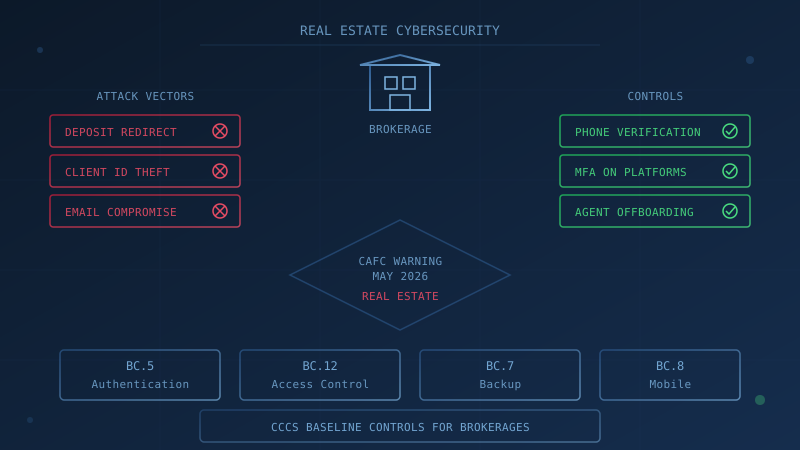
Real estate cybersecurity in Canada means protecting the deposits, closing funds, client identification records and transaction data that brokerages, teams and agents handle every day. The Canadian Anti-Fraud Centre's May 2026 advisory states that "businesses in the construction and contracting industry, and real estate sector are common targets" for payment redirection fraud. The advisory notes that fraudsters "may impersonate suppliers, contractors, financial institutions or legal representatives to redirect payments or change banking information." This guide covers why real estate is targeted, what the Canadian Centre for Cyber Security's Baseline Controls recommend, and which practical steps protect against the threats that matter most. This is informational context (not legal advice).
Why Are Real Estate Brokerages Targeted by Cybercriminals?
Real estate transactions combine everything criminals want: large sums, time pressure, multiple parties exchanging banking details by email, and sensitive identification documents. Three patterns make the industry attractive.
Large Deposits and Closing Funds: A single residential transaction can involve deposits of tens or hundreds of thousands of dollars. Commercial transactions involve more. The CAFC's May 2026 advisory warns that payment redirection frauds target businesses handling high-value transactions. Criminals who successfully redirect a closing payment can capture the full purchase price.
Email-Heavy Communication: Real estate deals involve buyers, sellers, agents, lawyers, notaries, lenders and title insurers exchanging documents and instructions by email. That legitimate complexity creates opportunities for fraudulent emails to blend in. Business email compromise works by impersonating someone the victim trusts, and real estate transactions have many parties to impersonate.
Sensitive Client Information: Brokerages collect identification documents, financial statements, employment letters and personal contact details from clients. Under FINTRAC requirements, real estate brokers and sales representatives who act as agents in purchases or sales must verify client identity and keep records. That identity verification requirement means brokerages hold exactly the documents criminals need for identity theft.
What Is Deposit and Closing Fund Fraud?
Deposit fraud follows a predictable pattern: an attacker sends an email appearing to come from the buyer's lawyer, the listing agent or another trusted party, provides fraudulent wiring instructions, and requests an urgent transfer. The CAFC's May 2026 advisory describes how fraudsters "manipulated email communications to provide fraudulent payment instructions" in a case where partners helped recover approximately $3.5 million.
The CAFC lists warning signs including:
- Requests to change or update banking or payment information
- Pressure to act quickly or bypass normal procedures
- Email addresses that closely resemble legitimate ones
- Unexpected wire transfer instructions
For real estate transactions, the risk is amplified by legitimate urgency. Closing dates create real deadlines. Deposits do need to move quickly. That pressure is exactly what attackers exploit. The CAFC advises businesses to "independently verify payment instructions before sending funds" and to "confirm banking changes using trusted contact information."
What Privacy Obligations Apply to Real Estate Brokerages?
The Office of the Privacy Commissioner of Canada states that PIPEDA applies to private-sector organizations that collect, use or disclose personal information in the course of commercial activity. Real estate brokerages collect client names, contact details, identification documents, financial information and transaction records in the course of commercial activity.
The OPC states that Alberta, British Columbia and Quebec have their own private-sector privacy laws that have been deemed substantially similar to PIPEDA for activities within those provinces. Brokerages operating in those provinces should check with the relevant provincial privacy commissioner for specific requirements.
PIPEDA requires organizations to report breaches of security safeguards involving personal information that pose a "real risk of significant harm" to individuals. Organizations must also notify affected individuals and keep records of all breaches for at least two years, whether or not they meet the reporting threshold. For a brokerage, a breach exposing client identification documents would require assessing whether the information could enable identity theft.
Why Do Real Estate Brokerages Hold Sensitive ID Records?
FINTRAC states that real estate brokers and sales representatives are reporting entities under the Proceeds of Crime (Money Laundering) and Terrorist Financing Act when they act as agents for purchasers or vendors in real property transactions. FINTRAC defines a real estate broker or sales representative as "a person or entity that is authorized under provincial legislation to act as an agent for purchasers or vendors in respect of a purchase or sale of real property or immovables."
FINTRAC's record-keeping guidance states that real estate brokers and sales representatives must verify client identity and keep certain records, including receipt of funds records and information records. The records must be kept in such a manner that they can be provided to FINTRAC within 30 days of a request.
From a cybersecurity perspective, this means brokerages hold exactly the sensitive identification documents criminals seek. The same records that demonstrate FINTRAC compliance are targets for data theft. Protecting these records requires the security controls described below.
Which Security Controls Should a Real Estate Brokerage Implement?
The Canadian Centre for Cyber Security's Baseline Cyber Security Controls for Small and Medium Organizations provides a practical framework. Several controls directly address the threats facing real estate businesses.
Multi-Factor Authentication (BC.5): BC.5.1 states that "organizations should implement two-factor authentication wherever possible" with priority on "financial accounts, system administrators, cloud administration, privileged users, and senior executives." For a brokerage, that means MFA on email, transaction management platforms, CRM systems, e-signature tools and any remote access. If attackers cannot get into your email, they cannot send fraudulent payment instructions from inside your account.
Access Control (BC.12): BC.12.3 states that "organizations should remove accounts and/or functionality when employees no longer require these for their tasks." Real estate teams include agents who may move between brokerages. When an agent departs, their access to client records, transaction platforms and shared systems must end promptly. See our employee offboarding checklist.
Backup and Encryption (BC.7): BC.7.1 states that "organizations should back up systems that contain essential business information, and ensure that recovery mechanisms effectively and efficiently restore these systems from back-ups." BC.7.2 requires that "long term backups (e.g. weekly backups) must be stored offline." Client records, transaction files and identification documents must be included. Tested, offline backups are the last line of defence against ransomware.
Mobile Devices (BC.8): The baseline controls state that organizations should "decide on an ownership model for mobile devices and document the rationale and associated risks." Real estate agents work from phones constantly, often personal devices. Clear rules about what apps can access client data and what happens if a phone is lost are essential. See our guide to mobile security and BYOD.
Incident Response Plan (BC.1): BC.1.2 states that "organizations should have a written incident response plan that details who is responsible for handling incidents including any relevant contact information for communicating to external parties, stakeholders and regulators." For a brokerage, the plan should list who calls the bank if a fraud is suspected, who contacts police, who notifies the privacy commissioner if required, and who communicates with affected clients.
How Should a Brokerage Communicate About Wire Instructions?
The most effective procedural control is clear, written communication with clients about how you will and will not send wiring instructions.
Tell clients in writing that you will never change wiring instructions by email. A sentence in your engagement letter or welcome package stating that any email claiming to change payment instructions is fraudulent gives clients a baseline to recognize fraud.
Verify by phone to a known number. Before processing any change to payment details, call the party at a phone number you already have on file, not one provided in the email.
Use secure communication channels. If your transaction management or e-signature platform has a secure messaging feature, use it for payment instructions rather than email.
These procedural controls are not technology: they are policy. The CAFC's advice to "confirm banking changes using trusted contact information" applies to real estate just as it does to any other industry.
What About Agents Using Personal Devices?
Real estate agents are mobile workers. They respond to clients from personal phones, access CRM systems from tablets, and work outside the office more than in it. The CCCS baseline control BC.8 addresses mobile device security, noting that organizations should document their ownership model and associated risks.
For a brokerage with agents on personal devices, consider:
- Requiring MFA on any app or service that accesses client data
- Enabling remote wipe capability for work data (not personal data) if a device is lost
- Setting clear expectations about what happens to client data when an agent leaves
- Ensuring encryption is enabled on devices that access client records
These measures do not require expensive software. Built-in features of iOS and Android, combined with MFA on cloud services, address the most common risks.
What Should a Brokerage Do After a Suspected Compromise?
Time matters. If you suspect a payment has been misdirected or your systems have been compromised:
- Contact your bank immediately and request a recall of any fraudulent transfer. The faster you act, the higher the chance of recovery.
- Report to the Canadian Anti-Fraud Centre online at reportcyberandfraud.canada.ca or by phone at 1-888-495-8501. The CAFC advises victims to contact local police and report to the CAFC.
- File a report with local police to create a file number your bank or insurer may require.
- Assess whether personal information was exposed. If client identification documents or personal information may have been compromised, determine whether notification to the privacy commissioner and affected individuals is required under PIPEDA or provincial law.
- Follow your incident response plan for next steps, including who notifies clients if their information may have been affected.
For detailed reporting guidance, see our guide to how to report a cyber attack in Canada.
Practical Checklist for Real Estate Cybersecurity
These steps address the threats most relevant to real estate brokerages:
- Tell clients in writing you will never change wiring instructions by email
- Verify any changed payment instructions by phone to a number you already have on file
- Enable MFA on email, CRM, transaction platforms and e-signature tools
- Offboard departing agents promptly by removing their access to all systems and client records
- Set mobile device policies for agents, including encryption and the ability to wipe work data if a phone is lost
- Test backups regularly by restoring files to confirm recovery works before you need it
- Secure storage and retention of ID copies to protect the documents collected for FINTRAC compliance
One Question to Ask Your IT Provider
"Is multi-factor authentication enabled on our email and transaction platforms, and do we have a procedure to remove agent access when someone leaves?"
If your IT lead or managed service provider cannot answer this question, that conversation is where your cybersecurity review should start.
Assess Your Brokerage's Cybersecurity Posture
Our free cybersecurity assessment evaluates your organization against the Canadian Centre for Cyber Security's 13 Baseline Control areas. The assessment covers 50 questions, takes under 30 minutes, and is completely confidential. Progress is saved locally for 48 hours. No signup is required. The results show which control areas need attention, so you know where to focus your cybersecurity investment. The assessment is not a compliance audit or legal advice; for those questions, consult a qualified professional.
How prepared is your business?
Find out where you stand against Canada's 13 Baseline Cyber Security Controls. The assessment takes under 30 minutes and your answers stay in your browser.
Check Your ScoreFrequently Asked Questions
Why are real estate brokerages targeted by cybercriminals?
Real estate transactions involve large deposits, closing funds, and email-heavy communication with lawyers, lenders and buyers. The Canadian Anti-Fraud Centre's May 2026 advisory states that businesses in the real estate sector are common targets for payment redirection fraud. Brokerages also hold sensitive client identification documents collected for FINTRAC compliance, making them attractive to criminals seeking personal information.
What is deposit fraud in real estate?
Deposit fraud occurs when criminals impersonate a party to a transaction and provide fraudulent wiring instructions for a deposit or closing payment. The Canadian Anti-Fraud Centre warns that fraudsters may impersonate legal representatives to redirect payments or change banking information. Verifying banking details by phone to a known number is the primary defence.
What cybersecurity controls should a real estate brokerage implement?
The Canadian Centre for Cyber Security's Baseline Controls for Small and Medium Organizations recommend multi-factor authentication wherever possible (BC.5), tested offline backups (BC.7), a written incident response plan (BC.1), and access controls that remove accounts when employees leave (BC.12). For brokerages, this means MFA on email, transaction platforms and CRM systems, plus offboarding procedures when agents depart.
Does PIPEDA apply to real estate brokerages in Canada?
PIPEDA applies to private-sector organizations that collect, use or disclose personal information in the course of commercial activity. The Office of the Privacy Commissioner states that Alberta, British Columbia and Quebec have private-sector privacy laws deemed substantially similar to PIPEDA for activities within those provinces. Real estate brokerages collect client identification documents, financial information and contact details in the course of commercial activity.
What should a real estate brokerage do after a suspected fraud?
Contact your bank immediately and request a recall of any fraudulent payment. Report the incident to the Canadian Anti-Fraud Centre online at reportcyberandfraud.canada.ca or by phone at 1-888-495-8501, and file a report with your local police. If personal information was exposed and the breach creates a real risk of significant harm, PIPEDA requires a report to the Office of the Privacy Commissioner and notification to affected individuals.
Cite This Page
Suggested citation:
Cybersecurity Canada (2026). Real Estate Cybersecurity in Canada. Retrieved from https://cybersecuritycanada.ca/news/posts/real-estate-cybersecurity-canada/
Permanent URL: https://cybersecuritycanada.ca/news/posts/real-estate-cybersecurity-canada/ · Published November 9, 2026
Disclaimer: This article is intended for general informational purposes only and does not constitute professional cybersecurity, legal, IT, or compliance advice. While we strive to ensure accuracy, the cybersecurity landscape changes rapidly and information may become outdated. Organizations should consult with qualified cybersecurity professionals and legal counsel to assess their specific situation and develop appropriate security policies. Use of this information is at your own risk. See our Privacy Policy for more information.
Cybersecurity Canada is an independent resource and is not affiliated with, endorsed by, or connected to the Canadian Centre for Cyber Security, the Communications Security Establishment, or the Government of Canada.
How does your organization measure up?
Take our free cybersecurity assessment based on the Canadian Centre for Cyber Security's Baseline Controls. 50 questions, under 30 minutes, 100% confidential. Your answers never leave your browser.
Take the Free Assessment