Cybersecurity for Insurance Brokers

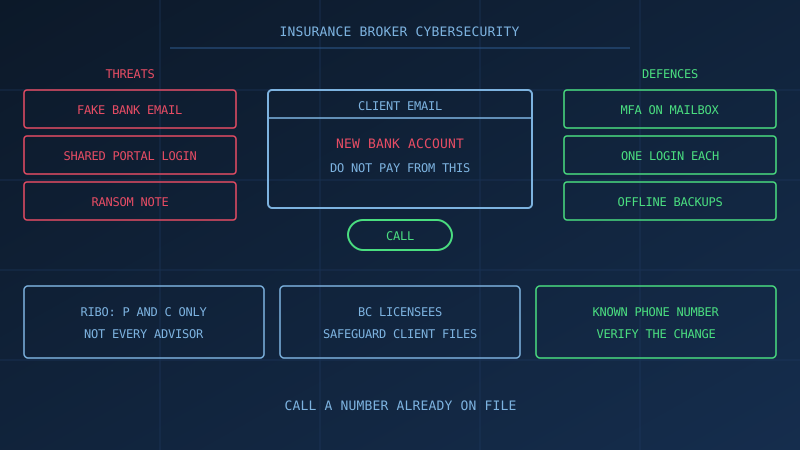
Cybersecurity for insurance brokers Canada means calling a known phone number before a brokerage changes banking or payment details. The Canadian Centre for Cyber Security's National Cyber Threat Assessment 2025-2026, based on information available as of September 20, 2024, lists Finance at 157% among ransomware-incident increases by sector from 2022 to 2023. This is informational context (not legal or regulatory advice).
Why are Canadian insurance brokerages targeted?
The Cyber Centre's National Cyber Threat Assessment 2025-2026, based on information available as of September 20, 2024, lists Finance at 157% among ransomware-incident increases by sector from 2022 to 2023. It publishes no separate insurance-broker count. The assessment says ransomware actors "are almost certainly opportunistic and do not target specific industries," and that ransomware "is almost certainly the top cybercrime threat facing Canada's critical infrastructure."
The baseline controls page says cyber threat actors target Canadian businesses "for their data about customers, partners and suppliers, financial information and payment systems, and proprietary information." The RIBO Code of Conduct Handbook, last updated April 2024, says a member holds information "concerning the business and affairs of the member's client." The Canadian Anti-Fraud Centre says it "may look like an email from existing contractor providing new payment directions."
Our guide to cybersecurity for accounting firms states: "Accounting and bookkeeping firms hold exactly what criminals want: sensitive personal and financial information, access to client financial systems, and involvement in financial transactions."
Which named brokerage described a cyberattack?
Canadian Underwriter reported on June 20, 2025 that Traci Boland, partner and manager of Ontario West Insurance Brokers and Bill Blaney Insurance Brokers Ltd., described a hack at an Insurance Brokers Association of B.C. conference on June 11, 2025. The article says the breach "happened a year ago." Insurance Business reported on January 24, 2025 that "A cyberattack on her own brokerage served as a wake-up call."
Canadian Underwriter reported that staff could not access the systems, that IT reported a hack, and that there was a ransom note. It says office systems were running for clients within 24 hours. Boland described "the immense guilt to my clients that their information was now on the dark web."
What do provincial regulators say about privacy and cyber?
RIBO's April 2024 handbook says: "Brokers must have appropriate safeguards in place to mitigate this risk from both a technology and liability insurance perspective." That handbook is for registered insurance brokers in Ontario. The Insurance Council of British Columbia says its licensees have a duty to safeguard clients' personal information. The AMF and the Alberta Insurance Council publish narrower statements below. Each quote covers only the people that page names. This is not legal advice.
Ontario, property and casualty brokers. RIBO's about page says it "regulates over 22,000 property and casualty insurance brokers in Ontario." The handbook says the code in section 14 of Ontario Regulation 991 provides rules "intended to set a standard of professional conduct for registered insurance brokers in the Province of Ontario." It also says there is "increasing risk to a client's confidential information as a result of potential cyber attacks on brokerage records." This article does not apply that code to life and benefits agencies that are not RIBO members.
British Columbia licensees. The Insurance Council of British Columbia privacy statement says the council is "responsible for the licensing and regulation of insurance agents, insurance salespersons, and insurance adjusters." The licensee responsibilities page says: "Licensees have a duty to safeguard clients' personal information and to determine the appropriate safeguards necessary to meet their duty." The same page says "Licensees must also follow the Personal Information Protection Act (PIPA)."
Quebec registered firms and representatives. The AMF page for cabinets et représentants covers registered persons (cabinets, sociétés autonomes and représentants autonomes) "dans le secteur de la distribution de produits et services financiers," under the Loi sur la distribution de produits et services financiers. For internet insurance sales, it says article 13 of the Regulation respecting alternative distribution methods obliges cabinets and sociétés autonomes, when they carry on that activity, to "s'assurer que les renseignements fournis par le client sont recueillis, utilisés, transmis et conservés de manière à en assurer la confidentialité et la sécurité." The page says the cabinet and the société autonome "devraient élaborer un plan de continuité des activités et de réponse aux cyberincidents." It also lists "Avoir des sauvegardes hors ligne de ses données." The same page states that the Chambre de l'assurance was created on July 4, 2025 after the merger of the Chambre de l'assurance de dommages (ChAD) and the Chambre de la sécurité financière (CSF), and that the regulations, codes of ethics and policies of the ChAD and the CSF remain in force until equivalent rules are adopted.
Alberta. The Alberta Insurance Council Fraud Prevention Month page addresses "licensed insurance brokers" and says: "Implement secure communication channels and data protection measures to safeguard sensitive client information." It also says: "Ensure that you and your team stay on the pulse of emerging fraud trends and cyber security threats." The same page says the council's role includes "the professional qualification, licensing and regulation of insurance agents, brokers, and independent adjusters." For consumers, it says: "Fraudsters often post as fake agents or representatives of legitimate companies."
What does PIPEDA require when client information is exposed?
PIPEDA Schedule 1, Principle 4.7, states: "Personal information shall be protected by security safeguards appropriate to the sensitivity of the information." The Office of the Privacy Commissioner says "PIPEDA applies to the collection, use and disclosure of personal information in the course of a commercial activity and across borders."
The same OPC page says: "If your organization operates in a province with substantially similar provincial legislation (B.C., Alberta and Quebec) and has to follow that law, PIPEDA only applies to interprovincial and international transactions." It also says "PIPEDA does not apply to employee information in provincially-regulated organizations." Quebec, Alberta and British Columbia have their own private-sector statutes. This article does not set those statutes out.
Where PIPEDA applies, the OPC breach guidance says organizations report breaches of security safeguards that pose a real risk of significant harm, notify affected individuals, and keep records of all breaches. The page says "the law requires you to keep breach records of all breaches of security safeguards for two years." The Breach of Security Safeguards Regulations say an organization "must maintain a record of every breach of security safeguards for 24 months after the day on which the organization determines that the breach has occurred."
What risks show up in payment email, shared logins and personal devices?
The Canadian Anti-Fraud Centre says fraudsters "will infiltrate or spoof a business or individual's email account and create a rule to send copies of incoming emails to one of their own accounts." The attack "may look like an email from existing contractor providing new payment directions." Our guide to business email compromise names the supplier version: "Criminals impersonate a real supplier your company already pays, claim the supplier changed banks, and redirect your next payment to a fraudulent account."
A shared carrier-portal password is a shared-use account. The baseline controls say organizations should "give all users unique individual accounts and minimize or eliminate the use of shared or shared-use accounts." A password used by several producers cannot be removed for one person who leaves. BC.12.3 says organizations should "remove accounts and/or functionality when employees no longer require these for their tasks." Our employee offboarding checklist states that "Access should be disabled the same day the employee departs."
BC.8.1 says organizations should "decide on an ownership model for mobile devices and document the rationale and associated risks." BC.8.2 says organizations should "enforce separation between work and personal data on mobile devices with access to corporate IT resources."
Which controls should cybersecurity for insurance brokers Canada put first?
The Baseline Cyber Security Controls for Small and Medium Organizations V1.2 are intended for "organizations that have less than 500 employees." The callback is Canadian Anti-Fraud Centre guidance, not a numbered baseline control. Our guide to the baseline controls describes them as "13 cyber security practices that the Canadian Centre for Cyber Security (CCCS) recommends for small and medium organizations."
- Call a known number (BC.6). BC.6.1 says organizations should "invest in cyber security awareness and training for their employees." The Canadian Anti-Fraud Centre says to use "verbal authentication for any urgent requests or changes in payment details." Its July 24, 2025 news release says: "Contact the sender using a trusted phone number, not the one provided in the email." Our Interac e-Transfer guide states that, before processing any change to payment details, you should "call the supplier or client at a phone number you already have on file, not one provided in the request."
- Two-factor authentication (BC.5). BC.5.1 says organizations should "implement two-factor authentication wherever possible" and require it for important accounts such as "financial accounts, system administrators, cloud administration, privileged users, and senior executives."
- One login per person (BC.12). Use the unique-account wording above, and apply BC.12.3 when a producer or staff member leaves.
- Offline copies (BC.7). BC.7.2 says "Long term backups (e.g. weekly backups) must be stored offline."
- A printed plan (BC.1). BC.1.2 says organizations should have a written incident response plan and "an up-to-date hard copy version of this plan." Our guide to building an incident response plan states that "when an incident hits, everything else depends on having a plan to follow."
- Personal phones (BC.8). Follow BC.8.1 and BC.8.2, quoted above.
What should staff do after a suspected incident?
If money may have moved, call the financial institution from a number already on file. The Canadian Anti-Fraud Centre says a business that believes it was targeted should report to the police of jurisdiction and to the Centre, through the online reporting system or by phone at 1-888-495-8501. Where PIPEDA applies and there is a real risk of significant harm, use the test above. This is general information, not legal advice.
Our guide to cyber insurance states that "Cyber insurance is not legally required in Canada." It also states that "Claims can be denied if these controls are not in place when an incident occurs," referring to the security controls that page says insurers now require before they will issue a policy.
Check the brokerage against the baseline controls
The free cybersecurity assessment for Canadian businesses states: "Evaluate your organization's security posture against the Canadian Centre for Cyber Security's Baseline Controls. 50 questions, under 30 minutes, completely confidential." It also states: "Your answers stay in your browser and are never transmitted. Progress is saved locally for 48 hours."
The same page says "No signup or email required," and that the information "does not constitute professional cybersecurity, legal, IT, compliance, or risk management advice."
How prepared is your business?
Find out where you stand against Canada's 13 Baseline Cyber Security Controls. The assessment takes under 30 minutes and your answers stay in your browser.
Check Your ScoreFrequently Asked Questions
Why are insurance brokerages targeted in Canada?
The Canadian Centre for Cyber Security's National Cyber Threat Assessment 2025-2026, based on information available as of September 20, 2024, lists Finance at 157% in the increase in ransomware incidents by sector observed from 2022 to 2023. It does not publish a separate insurance-broker figure. The assessment says ransomware actors are almost certainly opportunistic and do not target specific industries. Brokerages hold client files and handle premium payments. The Canadian Anti-Fraud Centre says fraudsters infiltrate or spoof a business email account and send new payment directions.
Does RIBO's cyber safeguard wording apply to every insurance advisor?
No. The Registered Insurance Brokers of Ontario says it regulates property and casualty insurance brokers in Ontario. Its Code of Conduct Handbook, last updated April 2024, says the code in section 14 of Ontario Regulation 991 is intended to set a standard of professional conduct for registered insurance brokers in Ontario. The handbook says there is increasing risk to a client's confidential information as a result of potential cyber attacks on brokerage records, and that brokers must have appropriate safeguards in place. That wording is for RIBO members. This article does not apply it to life and benefits agencies that are not RIBO members. This is general information, not legal advice.
What does PIPEDA require when client information is exposed?
PIPEDA Schedule 1, Principle 4.7, states that personal information shall be protected by security safeguards appropriate to the sensitivity of the information. Where PIPEDA applies, the Office of the Privacy Commissioner says organizations must report breaches of security safeguards that pose a real risk of significant harm, notify affected individuals, and keep records of every breach. The OPC says two years. The Breach of Security Safeguards Regulations say 24 months after the day the organization determines the breach occurred. Quebec, Alberta and British Columbia have their own private-sector privacy statutes. This article does not set those statutes out.
What should staff do with an email that changes banking details?
Do not change the payment from the email alone. The Canadian Anti-Fraud Centre says to put in place detailed payment procedures including verbal authentication for any urgent requests or changes in payment details. A July 24, 2025 CAFC news release says to contact the sender using a trusted phone number, not the one provided in the email. Use a number already on file.
Which baseline controls should a small brokerage put first?
The Baseline Cyber Security Controls for Small and Medium Organizations V1.2 are intended for organizations that have less than 500 employees. BC.6.1 says invest in cyber security awareness and training. BC.5.1 says implement two-factor authentication wherever possible, including financial accounts. BC.7.2 says long term backups must be stored offline. BC.1.2 says keep a written incident response plan and an up-to-date hard copy. BC.12.3 says remove accounts when employees no longer need them. The callback itself is Canadian Anti-Fraud Centre guidance, not a numbered baseline control.
Cite This Page
Suggested citation:
Cybersecurity Canada (2026). Cybersecurity for Insurance Brokers. Retrieved from https://cybersecuritycanada.ca/news/posts/cybersecurity-for-insurance-brokers-canada/
Permanent URL: https://cybersecuritycanada.ca/news/posts/cybersecurity-for-insurance-brokers-canada/ · Published November 16, 2026
Disclaimer: This article is intended for general informational purposes only and does not constitute professional cybersecurity, legal, IT, or compliance advice. While we strive to ensure accuracy, the cybersecurity landscape changes rapidly and information may become outdated. Organizations should consult with qualified cybersecurity professionals and legal counsel to assess their specific situation and develop appropriate security policies. Use of this information is at your own risk. See our Privacy Policy for more information.
Cybersecurity Canada is an independent resource and is not affiliated with, endorsed by, or connected to the Canadian Centre for Cyber Security, the Communications Security Establishment, or the Government of Canada.
How does your organization measure up?
Take our free cybersecurity assessment based on the Canadian Centre for Cyber Security's Baseline Controls. 50 questions, under 30 minutes, 100% confidential. Your answers never leave your browser.
Take the Free Assessment