Child Care Cybersecurity in Canada

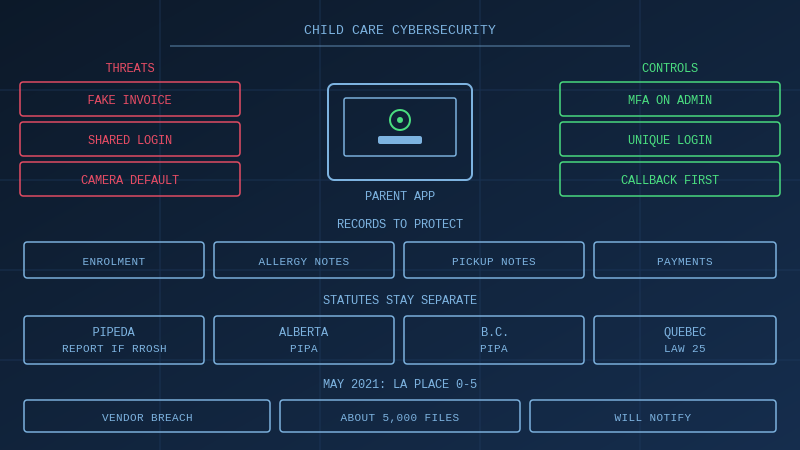
Child care cybersecurity in Canada starts with the enrolment, allergy, custody, contact, and payment records that licensed centres and daycares keep on children and families. The Baseline Cyber Security Controls for Small and Medium Organizations V1.2 say threat actors target Canadian businesses "for their data about customers, partners and suppliers, financial information and payment systems."
What records does a child care centre hold?
In general, a centre keeps enrolment forms, allergy and medication notes, pickup instructions, parent phone numbers and emails, and payment details. Baseline Controls V1.2 cover organizations with "less than 500 employees," and they say incidents can cause "operational disruptions." Those records may sit in a binder, a parent app, cloud billing software, or a camera system.
What are the main threats to child care cybersecurity in Canada?
Phishing, a fake invoice, a stolen parent-app password, a shared front-desk login, a camera left on a default password, a vendor breach, and a lost phone or tablet are the practical risks. Get Cyber Safe says phishing is an attack where a scammer "calls, texts or emails you" to trick you into "sharing sensitive information."
The Canadian Anti-Fraud Centre says fraudsters "will infiltrate or spoof" an email account, and an attack "may look like an email from existing contractor providing new payment directions." Our business email compromise guide states: "Criminals impersonate a real supplier your company already pays, claim the supplier changed banks, and redirect your next payment to a fraudulent account." The CAFC's July 24, 2025 news release says: "Contact the sender using a trusted phone number, not the one provided in the email."
Baseline Controls V1.2 say to "give all users unique individual accounts and minimize or eliminate the use of shared or shared-use accounts." Our authentication page states that shared accounts undermine accountability. Get Cyber Safe says to enable MFA "on all accounts where it is available." BC.5.1 says to "implement two-factor authentication wherever possible," including "financial accounts" and "cloud administration."
The Cyber Centre's ITSAP.00.012 (July 2022) lists "Networked security cameras," warns about "viewing surveillance cameras," and says to change "the default passwords on IoT devices." Get Cyber Safe says a manufacturer default password "is a huge security risk." Our secure configuration page states that changing default usernames and passwords is one of the most fundamental steps, because default credentials are widely known.
Our vendor risk guide states that if a vendor is breached, customer records, financial information, and employee details can be exposed. The OPC breach guidance says an organization "remains responsible" for personal information "transferred to a third party for processing," and control "needs to be assessed on a case-by-case basis." Get Cyber Safe says to set a procedure "if a device is lost or stolen." Our mobile security page says to require screen locks on devices that access business data, and that if a device is lost or stolen the organization should be able to remotely erase business data from it.
What did the May 2021 La Place 0-5 breach show?
On May 11, 2021, CBC News reported that "the personal information of about 5,000 parents and children was stolen" from La Place 0-5, Quebec's gateway to recognized child-care services. CBC News, citing the cooperative that runs it, said the files included children's names, parents' names, dates of birth, and the signup date.
The cooperative's May 11, 2021 statement says it learned this on May 10 at 11:15, that "une brèche chez son fournisseur technologique est en cause," and that "5 000 dossiers d'enfants sont concernés." It says "Les mots de passe n'ont pas été compromis," and that the list may contain parent phone numbers as well as names and dates of birth. This was the provincial registry, not a break-in at every centre.
What should you ask a child care software or camera vendor?
BC.10.2 says to judge how providers "handle and access" sensitive information. BC.10.3 covers the "legal jurisdictions" where they store it. BC.10.5 says cloud admin accounts should "use two-factor authentication and differ from internal administrator accounts." ITSAP.00.012 says to check "the types of data that the devices send and receive" before a camera goes on the network.
- Which admin accounts open enrolment, allergy, pickup, and payment records, and is that access logged?
- Do those accounts use two-factor authentication that is separate from our email password?
- Where are the records stored? The OPC says PIPEDA still applies to "transactions involving personal information transferred across borders."
- If you are breached, will you say in writing whether our families' files were involved, and which phone number should we already trust?
- For cameras: can we replace the default password, who can open the livestream, is the feed encrypted, and is that network off the enrolment computers?
- Will you share an AICPA SSAE 18 SOC 3 report? BC.10.1 says cloud customers should require one.
Which privacy statute applies, and when is an OPC report required?
The Office of the Privacy Commissioner says "Determining which law applies must be done on a case-by-case basis." Alberta, British Columbia, and Quebec have substantially similar private-sector laws. Organizations subject to one are "generally exempt from PIPEDA" for collection, use, or disclosure "within that province." Cross-border transfers can still fall under PIPEDA.
Our guide to cybersecurity for nonprofits states that non-profit organizations are usually not subject to PIPEDA because they do not typically engage in commercial activities. The OPC non-profit page says non-profit status "does not automatically exempt" an organization. This article does not decide which centres are non-profits or public bodies.
Alberta. Alberta.ca says PIPA "is Alberta's private sector privacy law for provincially regulated private sector organizations, businesses and, in some instances, non-profit organizations." The same page says the Protection of Privacy Act "Governs the protection of privacy related to personal information in the public sector."
British Columbia. The OIPC says PIPA applies to "any private sector organization (such as a business or corporation, union, political party, and not-for-profit)" collecting personal information of individuals in B.C., and that organizations must "protect and secure personal information against unauthorized use or disclosure." FIPPA covers the public sector. The OIPC says public bodies report breaches "that could reasonably be expected to result in harm" to the individuals and to the OIPC.
Quebec. The Commission d'accès à l'information says: "La Loi 25, adoptée en 2021, a apporté des modifications significatives aux lois sur la protection des renseignements personnels." It states: "Les organisations doivent aviser la Commission et les personnes concernées de tout incident de confidentialité impliquant un renseignement personnel qu'elles détiennent et présentant un risque de préjudice sérieux." They keep a register and give it to the Commission on request. That notice is not section 10.1 of PIPEDA. The page discusses public bodies and enterprises separately.
Where PIPEDA applies. Section 10.1 requires a report to the Commissioner, and notice to the person, when it is reasonable to believe there is "a real risk of significant harm." Both are due "as soon as feasible." Harm includes "financial loss" and "identity theft." The OPC says small businesses are included, and that records of every breach are kept "for two years," whether or not you report it. The regulations say 24 months after the day the organization determines the breach occurred. This is not legal advice.
What can a centre copy into a 30-day checklist?
For a centre with less than 500 employees, accounts, two-factor authentication, offline backups, training, and the hard copy are Baseline Controls V1.2. The callback is the Anti-Fraud Centre's. Camera passwords are ITSAP.00.012. Our guide to the baseline controls describes them as "13 cyber security practices that the Canadian Centre for Cyber Security (CCCS) recommends for small and medium organizations."
Days 1 to 7: accounts
- List email, the bank, the parent-app admin, billing, cameras, and remote access. Turn on two-factor authentication where the product offers it, and write down any gap (BC.5.1).
- One account per person. Retire the shared front-desk login. Our employee offboarding checklist states: "Access should be disabled the same day the employee departs." Change a shared password they knew (BC.12.3).
Days 8 to 14: phones, tablets, and cameras
- Lock each phone and tablet and turn on updates. Get Cyber Safe says a device used for work "must set their device to lock automatically." Confirm you can erase business data if it is lost.
- Replace each camera and router default password. List who can view the livestream, remove former staff, and keep cameras off the enrolment computers.
Days 15 to 21: money and backups
- Call a known number before a fee change, a new supplier account, a refund, or an e-transfer.
- Keep weekly backups offline and encrypted. Our backup and recovery page says to "Store at least one backup copy offline or offsite," disconnected from the network. BC.7.2 says long-term backups "must be stored offline." Restore one file and date the test.
Days 22 to 30: training and the card
- Train the front desk once on the fake invoice. BC.6.1 says to "invest in cyber security awareness and training for their employees."
- Print the plan. BC.1.2 wants who leads, plus "an up-to-date hard copy."
- Card: local police, 1-888-495-8501 (weekdays, 10 a.m. to 4:45 p.m. Eastern, holidays closed), reportcyberandfraud.canada.ca, the bank's published number, vendor numbers on file, and your privacy contact. The CAFC reporting page gives that line and those hours, and says to contact local police as soon as possible.
What should a centre do first after a privacy breach?
Open the hard copy before the first parent arrives, and before anyone emails the families. BC.1.2 names who leads and lists regulator contacts. Get Cyber Safe says the plan should name who employees call and which outside parties you will notify.
- One person decides whether to stay open on paper. Do not fall back to a shared login.
- Do not pay a new account from the email that announced it. The July 24, 2025 CAFC release says to use a trusted phone number, not the one in the email.
- If money moved, our business email compromise guide says: "Contact your bank immediately and request a recall of the wire transfer or e-transfer."
- Our guide to the first 24 hours says the first 24 hours are about three things: "contain, communicate, and preserve."
- Our guide to how to report a cyber attack in Canada says most businesses file through the National Cybercrime and Fraud Reporting System and contact local police.
- Ask the vendor in writing whether family files were accessed. The May 2021 cooperative statement said the cause was a breach at its technology provider.
- Where PIPEDA applies and the real-risk test is met, report to the Commissioner, notify people as soon as feasible, and keep the record. Quebec's notice and register, described by the CAI, are a different duty. This is not legal advice.
How can a centre check these controls?
The free cybersecurity assessment for Canadian businesses states: "Evaluate your organization's security posture against the Canadian Centre for Cyber Security's Baseline Controls. 50 questions, under 30 minutes, completely confidential." It also states: "Your answers stay in your browser and are never transmitted. Progress is saved locally for 48 hours." The same page says "No signup or email required." The page adds that the information "does not constitute professional cybersecurity, legal, IT, compliance, or risk management advice."
How prepared is your business?
Find out where you stand against Canada's 13 Baseline Cyber Security Controls. The assessment takes under 30 minutes and your answers stay in your browser.
Check Your ScoreFrequently Asked Questions
Why does child care cybersecurity in Canada matter?
A centre keeps enrolment forms, allergy and medication notes, custody or pickup notes, parent contact details, and payment information, often in a parent app or cloud billing system. The Baseline Cyber Security Controls for Small and Medium Organizations V1.2 say threat actors target Canadian businesses for customer, partner and supplier data, financial information and payment systems. The same page says incidents can result in operational disruptions. Get Cyber Safe describes phishing as a call, text, or email that tricks someone into sharing sensitive information. The Canadian Anti-Fraud Centre says an attack may look like an email from an existing contractor providing new payment directions.
What did the May 2021 La Place 0-5 breach involve?
On May 11, 2021, CBC News reported that the personal information of about 5,000 parents and children was stolen from La Place 0-5, Quebec's gateway to recognized child-care services. CBC News, citing Coopérative Enfance Famille, said the stolen information includes children's names, parents' names, dates of birth, and the date they signed up. The cooperative's May 11, 2021 statement says it was informed on May 10, 2021 at 11:15 a.m. that an unauthorized person had a waiting list covering 5,000 children's files, that the cause was a breach at its technology provider, and that passwords were not compromised. The statement says the list may contain parent names, phone numbers, the child's name, date of birth, and registration date. This was the provincial registry, not a report that every centre was breached.
When must a centre report a breach to the OPC?
Only where PIPEDA applies. The Office of the Privacy Commissioner says determining which law applies must be done on a case-by-case basis. It also says non-profit organizations are usually not subject to PIPEDA because they do not typically engage in commercial activities, and that non-profit status does not automatically exempt an organization. Alberta's Personal Information Protection Act, British Columbia's Personal Information Protection Act, and Quebec's private-sector act can apply instead for collection inside that province. Public-sector statutes are separate. Where PIPEDA applies, section 10.1 requires a report to the Commissioner and notice to the individual when it is reasonable to believe the breach creates a real risk of significant harm. Both are due as soon as feasible. The OPC says keep records for two years. The Breach of Security Safeguards Regulations say 24 months after the day the organization determines the breach occurred. This is general information, not legal advice.
What should staff do before a payment change?
The Canadian Anti-Fraud Centre says to put in place detailed payment procedures, including verbal authentication for any urgent requests or changes in payment details. Its July 24, 2025 news release says to contact the sender using a trusted phone number, not the one provided in the email. A number printed in the email is not that check. If money has already moved, our business email compromise guide says to contact the bank immediately and request a recall of the wire transfer or e-transfer.
What belongs on a 30-day child care checklist?
Baseline Controls V1.2 say to implement two-factor authentication wherever possible, give every user a unique account, store long-term backups offline, train employees, and keep a written incident response plan with an up-to-date hard copy. Get Cyber Safe says to enable multi-factor authentication where it is available, change a device's default password, lock phones and tablets, and back up at least weekly. The Canadian Anti-Fraud Centre supplies the callback rule. Remove accounts when people leave. The Cyber Centre's July 2022 note ITSAP.00.012 says to change default passwords on networked security cameras. These steps reduce likelihood. They are not a promise that a breach will be prevented.
Cite This Page
Suggested citation:
Cybersecurity Canada (2026). Child Care Cybersecurity in Canada. Retrieved from https://cybersecuritycanada.ca/news/posts/child-care-cybersecurity-in-canada/
Permanent URL: https://cybersecuritycanada.ca/news/posts/child-care-cybersecurity-in-canada/ · Published November 26, 2026
Disclaimer: This article is intended for general informational purposes only and does not constitute professional cybersecurity, legal, IT, or compliance advice. While we strive to ensure accuracy, the cybersecurity landscape changes rapidly and information may become outdated. Organizations should consult with qualified cybersecurity professionals and legal counsel to assess their specific situation and develop appropriate security policies. Use of this information is at your own risk. See our Privacy Policy for more information.
Cybersecurity Canada is an independent resource and is not affiliated with, endorsed by, or connected to the Canadian Centre for Cyber Security, the Communications Security Establishment, or the Government of Canada.
How does your organization measure up?
Take our free cybersecurity assessment based on the Canadian Centre for Cyber Security's Baseline Controls. 50 questions, under 30 minutes, 100% confidential. Your answers never leave your browser.
Take the Free Assessment