Auto Dealership Cybersecurity Canada

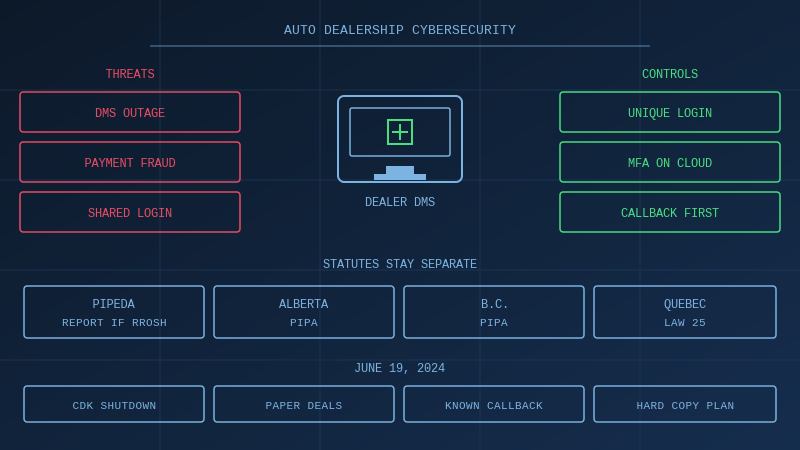
Auto dealership cybersecurity in Canada starts with identity and credit files held on a cloud dealer management system (DMS). On June 19, 2024, CDK Global shut down a majority of its systems after a cyber incident, according to AutoCanada Inc. CBC News reported the next day that dealers in Canada and the United States were affected.
Why do Canadian dealerships face both a breach risk and a downtime risk?
The Baseline Cyber Security Controls for Small and Medium Organizations V1.2 say threat actors target Canadian businesses "for their data about customers, partners and suppliers, financial information and payment systems, and proprietary information," and that incidents can cause "operational disruptions." The controls are for organizations with less than 500 employees. A dealership holds both: finance files that can be misused, and a DMS it needs in order to sell.
In general, finance and insurance (F&I) staff take a credit application and a driver's licence copy when someone asks for financing, plus contact details and the income or insurance information a lender asks for. Service keeps a name, a phone number, and a vehicle record.
What did the June 2024 CDK outage do to dealerships in Canada?
On June 20, 2024, CBC News reported the outage was in its second day and was impacting dealers in Canada and the United States. Tim Reuss said "hundreds of dealers" across Canada were impacted. Global News on June 25, 2024 quoted him: "We're talking hundreds of dealerships across Canada and they have all brands under the sun."
Systems went down on Wednesday, June 19, 2024. CBC News reported a second breach that evening. AutoCanada said CDK "had shut down a majority of its systems, including systems necessary to support our dealer management system," which supports "sales, service, inventory, and accounting functions." Global News added "financing, insurance and repairs." CBC News and Global News both reported more than 15,000 retail locations across North America, not a count of Canadian rooftops.
CBC News said pen-and-paper work had to be entered later. Global News said many of Stellantis's dealerships moved to manual processes, including pen and paper. Reuss said that work "needs to be put back into their central systems and then reconciled with their reality." AutoCanada stayed open "through manual and alternative processes." CBC News said it was "unclear whether any customer or employee data was breached." AutoCanada had "not identified any compromise or unauthorized access to our systems," and access to customer or vendor data on the DMS was "not yet known." CBC News said CDK was "neither confirming or denying if it had received a ransom demand." CBC News reported scammers "impersonating CDK representatives," and Global News reported the same warning.
What does auto dealership cybersecurity in Canada require first?
Auto dealership cybersecurity in Canada, for organizations with less than 500 employees, starts in Baseline Controls V1.2 and at the Canadian Anti-Fraud Centre. BC.5.1 says "implement two-factor authentication wherever possible," including financial accounts, administrators, cloud administration, privileged users, and senior executives. Give each person a "unique individual" account. BC.7.2 says long-term backups "must be stored offline." Use "verbal authentication for any urgent requests or changes in payment details."
Start with the bank, the DMS and CRM administrators, the deal mailbox, and the dealer principal, and document any exception. Our authentication page says shared accounts "undermine accountability." Our backup and recovery page says to "Store at least one backup copy offline or offsite," disconnected from the organization's network, and to test restoration. BC.1.2 needs a written plan and "an up-to-date hard copy."
How do payment fraud and shared logins reach the sales desk?
The Canadian Anti-Fraud Centre says fraudsters "will infiltrate or spoof" an email account, and an attack "may look like an email from existing contractor providing new payment directions." Our business email compromise guide states: "Criminals impersonate a real supplier your company already pays, claim the supplier changed banks, and redirect your next payment to a fraudulent account." Phone a number you already have.
If the money left, the same guide says: "Contact your bank immediately and request a recall of the wire transfer or e-transfer." A number in the email does not count. Do not give a password to anyone posing as the DMS vendor. CBC News reported scammers impersonating CDK, and BleepingComputer reported callers "posing as CDK agents or affiliates." Change a shared password the day someone leaves. BC.9.6 says to "isolate point-of-sale systems from the Internet and other areas of the corporate network with a firewall."
What should you ask a DMS or CRM provider?
BC.10.2 says to judge how providers "handle and access" sensitive information. BC.10.3 covers the "legal jurisdictions" where they store it. BC.10.5 says cloud admin accounts "use two-factor authentication and differ from internal administrator accounts." Our vendor risk guide says a vendor breach can expose customer records and financial information.
- Which admin accounts open our finance files, and is their two-factor authentication separate from ours?
- Where are the records stored, and does a cross-border transfer change which statute applies?
- Who on your staff can see our data, and is that access logged?
- What paper process covers a deal, a repair order, and a parts invoice, and who reconciles them?
- Which phone number should we already trust if you call about an incident?
- Will you share an AICPA SSAE 18 SOC 3 report? BC.10.1 says cloud customers should require one.
The OPC breach page says an organization "remains responsible" for personal information "transferred to a third party for processing," and that who has information "under its control" "needs to be assessed on a case-by-case basis."
Which privacy statute applies, and when is an OPC report required?
The Office of the Privacy Commissioner says "Determining which law applies must be done on a case-by-case basis." Alberta, British Columbia, and Quebec have substantially similar private-sector laws. Organizations subject to one are "generally exempt from PIPEDA with respect to the collection, use or disclosure of personal information that occurs within that province." Cross-border transfers, and banks, telecommunications, and transportation companies, can still fall under PIPEDA.
Alberta. Alberta.ca says PIPA "is Alberta's private sector privacy law for provincially regulated private sector organizations, businesses and, in some instances, non-profit organizations."
British Columbia. The B.C. privacy commissioner says PIPA applies to a private-sector organization that collects, uses, and discloses personal information of individuals in B.C., and that it must "protect and secure personal information against unauthorized use or disclosure."
Quebec. The Commission d'accès à l'information says: "La Loi 25, adoptée en 2021, a apporté des modifications significatives aux lois sur la protection des renseignements personnels." It states: "Toute personne qui exploite une entreprise est responsable de la protection des renseignements personnels qu'elle détient." It also states: "Les organisations doivent aviser la Commission et les personnes concernées de tout incident de confidentialité impliquant un renseignement personnel qu'elles détiennent et présentant un risque de préjudice sérieux." It also says organizations keep a register of confidentiality incidents and give it to the Commission on request. That is the private-sector act in Quebec, not section 10.1, and not Alberta or B.C. PIPA.
Where PIPEDA applies. Section 10.1(1) requires a report to the Commissioner, and notice to the person, when it is reasonable to believe there is "a real risk of significant harm." Both are due "as soon as feasible." Harm includes "financial loss, identity theft, negative effects on the credit record." Section 10.3 requires a record of every breach. The regulations say 24 months after the day the organization determines the breach occurred. The OPC says "for two years," including breaches you do not report, and says the test can be met for one person or "a 1,000." The OPC says the duties apply to small businesses. This is not legal advice.
What can a dealership copy into a 30-day checklist?
For a store with less than 500 employees: accounts, two-factor authentication, offline backups, training, and the hard copy are Baseline Controls V1.2. The callback is the Anti-Fraud Centre's. The paper deal is what CBC News, Global News, and AutoCanada described in June 2024.
Days 1 to 7: accounts
- List DMS, CRM, email, bank, remote access, and the vendor admin.
- Turn on two-factor authentication for bank, DMS, CRM, and the dealer principal. Note exceptions.
- One account per person. Retire the shared showroom login.
- Remove leavers the same day and change passwords they know.
Days 8 to 14: backups and paper
- Keep weekly backups offline and encrypted.
- Restore one sample deal and date the test.
- Name who may write a deal, a repair order, and a parts invoice on paper, who re-enters them, and who matches the deposit and the floorplan.
- Print the sheet. BC.1.2 wants a hard copy when screens are down.
Days 15 to 21: money and training
- Call a known number before a payoff change, a new vendor account, a refund, or a wire. Read both numbers.
- Write that the dealer principal will not demand a wire, or a payment change, by email or text.
- Train sales, F&I, and service once on the fake vendor call. That is BC.6.1.
Days 22 to 30: the card
- Police, 1-888-495-8501 (weekdays 10 a.m. to 4:45 p.m. Eastern, holidays closed), reportcyberandfraud.canada.ca, the bank's published number, vendor numbers already on file, and your privacy contact.
- Separate the card terminal from the sales network (BC.9.6). Use a VPN with two-factor authentication remotely (BC.9.3).
What should a dealership do first after an incident?
Open the hard copy before the first customer arrives. BC.1.2 names who leads and lists regulator contacts. On June 24, 2024, AutoCanada stayed open through "manual and alternative processes." Without that script, the desk will invent one while people wait.
- One person decides if sales and service continue on paper. No shared login.
- No passwords for a caller who claims to be the DMS vendor. Use the printed number. CBC News reported the impostor warning.
- If money moved, call the bank on a known number and ask for a recall, as the business email compromise guide says.
- Keep notes. The first 24 hours guide says to "contain, communicate, and preserve."
- Our guide to how to report a cyber attack in Canada says most businesses file through the National Cybercrime and Fraud Reporting System and contact local police. The CAFC takes reports at reportcyberandfraud.canada.ca and at 1-888-495-8501, and says victims should call police as soon as possible.
- Ask the provider in writing whether customer or finance data was accessed. CBC News and AutoCanada left that unknown in June 2024.
- Where PIPEDA applies and the real-risk test is met, report to the Commissioner, notify people as soon as feasible, and keep every record. In Quebec, use the Commission notice and register. Alberta and British Columbia use their own statutes. This is not legal advice.
How can a dealership check these controls?
The free cybersecurity assessment for Canadian businesses states: "Evaluate your organization's security posture against the Canadian Centre for Cyber Security's Baseline Controls. 50 questions, under 30 minutes, completely confidential." It also states: "Your answers stay in your browser and are never transmitted. Progress is saved locally for 48 hours." The same page says "No signup or email required." The page adds that the information "does not constitute professional cybersecurity, legal, IT, compliance, or risk management advice."
How prepared is your business?
Find out where you stand against Canada's 13 Baseline Cyber Security Controls. The assessment takes under 30 minutes and your answers stay in your browser.
Check Your ScoreFrequently Asked Questions
Why does auto dealership cybersecurity in Canada matter?
A dealership holds customer identity and financing files and runs the day on a cloud dealer management system, so it faces both misuse of personal information and an outage that stops normal sales and service. The Baseline Cyber Security Controls for Small and Medium Organizations V1.2 say cyber threat actors target Canadian businesses for customer, partner and supplier data, financial information and payment systems. The same page says incidents can result in operational disruptions. On June 19, 2024, CDK Global shut down a majority of its systems after a cyber incident, according to AutoCanada. CBC News reported the next day that dealers in Canada and the United States were affected.
What did the June 2024 CDK outage do in Canada?
CBC News reported on June 20, 2024 that Tim Reuss of the Canadian Automobile Dealers Association said hundreds of dealers across Canada had been impacted, and that it remained unclear whether any customer or employee data was breached. Global News reported on June 25, 2024 that Reuss said hundreds of dealerships across Canada, of all brands, were affected, and that Stellantis said many of its dealerships had switched to manual processes, including pen and paper. AutoCanada said on June 24, 2024 that its dealerships stayed open through manual and alternative processes, that it had not identified a compromise of its own systems, and that any access to customer or vendor data held by CDK was not yet known.
When must a dealership report a breach to the OPC?
Only where PIPEDA applies. The Office of the Privacy Commissioner says determining which law applies must be done on a case-by-case basis. Alberta's Personal Information Protection Act, British Columbia's Personal Information Protection Act, and Quebec's Act Respecting the Protection of Personal Information in the Private Sector are substantially similar laws that generally apply instead of PIPEDA to collection, use, or disclosure inside that province. Where PIPEDA applies, section 10.1 requires a report to the Commissioner and notice to the individual when it is reasonable to believe the breach creates a real risk of significant harm. Notice and the report are due as soon as feasible. The organization must keep a record of every breach. The OPC says two years. The Breach of Security Safeguards Regulations say 24 months after the day the organization determines the breach occurred. This is general information, not legal advice.
What should staff do before a payment change?
The Canadian Anti-Fraud Centre says to put in place detailed payment procedures, including verbal authentication for any urgent requests or changes in payment details. Call a number already on file. A number printed in the email is not that check. The same page says an attack may look like an email from an existing contractor providing new payment directions, or like a top executive requesting an urgent payment. During the June 2024 CDK outage, CBC News reported that scammers impersonated CDK representatives to steal log-in credentials. Do not give a password to that caller.
What belongs on a 30-day dealership checklist?
Baseline Controls V1.2 say to implement two-factor authentication wherever possible, give every user a unique account, store long-term backups offline, train employees, and keep a written incident response plan with an up-to-date hard copy. The Canadian Anti-Fraud Centre supplies the callback rule. The June 2024 CDK outage, as described by CBC News, Global News, and AutoCanada, is the reason to write a paper process for deals, repair orders, and parts invoices, and to name who reconciles those records when the DMS returns. Remove accounts when people leave. These steps reduce likelihood. They are not a promise that a breach will be prevented.
Cite This Page
Suggested citation:
Cybersecurity Canada (2026). Auto Dealership Cybersecurity Canada. Retrieved from https://cybersecuritycanada.ca/news/posts/auto-dealership-cybersecurity-canada/
Permanent URL: https://cybersecuritycanada.ca/news/posts/auto-dealership-cybersecurity-canada/ · Published November 25, 2026
Disclaimer: This article is intended for general informational purposes only and does not constitute professional cybersecurity, legal, IT, or compliance advice. While we strive to ensure accuracy, the cybersecurity landscape changes rapidly and information may become outdated. Organizations should consult with qualified cybersecurity professionals and legal counsel to assess their specific situation and develop appropriate security policies. Use of this information is at your own risk. See our Privacy Policy for more information.
Cybersecurity Canada is an independent resource and is not affiliated with, endorsed by, or connected to the Canadian Centre for Cyber Security, the Communications Security Establishment, or the Government of Canada.
How does your organization measure up?
Take our free cybersecurity assessment based on the Canadian Centre for Cyber Security's Baseline Controls. 50 questions, under 30 minutes, 100% confidential. Your answers never leave your browser.
Take the Free Assessment