Pharmacy Cybersecurity in Canada

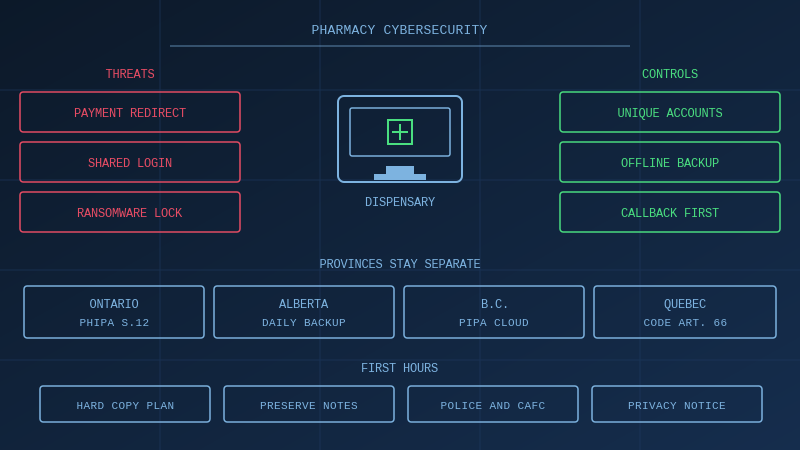
Pharmacy cybersecurity in Canada starts with a separate login for every person who can open the dispensing system, and a callback on a known number before anyone changes a payment. The Baseline Cyber Security Controls for Small and Medium Organizations V1.2 are for organizations with less than 500 employees, and they say threat actors target Canadian businesses "for their data about customers, partners and suppliers, financial information and payment systems." Each province below keeps its own statute. This is general information, not legal advice.
Why are Canadian pharmacies hit by ransomware?
The Cyber Centre's National Cyber Threat Assessment 2025-2026, based on information available as of September 20, 2024, says ransomware actors "are almost certainly opportunistic and do not target specific industries." Figure 12 lists Healthcare at 75% for the increase in Canadian ransomware incidents observed from 2022 to 2023. The assessment publishes no community-pharmacy count.
Under February 2024, the assessment says "LockBit reportedly claimed responsibility for a ransomware incident affecting Canadian pharmacy chain London Drugs, which forced the company to temporarily close some of its stores in Western Canada." CBC News, posted April 28, 2024, says London Drugs was the "victim of a cybersecurity incident" and that all 79 locations in British Columbia, Alberta, Saskatchewan and Manitoba were closed. Our review of the biggest cyber attacks in Canada states that London Drugs closed all 79 of its stores in those four provinces after a cyber attack discovered on April 28, 2024.
What does pharmacy cybersecurity in Canada require first?
Pharmacy cybersecurity in Canada, for a small dispensary, starts with controls in Baseline Controls V1.2 and one payment check from the Canadian Anti-Fraud Centre. BC.5.1 says to "implement two-factor authentication wherever possible," including "financial accounts, system administrators, cloud administration, privileged users, and senior executives." The access section says to "give all users unique individual accounts and minimize or eliminate the use of shared or shared-use accounts."
BC.7.2 says long term backups "must be stored offline," while frequent backups may stay online, and that backups are stored "in an encrypted state." BC.1.2 says to keep a written incident response plan, with contacts for external parties, stakeholders and regulators, plus "an up-to-date hard copy." The Canadian Anti-Fraud Centre says an attack "may look like an email from existing contractor providing new payment directions," and it says to use "verbal authentication for any urgent requests or changes in payment details."
BC.2.2 requires "a business process to ensure regular manual updates" when software cannot update itself. BC.3.1 says to "enable anti-malware solutions that update and scan automatically." BC.1.3 says to consider cyber insurance for incident response and recovery, or to record why you are not buying it. That sentence does not say what a policy pays.
What must an Ontario pharmacy protect under PHIPA?
In Ontario only, PHIPA section 3(1) lists, as a health information custodian, "A pharmacy within the meaning of the Drug and Pharmacies Regulation Act." Section 12(1) says a custodian shall take steps that are reasonable in the circumstances so personal health information is protected against theft, loss and unauthorized use or disclosure, and so the records are protected against unauthorized copying, modification or disposal. That duty is Ontario's. It is not the Alberta or British Columbia rule below.
The College's record guideline, revised September 2014, says pharmacies as custodians must keep technical safeguards, including "password protection, firewalls, and back-up and recovery systems" and "a digital back-up off-site or in a fire-proof or theft-resistant safe." On a mobile device, transport "only the minimum necessary data" and encrypt it. The page says to avoid email for personal health information unless the pharmacy has "a secure e-mail service offering strong encryption." Section 12(2) requires notice to the individual "at the first reasonable opportunity" if information is stolen, lost, or used or disclosed without authority. The College's reporting page says to tell the Information and Privacy Commissioner "as soon as possible after discovery" when personal health information "is lost or stolen, used, or disclosed without authority." Records stay at least 10 years from the last professional pharmacy service, or until 10 years after the patient reached or would have reached 18, whichever is longer.
What backup and login rules apply in Alberta?
For an Alberta licensed pharmacy, the Standards for the Operation of Licensed Pharmacies, effective February 1, 2025, say in Standard 5.5.1 that required data "is backed up at least once daily." A copy sits at an approved off-site location, with a secure cloud provider that stores data within Canada, or in a fire- and theft-resistant safe, with a disaster recovery plan "to restore patient data and systems as quickly as possible."
Appendix A, A1.1.1, says the system must "uniquely identify each regulated member and employee who is granted access" and "create an accurate audit trail." The College's storage page repeats the daily backup, the within-Canada cloud option, the safe, and an approved off-site location. It says the licensee "is designated as the custodian of patient health information under the Health Information Regulation." Standard 5.4.1 keeps a human patient's record for not less than 10 years after the last professional service, or two years past the age of majority, whichever is greater. Do not use that period, or the Canada-only cloud rule, outside Alberta.
What does the B.C. pharmacy college say about records?
The College of Pharmacists of British Columbia's record-keeping FAQ says the College has no cloud-storage restriction of its own. It says many community pharmacies are private-sector organizations governed by B.C.'s Personal Information Protection Act, that PIPA "does not contain restrictions on the storage of, or access to, personal information from outside Canada," and that "Many community pharmacies will fall under this category."
The same page quotes Pharmacy Operations and Drug Scheduling Act Bylaws section 23.3(1): electronic personal health information requires "the equipment, software and systems necessary for the input, storage, use, protection and retrieval of records." The College says one answer on that page "does not constitute legal advice." Do not import Alberta's Canada-only backup rule.
What does Quebec's pharmacy code of ethics require?
Article 62 of the Code de déontologie des pharmaciens, chapter P-10, r. 7, states: "Le pharmacien doit respecter le secret de tout renseignement de nature confidentielle obtenu dans l'exercice de la pharmacie." Article 66 states: "Le pharmacien doit prendre les mesures raisonnables à l'égard de ses employés et du personnel qui travaille avec lui pour que soit préservé le secret des renseignements de nature confidentielle." Both are marked D. 467-2008.
Rely on the French text. This section does not set out Law 5. A shared dispensing password is a weak match for article 66, which requires reasonable measures toward staff. The baseline unique-account line is national guidance, not a Quebec statute.
When does a PIPEDA breach report apply?
The Office of the Privacy Commissioner says PIPEDA applies to personal information "in the course of commercial activities," and that "Determining which law applies must be done on a case-by-case basis." Alberta, British Columbia and Quebec have substantially similar private-sector laws that generally apply instead of PIPEDA inside the province. PIPEDA can still apply to information transferred across borders. Ontario's PHIPA is listed as a substantially similar health information law.
Where PIPEDA applies, the OPC's breach guidance says to report a breach of security safeguards when it is reasonable to believe the breach creates a "real risk of significant harm." "Whether a breach of security safeguards affects one person or a 1,000, it will still need to be reported" if that test is met. Notice is given "as soon as feasible." Records of all breaches are kept "for two years." Do not send an Ontario PHIPA notice and call it a PIPEDA report.
What should staff check before a payment change?
The Canadian Anti-Fraud Centre says fraudsters "will infiltrate or spoof a business or individual's email account," and that an attack "may look like an email from existing contractor providing new payment directions." The page says to use "verbal authentication for any urgent requests or changes in payment details." Call a number already on file. A number inside the email is not that check.
Our guide to business email compromise states: "Criminals impersonate a real supplier your company already pays, claim the supplier changed banks, and redirect your next payment to a fraudulent account." A wholesaler or benefits payer can be that supplier. In Ontario only, avoid email for personal health information unless you have secure email with strong encryption. Our retail cybersecurity guide states that organizations should "isolate point-of-sale systems from the Internet and other areas of the corporate network with a firewall" (BC.9.6). A till on the dispensing network shortens the path from one email to card data and patient profiles.
What should a pharmacy do in the first hours?
The Ransomware playbook (ITSM.00.099) says that if you believe you are a victim of ransomware, report it to local police, the Canadian Anti-Fraud Centre, and the Cyber Centre. Its response list says "Preserve evidence and document steps taken," and it gives "disconnect devices" as one example of a mitigation. The hard copy required by BC.1.2 names who decides whether a dispensing computer stays on for urgent fills.
Our guide to how to report a cyber attack in Canada states that most businesses file through the National Cybercrime and Fraud Reporting System and contact local police, that the CAFC takes reports at 1-888-495-8501, and that the Cyber Centre can be reached at 1-833-CYBER-88 or contact@cyber.gc.ca. File the national report and the police report. In Ontario, add the section 12(2) notice and the College's report to the Information and Privacy Commissioner. Where PIPEDA applies, use the real-risk test, notice "as soon as feasible," and the two-year record. Our employee offboarding checklist states: "Access should be disabled the same day the employee departs." Change any shared password that person still knows. BC.12.3 says to remove accounts when employees no longer require them.
What can a pharmacy copy into a pre-incident checklist?
Use this national list, then add only the duties in your province's section above. Baseline Controls V1.2, for organizations with less than 500 employees, are the source of the unique-account, two-factor, offline-backup and hard-copy plan lines. The callback line is the Anti-Fraud Centre's, not a numbered baseline control. Do not copy an Ontario retention period or an Alberta cloud rule into another province.
National block
- One account per person on dispensing, email and remote access.
- Two-factor authentication on financial, administrator, cloud and remote-access accounts.
- Long-term backups offline and encrypted, and a tested restore. The backup and recovery page says to store at least one backup copy offline or offsite, disconnected from the organization's network.
- A paper plan naming police, the Anti-Fraud Centre, the Cyber Centre and your privacy office.
- A callback on a known number before any payment change, and same-day removal of a departing person's account.
Pharmacy cybersecurity in Canada depends on each province's statute and the federal baseline controls referenced above.
How prepared is your business?
Find out where you stand against Canada's 13 Baseline Cyber Security Controls. The assessment takes under 30 minutes and your answers stay in your browser.
Check Your ScoreFrequently Asked Questions
Why are Canadian pharmacies targeted?
The Canadian Centre for Cyber Security's National Cyber Threat Assessment 2025-2026, based on information available as of September 20, 2024, says ransomware actors are almost certainly opportunistic and do not target specific industries. Figure 12 lists Healthcare at 75 percent for the increase in Canadian ransomware incidents the Cyber Centre observed from 2022 to 2023. The assessment publishes no community-pharmacy count. It lists a reported LockBit claim against London Drugs under February 2024. CBC News reported that on April 28, 2024, London Drugs closed all 79 stores in British Columbia, Alberta, Saskatchewan and Manitoba after a cybersecurity incident.
What does pharmacy cybersecurity in Canada require first?
The Baseline Cyber Security Controls for Small and Medium Organizations V1.2 say to give every user a unique account, implement two-factor authentication wherever possible, store long-term backups offline, and keep a written incident response plan with an up-to-date hard copy. The Canadian Anti-Fraud Centre says to use verbal authentication before any change in payment details. Those steps are practical controls. They are not a promise that a breach will be prevented.
Which privacy statute applies to a pharmacy?
The Office of the Privacy Commissioner of Canada says determining which law applies must be done on a case-by-case basis. In Ontario, PHIPA section 3 lists a pharmacy as a health information custodian, and the Ontario College of Pharmacists says pharmacies are custodians. In Alberta, the Alberta College of Pharmacy says the licensee is the custodian under the Health Information Regulation. In British Columbia, the College of Pharmacists says many community pharmacies fall under PIPA. In Quebec, this article quotes the pharmacy code of ethics and does not set out Law 5. This is general information, not legal advice.
What should a pharmacy do in the first hours after an incident?
Use the hard-copy incident response plan. The Cyber Centre ransomware playbook ITSM.00.099 says to preserve evidence and document steps taken, and it lists disconnecting devices as one mitigation example. Report the cybercrime to local police, the Canadian Anti-Fraud Centre and the Cyber Centre. Patient-notice rules are separate and are not interchangeable. Ontario PHIPA and a PIPEDA report, where PIPEDA applies, are different duties.
Does every pharmacy file a PIPEDA breach report with the OPC?
No. The Office of the Privacy Commissioner says PIPEDA applies to personal information in the course of commercial activity, and that a substantially similar provincial law can apply instead. Where PIPEDA applies, report a breach of security safeguards to the OPC when it is reasonable to believe the breach creates a real risk of significant harm, notify affected individuals as soon as feasible, and keep records of all breaches for two years. An Ontario pharmacy's patient-health-information duties are addressed under PHIPA in this article, not under that PIPEDA test.
Cite This Page
Suggested citation:
Cybersecurity Canada (2026). Pharmacy Cybersecurity in Canada. Retrieved from https://cybersecuritycanada.ca/news/posts/pharmacy-cybersecurity-in-canada/
Permanent URL: https://cybersecuritycanada.ca/news/posts/pharmacy-cybersecurity-in-canada/ · Published November 23, 2026
Disclaimer: This article is intended for general informational purposes only and does not constitute professional cybersecurity, legal, IT, or compliance advice. While we strive to ensure accuracy, the cybersecurity landscape changes rapidly and information may become outdated. Organizations should consult with qualified cybersecurity professionals and legal counsel to assess their specific situation and develop appropriate security policies. Use of this information is at your own risk. See our Privacy Policy for more information.
Cybersecurity Canada is an independent resource and is not affiliated with, endorsed by, or connected to the Canadian Centre for Cyber Security, the Communications Security Establishment, or the Government of Canada.
How does your organization measure up?
Take our free cybersecurity assessment based on the Canadian Centre for Cyber Security's Baseline Controls. 50 questions, under 30 minutes, 100% confidential. Your answers never leave your browser.
Take the Free Assessment