Penetration Testing Canada for SMBs

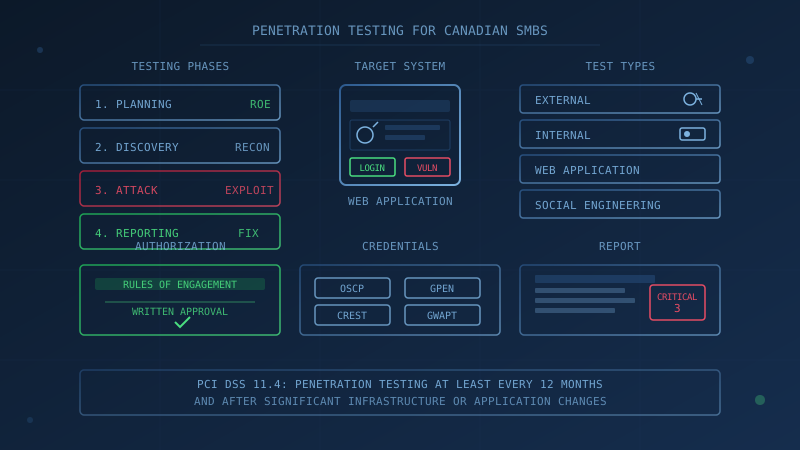
Penetration testing in Canada validates whether the vulnerabilities in your systems can actually be exploited, and it requires written authorization before any testing begins. For Canadian small businesses considering a penetration test, the questions to ask before hiring a tester are as important as the test itself: what is in scope, what methods will be used, how findings will be handled, and whether the tester has the credentials and insurance to do the work safely. This guide covers what a penetration test is, how it differs from a vulnerability scan, when standards require it, and the questions to ask any firm before signing.
What Is a Penetration Test?
A penetration test is security testing in which evaluators mimic real-world attacks to identify ways to circumvent security features. NIST SP 800-115, the Technical Guide to Information Security Testing and Assessment, defines penetration testing as "security testing in which evaluators mimic real-world attacks in an attempt to identify ways to circumvent the security features of an application, system, or network." The guide states that penetration testing "often involves issuing real attacks on real systems and data, using the same tools and techniques used by actual attackers."
The Canadian Centre for Cyber Security's guidance on penetration testing describes it as "a specialized type of assessment conducted on systems or individual system components to identify vulnerabilities that could be exploited by adversaries." The CCCS states that penetration testing "goes beyond automated vulnerability scanning and is conducted by agents and teams with demonstrable skills and experience."
How Is a Penetration Test Different From a Vulnerability Scan?
A vulnerability scan identifies known weaknesses; a penetration test validates whether those weaknesses can be exploited. NIST SP 800-115 classifies vulnerability scanning as a "target identification and analysis technique" and penetration testing as a "target vulnerability validation technique." The practical difference: a scanner produces a list of potential issues, while a penetration test confirms which ones matter.
As our guide to which cyber security service you need first explains, the right sequence for most organizations is: assessment first (to identify policy and process gaps), then vulnerability scanning (to identify technical weaknesses), then penetration testing (to validate whether those weaknesses can be exploited), then audit (to verify compliance to a third party). Running a penetration test before fixing known gaps from an assessment means paying a tester to confirm problems you could have found yourself.
What Types of Penetration Tests Exist?
Penetration tests are categorized by what is tested and from where. The CCCS states that penetration testing "can be conducted internally or externally on the hardware, software, or firmware components of a system and can exercise both physical and technical controls."
External penetration testing targets systems accessible from the internet: websites, email gateways, VPNs, cloud services, and any other internet-facing infrastructure. This simulates an attacker with no prior access to your network.
Internal penetration testing assumes the attacker already has access to the internal network, either through a compromised employee account, a successful phishing attack, or physical access. This tests whether internal controls prevent lateral movement.
Web application penetration testing focuses specifically on custom web applications. The OWASP Web Security Testing Guide provides a methodology covering 12 testing categories, from information gathering through input validation and business logic testing. Our website security guide covers what the CCCS recommends for web application security.
Wireless penetration testing evaluates the security of wireless networks, including encryption strength, access controls, and rogue access point detection.
Social engineering testing evaluates human defences through phishing simulations, pretexting, or physical access attempts. This tests whether security awareness training and policies hold up against realistic attack scenarios.
What Should a Rules of Engagement Document Include?
The rules of engagement define the boundaries of the test before it begins. The Canadian Centre for Cyber Security states that "all parties agree to the rules of engagement before commencing penetration testing scenarios" and that "organizations correlate the rules of engagement for the penetration tests with the tools, techniques, and procedures that are anticipated to be employed by adversaries."
A complete rules of engagement document should specify:
- Scope: which systems, networks, and applications are in scope and which are explicitly excluded
- Timing: when testing will occur, whether business hours or after hours, and any blackout periods
- Techniques: what methods are permitted (for example, whether denial of service testing or social engineering is in scope)
- Communication: how the tester will report critical findings discovered during testing, and who to contact in an emergency
- Data handling: how any sensitive data accessed during testing will be protected and destroyed
- Authorization chain: who has authority to approve the test and expand or limit scope if needed
Why Is Written Authorization Required?
Without written authorization, penetration testing is indistinguishable from unauthorized access. NIST SP 800-115 requires that "by signing the assessment plan, all parties acknowledge and approve of the assessment." The guide recommends that the test team leader and the organization's senior management (such as the CSO, CISO, or CIO) sign the rules of engagement, confirming they understand the test's scope and boundaries.
In Canada, the Criminal Code sections on unauthorized use of a computer (section 342.1) and mischief in relation to computer data (section 430) apply to anyone accessing a system without authorization. Your authorization letter protects both your organization and the tester by documenting that the activity was requested and within defined bounds.
What Canadian Privacy Obligations Apply?
If penetration testers can access personal information during testing, your organization's privacy obligations still apply. PIPEDA Schedule 1, Principle 4.7 states: "Personal information shall be protected by security safeguards appropriate to the sensitivity of the information." Clause 4.7.1 requires that "security safeguards shall protect personal information against loss or theft, as well as unauthorized access, disclosure, copying, use, or modification."
For a penetration test, this means:
- The tester's access to personal information should be limited to what is necessary to demonstrate the vulnerability
- Findings containing personal information should be handled with appropriate safeguards
- Your contract should specify data handling, encryption in transit and at rest, and destruction timelines
- If findings are stored outside Canada, you should understand your obligations under Canada's privacy landscape
The CCCS notes that "penetration testing may result in the exposure of information that is protected by laws or regulations, to individuals conducting the testing. Rules of engagement, contracts, or other appropriate mechanisms can be used to communicate expectations for how to protect this information."
How Often Is Penetration Testing Required?
Frequency depends on which standards apply to your organization. For organizations subject to PCI DSS (anyone accepting credit card payments), PCI DSS v4.0.1 requires internal and external penetration testing at least every 12 months and after significant infrastructure or application changes (Requirements 11.4.2 and 11.4.3). Requirement 11.4.4 requires that vulnerabilities "found during penetration testing" are corrected and that testing is repeated to verify the corrections.
For service providers under PCI DSS, segmentation controls must be tested at least every six months under Requirement 11.4.6.
For organizations not subject to PCI DSS or similar requirements, penetration testing frequency should be based on your risk assessment. Common triggers for testing include:
- Major changes to internet-facing systems
- Deployment of new web applications
- Changes to network architecture or segmentation
- After a security incident
- At least annually for organizations handling sensitive data
What Should a Penetration Test Report Contain?
A professional penetration test report is not just a list of vulnerabilities. Effective penetration testing includes pretest analysis to understand the target environment, identification of potential vulnerabilities based on that analysis, and testing designed to determine whether those vulnerabilities can be exploited.
A useful report should include:
- Executive summary: business-level description of findings and risk, written for non-technical readers
- Scope and methodology: what was tested, what techniques were used, and any limitations
- Findings with severity ratings: each vulnerability ranked by impact and exploitability, not just technical severity scores
- Evidence: screenshots, logs, or other proof that the vulnerability exists and can be exploited
- Remediation guidance: specific steps to address each finding, prioritized by risk
- Retesting scope: confirmation of what the tester will verify after remediation
What Credentials Should a Penetration Tester Have?
Professional credentials indicate that a tester has demonstrated skills through examination. Our guide to cybersecurity certifications in Canada lists OSCP as a widely respected certification for penetration testers.
OSCP (Offensive Security Certified Professional) is a hands-on certification from OffSec that "demonstrates your ability to ethically identify vulnerabilities, exploit systems, and escalate privileges." The OSCP certification requires passing a 24-hour practical exam against live systems.
CREST accreditation provides quality assurance for penetration testing companies. CREST states that accredited companies "operate with robust governance and security controls, employ highly skilled and technically competent professionals, follow proven methodologies and best practices, and uphold high standards of data security and client protection."
GIAC certifications from the SANS Institute include GPEN (Penetration Tester) and GWAPT (Web Application Penetration Tester), which are widely respected in the industry.
The Canadian Centre for Cyber Security's penetration tester role description lists required competencies including "penetration testing principles, tools, and techniques" and "advanced threat actor tools, techniques and protocols."
What Questions Should You Ask Before Hiring?
Before engaging a penetration testing firm, ask these questions:
-
What credentials do your testers hold? Look for OSCP, GPEN, GWAPT, or CREST-registered testers.
-
Are you insured? Professional liability and errors and omissions insurance protects both parties if something goes wrong during testing.
-
What is your methodology? A reputable firm should be able to explain their approach, not just promise a "pentest."
-
What is included in the report? Ask for a sample report (redacted) to evaluate quality.
-
Is retesting included? Confirm whether the engagement includes verification that remediated vulnerabilities have been fixed.
-
How will you handle sensitive data? Understand how findings will be transmitted, stored, and destroyed.
-
What is your escalation process? Know how critical findings discovered during testing will be communicated immediately, not just in the final report.
-
Can you provide references? Ask for references from similar-sized Canadian organizations.
What Is the Difference Between a Penetration Test and Red Team Exercise?
The CCCS describes red team exercises as exercises that "extend the objectives of penetration testing by examining the security and privacy posture of organizations and the capability to implement effective cyber defences." Red team exercises "simulate attempts by adversaries to compromise mission and business functions and provide a comprehensive assessment of the security and privacy posture of systems and organizations."
A penetration test typically has a defined scope and timeline. A red team exercise is broader, testing detection and response capabilities as well as technical controls, and may include social engineering, physical access attempts, and other tactics outside a typical penetration test scope.
For most Canadian small businesses, a penetration test is the appropriate starting point. Red team exercises are typically relevant for larger organizations with mature security programs that want to test their detection and response capabilities.
One Question to Ask Your IT Provider
"If we were to have a penetration test done, what systems would be in scope, and when was the last time any of our internet-facing systems were tested?"
That conversation will reveal whether your provider has thought about this, whether you know what is internet-facing, and whether testing has ever been done. If the answer is unclear, that is information worth having before you hire a tester.
Assess Your Security Posture First
Before engaging a penetration testing firm, understand where your organization stands. Our free cybersecurity assessment evaluates your practices against the Canadian Centre for Cyber Security's 13 Baseline Control areas. The assessment covers 50 questions, takes under 30 minutes, is based on the CCCS baseline controls, and your answers stay in your browser. Progress is saved locally for 48 hours. No signup is required.
The assessment is not a penetration test or vulnerability scan. It helps you understand which control areas need attention, so you can prioritize remediation before paying for external testing. A penetration test is most valuable after you have addressed known gaps, not as a way to discover them.
How prepared is your business?
Find out where you stand against Canada's 13 Baseline Cyber Security Controls. The assessment takes under 30 minutes and your answers stay in your browser.
Check Your ScoreFrequently Asked Questions
What is penetration testing?
Penetration testing is security testing in which evaluators mimic real-world attacks to identify methods for circumventing the security features of an application, system, or network. According to NIST SP 800-115, penetration testing often involves issuing real attacks on real systems and data, using the same tools and techniques used by actual attackers. It is a validation technique, not an identification technique.
How is a penetration test different from a vulnerability scan?
A vulnerability scan is an automated technique that identifies known weaknesses by matching system attributes against vulnerability databases. A penetration test is hands-on testing where evaluators attempt to exploit those vulnerabilities. NIST SP 800-115 describes vulnerability scanning as an identification technique and penetration testing as a target vulnerability validation technique.
How often is penetration testing required?
For organizations subject to PCI DSS, Requirement 11.4 of PCI DSS v4.0.1 requires internal and external penetration testing at least once every 12 months and after any significant infrastructure or application upgrade or change. For organizations not subject to specific compliance requirements, frequency depends on risk assessment and the rate of change in your environment.
What credentials should a penetration tester have?
The OSCP (Offensive Security Certified Professional) from OffSec demonstrates your ability to ethically identify vulnerabilities, exploit systems, and escalate privileges. CREST offers accreditation for penetration testing companies and certifications for individual testers. GIAC offers GPEN (Penetration Tester) and GWAPT (Web Application Penetration Tester) certifications.
What is a rules of engagement document for penetration testing?
The rules of engagement define the scope, techniques, timing, and constraints of the test before it begins. The Canadian Centre for Cyber Security states that all parties should agree to the rules of engagement before commencing penetration testing scenarios, and that organizations should correlate those rules with the tools, techniques, and procedures anticipated to be employed by adversaries.
Cite This Page
Suggested citation:
Cybersecurity Canada (2026). Penetration Testing Canada for SMBs. Retrieved from https://cybersecuritycanada.ca/news/posts/penetration-testing-canada-for-smbs/
Permanent URL: https://cybersecuritycanada.ca/news/posts/penetration-testing-canada-for-smbs/ · Published November 4, 2026
Disclaimer: This article is intended for general informational purposes only and does not constitute professional cybersecurity, legal, IT, or compliance advice. While we strive to ensure accuracy, the cybersecurity landscape changes rapidly and information may become outdated. Organizations should consult with qualified cybersecurity professionals and legal counsel to assess their specific situation and develop appropriate security policies. Use of this information is at your own risk. See our Privacy Policy for more information.
Cybersecurity Canada is an independent resource and is not affiliated with, endorsed by, or connected to the Canadian Centre for Cyber Security, the Communications Security Establishment, or the Government of Canada.
How does your organization measure up?
Take our free cybersecurity assessment based on the Canadian Centre for Cyber Security's Baseline Controls. 50 questions, under 30 minutes, 100% confidential. Your answers never leave your browser.
Take the Free Assessment