Cybersecurity Certifications in Canada: CyberSecure Canada and the Professional Credentials That Matter
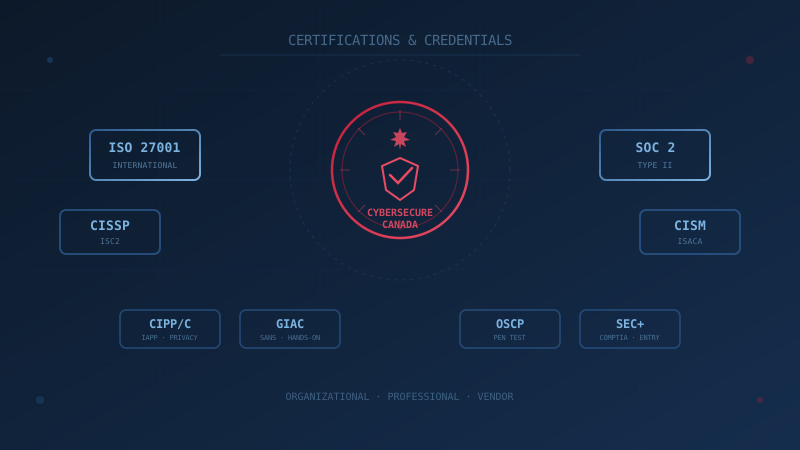
Cybersecurity certifications in Canada fall into two distinct categories, and they are often confused. Organizational certifications tell customers and regulators that your business meets a defined security standard. Professional certifications tell you that a person (an employee, a contractor, an MSP technician) has a defined baseline of skills and knowledge.
Both matter. They answer different questions. This guide covers the certifications that Canadian businesses encounter most often in 2026, with a focus on what is recognized in Canada, what each certification actually verifies, and where small and medium businesses should start.
How Do You Get CyberSecure Canada Certification?
According to ISED's CyberSecure Canada information sheet, the process involves four steps:
-
Implement the 13 baseline security controls. Review and implement all 13 controls established by the Canadian Centre for Cyber Security, from incident response planning to secure cloud services. Free e-learning tools and guidance are available at Canada.ca/cybersecure.
-
Apply for certification. Once your organization has implemented the controls, submit your application at Canada.ca/cybersecure.
-
Work with an accredited certification body. A certification body accredited by the Standards Council of Canada will evaluate your implementation. They will assess your readiness, provide a cost estimate, and audit your implementation of the security controls.
-
Receive your certification mark. Once certified, the Government of Canada provides a CyberSecure Canada certification mark, valid for two years, that you can display on your website and at your place of business.
Before applying, our free cybersecurity assessment uses the same 13-control structure and can help you understand where your business stands.
Organizational Certifications: Proving Your Business Meets a Standard
CyberSecure Canada
CyberSecure Canada is the federal government's certification program for small and medium organizations, administered by Innovation, Science and Economic Development Canada (ISED) and the Standards Council of Canada. It is built directly on the Canadian Centre for Cyber Security's Baseline Cyber Security Controls.
What certification requires:
- Implement the 13 Baseline Control areas, from incident response through to portable media controls
- Undergo assessment by an accredited certification body
- Maintain the controls on an ongoing basis, with renewal every two years
Why it matters for Canadian SMBs:
- It is the only Canadian government-backed cybersecurity certification designed specifically for small and medium organizations
- It is increasingly referenced in federal and provincial procurement
- Customers and partners use it as an objective signal that baseline controls are in place
- It provides a clear roadmap (the 13 Baseline Controls) for organizations that do not know where to start
Cost and timeline vary by organization size and complexity. For most SMBs, preparing for CyberSecure Canada certification takes several months of implementation work, followed by assessment. Our free cybersecurity assessment uses the same 13-control structure and is a useful first step to understand where your business stands before engaging a certification body. For information on available government cybersecurity grants and funding, see our 2026 guide.
Cybersecurity Canada is an independent resource and is not affiliated with or endorsed by the CyberSecure Canada program or ISED.
ISO/IEC 27001
ISO/IEC 27001 is the international standard for information security management systems (ISMS). It is sector-neutral, globally recognized, and widely required by enterprise customers as a condition of doing business.
ISO 27001 certification is more rigorous (and more expensive) than CyberSecure Canada. It requires an organization to establish a formal ISMS, define a risk treatment process, implement controls from Annex A, and undergo audits by an accredited certification body. It is the baseline expectation for many Canadian technology vendors, MSPs, and service providers targeting mid-market and enterprise customers.
SOC 2
SOC 2 (System and Organization Controls 2) is an attestation report produced by a licensed CPA firm, evaluating a service organization's controls across five "trust service criteria": security, availability, processing integrity, confidentiality, and privacy.
SOC 2 Type I is a point-in-time snapshot. SOC 2 Type II is an examination over a period of time (typically 6 to 12 months) and is the version most enterprise buyers require. It is especially common among Canadian SaaS companies and cloud service providers selling to U.S. customers.
PCI DSS
If your business accepts, processes, stores, or transmits credit card information, you are subject to the Payment Card Industry Data Security Standard (PCI DSS). PCI DSS is not a government law but a contractual requirement imposed by the card brands (Visa, Mastercard, American Express, Discover, JCB). Validation requirements scale with transaction volume, from self-assessment questionnaires for small merchants to full on-site audits for the largest.
Sector-Specific
- OSFI-regulated financial institutions: OSFI's Guideline B-13 sets expectations that are effectively certification-adjacent, with supervisory examinations rather than third-party certification
- Canadian Industrial Security Program (federal contractors): facility and personnel security clearances required for classified contracts
- ITSG-33 (federal IT systems): the CCCS's security control framework for federal government systems
Professional Certifications: Evaluating Individuals
For businesses hiring cybersecurity staff or vetting an MSP or MSSP, professional certifications are a practical signal. They are not a replacement for interviewing, checking references, and evaluating actual work, but the absence of any recognized certification on a senior security role is a legitimate concern in 2026.
The Senior and Strategic Tier
CISSP (Certified Information Systems Security Professional, ISC2)
The most widely recognized senior cybersecurity certification globally. CISSP requires a broad, manager-level understanding across eight domains (from asset security to software development security), plus five years of verified professional experience. In Canada, CISSP is the default expectation for senior security roles in most mid-to-large organizations and is frequently specified in federal government competitions.
CISM (Certified Information Security Manager, ISACA)
CISM is management-oriented, focused on information security program governance, risk management, and incident management. It is common among CISOs, security managers, and heads of compliance.
CISA (Certified Information Systems Auditor, ISACA)
CISA is the standard credential for IT auditors. If your organization is engaging an internal audit or external auditor to review cybersecurity controls, CISA is the baseline credential to look for.
CRISC (Certified in Risk and Information Systems Control, ISACA)
Focused on IT risk management and the implementation of risk-based controls. Increasingly common among risk and compliance professionals.
CISSP-ISSAP / ISSEP / ISSMP ISC2
CISSP concentrations in architecture, engineering, and management respectively. Relevant for senior specialist and principal-level roles.
The Hands-On Technical Tier
GIAC Certifications (SANS Institute)
GIAC certifications are tightly aligned with SANS training courses and are widely considered the most rigorous hands-on credentials in the industry. Most relevant to Canadian SMBs:
- GSEC (Security Essentials): practical security foundations
- GCIH (Certified Incident Handler): incident response skills
- GCFA / GNFA (Forensic Analyst / Network Forensic Analyst): digital forensics
- GPEN / GWAPT (Penetration Tester / Web Application Penetration Tester): offensive security
- GSLC (Security Leadership): for technical leaders
SANS operates in Canada, and GIAC-certified professionals are often found at Canadian MSSPs, government security teams, and mature enterprise security functions.
OSCP (Offensive Security Certified Professional)
A hands-on penetration testing certification requiring candidates to compromise a series of lab systems under time pressure. Widely respected as a working-level offensive security credential. Often required for Canadian penetration testing firms.
CEH (Certified Ethical Hacker, EC-Council)
CEH is more theoretical than OSCP and less hands-on than GIAC certifications, but remains commonly referenced in job postings and contract requirements, particularly in government.
The Entry and Foundational Tier
CompTIA Security+ / Network+ / A+
CompTIA's certifications are vendor-neutral and form a common baseline for early-career IT and security professionals. Security+ is frequently required for entry-level roles, and the U.S. Department of Defense Cyber Workforce Framework (DoD 8140, which replaced the earlier 8570 directive) recognizes Security+ as a baseline credential.
CompTIA CySA+, PenTest+, SecurityX (formerly CASP+)
Intermediate-to-advanced CompTIA credentials that bridge into the professional tier.
ISC2 CC (Certified in Cybersecurity)
A newer entry-level credential from ISC2, designed to be a stepping-stone toward CISSP.
Vendor and Platform Certifications
Cloud and platform certifications matter significantly for businesses running on Microsoft, Google, or AWS:
- Microsoft Certified: Security Operations Analyst Associate (SC-200): hands-on Microsoft 365 and Azure security
- Microsoft Certified: Cybersecurity Architect Expert (SC-100): senior architecture role
- Microsoft Identity and Access Administrator (SC-300): identity-focused
- Google Professional Cloud Security Engineer: Google Cloud Platform security
- AWS Certified Security, Specialty: AWS-specific security knowledge
- Cisco CCNP Security: network security with Cisco stack
- Palo Alto PCNSE: firewall and next-generation security
For a Canadian SMB running on Microsoft 365, an MSP engineer with SC-200 or SC-300 is meaningfully more capable in your environment than one without. Ask.
Privacy-Specific Certifications
IAPP (International Association of Privacy Professionals)
- CIPP/C (Canadian Privacy): the only privacy certification specific to Canadian privacy law (PIPEDA, provincial statutes)
- CIPP/E (European Privacy): GDPR focus
- CIPM (Certified Information Privacy Manager): privacy program management
- CIPT (Certified Information Privacy Technologist): technical privacy
For Canadian businesses with material privacy obligations under PIPEDA or Quebec Law 25, CIPP/C is the most directly relevant credential for a Privacy Officer.
Canadian Training and Academic Programs
Several Canadian institutions offer recognized cybersecurity degrees and professional programs:
- Concordia University (Montreal): Institute for Information Systems Engineering, undergraduate and graduate cybersecurity programs
- University of New Brunswick: Canadian Institute for Cybersecurity, a leading research institute
- University of Waterloo: Cybersecurity and Privacy Institute, research and graduate programs
- Rogers Cybersecure Catalyst (Toronto Metropolitan University): professional training and women-in-cybersecurity programs
- BCIT (Burnaby): applied cybersecurity programs widely recognized by BC employers
- Seneca Polytechnic, SAIT, NAIT, and other colleges: applied cybersecurity diplomas and degrees
The Information and Communications Technology Council (ICTC) runs CyberTitan through the Cyber Foundations initiative, with support from the Communications Security Establishment and other partners, as part of broader efforts to build the Canadian cybersecurity workforce.
What Matters Most for Canadian SMBs
If you are not buying enterprise software and not hiring a cybersecurity team, most of the certifications above are not directly relevant to you. The three that typically do matter:
- CyberSecure Canada: for demonstrating to customers, regulators, and insurers that your organization has implemented the Canadian Baseline Controls
- CISSP, CISM, or GIAC (GCIH/GSEC): to look for when vetting a cybersecurity provider or MSP's senior staff
- CIPP/C: if your business has meaningful privacy obligations and is designating a Privacy Officer
Everything else is context-dependent. A certification is a signal, not a guarantee. Ask what the person or organization has actually done, not just what they hold.
Starting Point: Know Where You Stand
Before pursuing a certification (organizational or individual), it is worth knowing where your business stands today. The Canadian Centre for Cyber Security's Baseline Controls are the most practical starting framework, and our free cybersecurity assessment evaluates your organization across all 13 Baseline Control areas in under 30 minutes. The results map directly to CyberSecure Canada and serve as a realistic pre-check before engaging a certification body.
For deeper context on the 13 Baseline Controls and how they fit into Canadian cybersecurity law and practice, see our guides on understanding Canada's Baseline Cyber Security Controls and the cybersecurity laws that apply to Canadian businesses in 2026.
Frequently Asked Questions
Is CyberSecure Canada worth pursuing for a small business?
For most Canadian SMBs, yes, particularly those selling to government, regulated industries, or enterprise customers that ask about security posture. It provides an independent, government-recognized validation of the 13 Baseline Controls and is less costly and less complex than ISO 27001. If your customers are not asking about security certifications today, a practical first step is to implement the Baseline Controls internally; certification can follow when the business case emerges.
What is the difference between CyberSecure Canada and ISO 27001?
CyberSecure Canada is built specifically for small and medium Canadian organizations and is based on a defined set of 13 baseline controls. ISO 27001 is an international, sector-neutral standard that requires a full information security management system (ISMS) and a risk-based approach to control selection. ISO 27001 is more flexible and more rigorous, typically required by enterprise and international customers. CyberSecure Canada is more prescriptive and more approachable for SMBs. Many organizations start with CyberSecure Canada and progress to ISO 27001 as they grow.
Which cybersecurity certification should I hire for?
It depends on the role. For a strategic or managerial security hire: CISSP, CISM, or CIPP/C (for privacy-focused roles). For a hands-on analyst or incident responder: GCIH, GSEC, Security+, or SC-200 (for Microsoft environments). For a penetration tester: OSCP. For an auditor: CISA. Certifications are a starting filter; actual interview, reference, and practical assessment matter more.
Are Canadian cybersecurity certifications recognized internationally?
Most professional certifications relevant in Canada (CISSP, CISM, CISA, GIAC, OSCP, CompTIA, CIPP) are internationally recognized. CyberSecure Canada is a Canadian government program and is not directly recognized outside Canada, but it maps closely to international baseline frameworks (CIS Controls, NIST CSF) and provides equivalent evidence of security posture for most purposes.
Does my MSP need to be certified?
There is no Canadian law requiring MSPs to hold a specific certification, but there are strong reasons to prefer certified providers. An MSP holding ISO 27001 or SOC 2 Type II has subjected its own operations to independent audit, which is particularly relevant because an MSP is a high-value target whose security posture directly affects yours. Asking about your MSP's certifications, and the credentials of the senior staff who will actually manage your environment, is part of responsible vendor and third-party risk management.
How prepared is your business?
Find out where you stand against Canada's 13 Baseline Cyber Security Controls. The assessment takes under 30 minutes and your answers stay in your browser.
Check Your ScoreCite This Page
Suggested citation:
Cybersecurity Canada (2026). Cybersecurity Certifications in Canada: CyberSecure Canada and the Professional Credentials That Matter. Retrieved from https://cybersecuritycanada.ca/news/posts/cybersecurity-certifications-in-canada-cybersecure-canada-and-professional-credentials/
Permanent URL: https://cybersecuritycanada.ca/news/posts/cybersecurity-certifications-in-canada-cybersecure-canada-and-professional-credentials/ · Last updated October 11, 2026
Disclaimer: This article is intended for general informational purposes only and does not constitute professional cybersecurity, legal, IT, or compliance advice. While we strive to ensure accuracy, the cybersecurity landscape changes rapidly and information may become outdated. Organizations should consult with qualified cybersecurity professionals and legal counsel to assess their specific situation and develop appropriate security policies. Use of this information is at your own risk. See our Privacy Policy for more information.
Cybersecurity Canada is an independent resource and is not affiliated with, endorsed by, or connected to the Canadian Centre for Cyber Security, the Communications Security Establishment, or the Government of Canada.
How does your organization measure up?
Take our free cybersecurity assessment based on the Canadian Centre for Cyber Security's Baseline Controls. 50 questions, under 30 minutes, 100% confidential. Your answers never leave your browser.
Take the Free Assessment