Cyber Security Audit Canada: Which Service You Need First

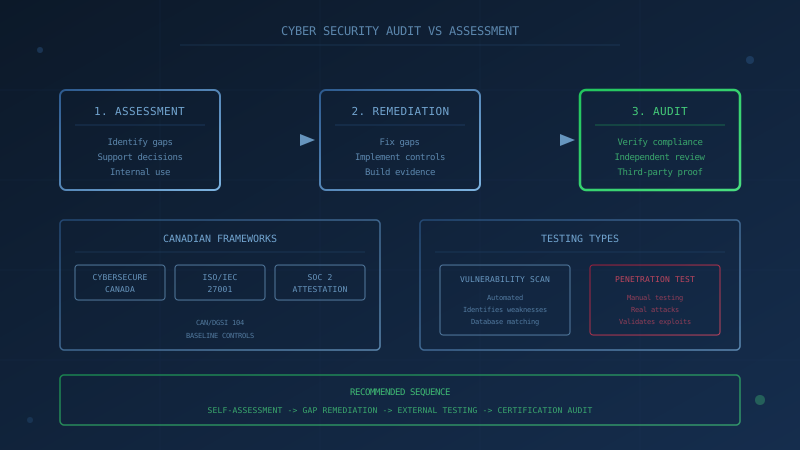
A cyber security audit in Canada is an independent review that verifies whether your organization meets a defined standard or contractual requirement, while an assessment identifies gaps in your security posture to support decision-making. Most Canadian small businesses should complete an assessment first, fix the gaps they find, then pursue an audit or certification only when a client, insurer, or regulation requires documented proof. Paying an auditor to confirm what you already know is broken wastes money that could go toward fixing it.
What Is a Cybersecurity Audit vs a Cybersecurity Assessment?
The NIST glossary defines an audit as a "systematic, independent and documented process for obtaining audit evidence and evaluating it objectively to determine the extent to which the audit criteria are fulfilled." The same glossary defines an assessment as an "evidence-based evaluation and judgement on the nature, characteristics, quality, effectiveness, intent, impact, or capabilities" that is "generally informational in nature and used to support decision making and to inform formal inspections or audits."
The practical difference for Canadian businesses:
An audit answers: "Does this organization meet the requirements of a specific standard, contract, or regulation?" The output is a formal attestation or certificate, typically used to demonstrate compliance to a third party (a customer, insurer, or regulator). Audits are conducted by independent parties against defined criteria.
An assessment answers: "Where do we currently stand, and what should we improve?" The output is a gap analysis or risk profile, used internally to guide security investments. Assessments can be self-directed or conducted by consultants, and they inform the decisions that precede an audit.
For Canadian small businesses, the Canadian Centre for Cyber Security's Baseline Controls provide a practical framework for assessment against the 13 control areas.
What Is the Difference Between a Vulnerability Scan and a Penetration Test?
A vulnerability scan is an automated technique that identifies known weaknesses, while a penetration test is hands-on security testing that validates whether those weaknesses can actually be exploited. Both differ from a cybersecurity assessment (which evaluates policies, processes, and controls against a framework) and from an audit (which verifies compliance for a third party). Understanding where each fits helps you spend money in the right order.
Vulnerability scanning is, according to NIST SP 800-115, "a technique used to identify hosts/host attributes and associated vulnerabilities." Scanners match your systems against databases of known vulnerabilities to find outdated software, missing patches, and misconfigurations. This is largely automated and identifies potential weaknesses without exploiting them.
Penetration testing is, according to NIST SP 800-115, "security testing in which evaluators mimic real-world attacks in an attempt to identify ways to circumvent the security features of an application, system, or network." Penetration testing "often involves issuing real attacks on real systems and data, using the same tools and techniques used by actual attackers." This is hands-on work that validates whether vulnerabilities can actually be exploited.
The Canadian Centre for Cyber Security's ITSG-33 glossary defines a vulnerability assessment as "a determination of the existence of information system vulnerabilities."
Where each fits in the sequence:
- Assessment: Identify gaps against a framework (policy, process, and technical controls)
- Vulnerability scan: Identify technical weaknesses in systems
- Penetration test: Validate whether those weaknesses can be exploited
- Audit: Verify that controls meet a defined standard for a third party
Running a penetration test before fixing known gaps from an assessment is like hiring an inspector before finishing construction.
What Frameworks Do Canadian Small Businesses Get Audited Against?
When a client, insurer, or contract asks a Canadian business to "get audited," they typically mean one of these frameworks: CyberSecure Canada certification (the federal program for SMEs), ISO/IEC 27001 (the international ISMS standard), or a SOC 2 attestation report (for service organizations). Some face only contract or insurer questionnaires rather than formal certification. The right choice depends on what your customer or regulator actually requires.
CyberSecure Canada Certification
CyberSecure Canada is the federal government's certification program for small and medium organizations. As of March 31, 2023, ISED is no longer the program authority and directs readers to the Standards Council of Canada. SCC accredits the certification bodies that assess organizations.
The underlying standard is CAN/DGSI 104, Baseline Cyber Security Controls for Small and Medium Organizations. This standard defines controls that map to the Canadian Centre for Cyber Security's Baseline Cyber Security Controls guidance.
Certification requires implementing the baseline controls and undergoing assessment by an accredited certification body. Certification is valid for two years.
For a detailed overview of the program and how it relates to professional credentials, see our guide to cybersecurity certifications in Canada.
ISO/IEC 27001
ISO/IEC 27001 is the international standard for information security management systems (ISMS). It requires organizations to establish a formal management system, define a risk treatment process, and implement controls from its Annex A. Certification is conducted by accredited certification bodies.
ISO 27001 is more comprehensive (and more expensive to implement) than CyberSecure Canada. As our cybersecurity certifications guide notes, it is the baseline expectation for many Canadian technology vendors, MSPs, and service providers targeting mid-market and enterprise customers.
SOC 2 Attestation
SOC 2 (System and Organization Controls 2) is not a certification. It is an attestation report produced by a licensed CPA firm examining a service organization's controls. CPA Canada's SOC 2 guide describes SOC 2 as "a practical resource for practitioners engaged to report on service organization's controls relevant to security, availability, processing integrity, confidentiality or privacy."
A SOC 2 Type I report is a point-in-time snapshot of control design. A SOC 2 Type II report examines control effectiveness over a period. SOC 2 reports are based on the AICPA's Trust Services Criteria.
Contract and Insurer Questionnaires
Many Canadian businesses never pursue formal certification but still face audit-like requirements through customer security questionnaires or cyber insurance applications. These questionnaires can ask about the same controls covered by the Baseline Controls: incident response planning, multi-factor authentication, backup procedures, and patch management.
Completing a structured assessment prepares you to answer these questionnaires accurately and identify gaps before an insurer or customer finds them.
Which Service Should a Canadian Small Business Choose First?
The right sequence depends on what is driving the need. If you have no baseline yet, start with an assessment. If a client or insurer demands proof, determine exactly what they require. If you have recently made major changes, re-assess before assuming existing controls still apply. If you handle regulated data, identify the specific compliance requirements first. In most cases, assessment comes before audit.
Scenario 1: No Baseline Yet
If your organization has not systematically evaluated its security posture, start with an assessment against the Canadian Centre for Cyber Security's Baseline Controls. Fix the highest-priority gaps before spending money on external services.
Scenario 2: Client or Insurer Demands Proof
If a customer or insurer is asking for documented evidence of your security posture, determine exactly what they require. Some accept a completed security questionnaire. Others want specific certifications (CyberSecure Canada, ISO 27001) or attestation reports (SOC 2). Match your investment to the actual requirement.
If certification is required, start with a gap assessment against that standard, remediate the gaps, then engage a certification body.
Scenario 3: After a Major Change
After significant changes (new systems, acquisitions, leadership transitions, or a security incident), re-assess before assuming existing controls still apply. An assessment identifies what changed and what new gaps exist. An audit at this stage would only document the current (possibly degraded) state.
Scenario 4: Regulated Data or Industry Requirements
Some industries have specific security requirements. PIPEDA requires organizations to protect personal information with safeguards appropriate to its sensitivity. Bill C-8, which received Royal Assent on June 15, 2026, imposes requirements on federally regulated critical infrastructure operators.
If your business handles regulated data, identify the specific compliance requirements first, then assess and remediate against those requirements before pursuing certification.
Why Should an Assessment Come Before an Audit?
An assessment identifies what is broken. Remediation fixes it. An audit verifies it is fixed. Running that sequence backward means paying an auditor to document problems you could have found yourself. The auditor's report becomes a list of failures rather than a certificate of compliance, adding cost and delay.
The practical approach:
- Complete a self-assessment against the relevant framework (Baseline Controls, ISO 27001 requirements, SOC 2 criteria)
- Prioritize and remediate the gaps
- Re-assess to confirm improvements
- Engage an auditor or certification body only when you expect to pass
For organizations preparing for CyberSecure Canada certification, the process is to implement the controls, then apply and undergo assessment by an accredited certification body.
Who Should Conduct Your Assessment, Pen Test, or Audit?
Different services require different providers, and using the wrong one wastes money. A self-assessment can be done internally or with a structured tool. Vulnerability scanning is often included by managed service providers. Penetration testing requires qualified testers. Certification audits can only be conducted by accredited bodies or licensed CPA firms. Matching the provider to the service ensures you get usable results.
- Self-assessment: Use a structured tool or work through the Baseline Controls guidance yourself
- Vulnerability scanning: Many managed service providers include this, or use commercial scanning tools
- Penetration testing: Engage a firm with qualified testers; our cybersecurity certifications guide notes that OSCP is often required for Canadian penetration testing firms
- Gap assessment against a standard: Consultants familiar with the target framework
- Certification audit: Only an accredited certification body (for CyberSecure Canada or ISO 27001) or a licensed CPA firm (for SOC 2)
For guidance on evaluating providers, see our guide to how to choose a cybersecurity provider for your Canadian small business.
What Should You Ask Your IT Provider This Week?
The free cybersecurity assessment evaluates your organization against all 13 Baseline Control areas: 50 questions, under 30 minutes, based on the CCCS baseline controls, and your answers stay in your browser. It requires no signup, collects no data, and gives you a clear picture of where your gaps are. That picture is the starting point for deciding whether you need remediation, external testing, or certification.
One question to ask your IT lead or provider this week: which of the 13 Baseline Controls can we demonstrate evidence for if a customer or insurer asks?
How prepared is your business?
Find out where you stand against Canada's 13 Baseline Cyber Security Controls. The assessment takes under 30 minutes and your answers stay in your browser.
Check Your ScoreFrequently Asked Questions
What is the difference between a cybersecurity audit and a cybersecurity assessment?
A cybersecurity audit is an independent, systematic review of evidence to determine whether your organization meets a defined standard or requirement. An assessment is an evidence-based evaluation that identifies gaps and supports decision-making, generally informational in nature and used to inform formal inspections or audits. An assessment tells you where you stand; an audit tells a third party whether you meet their criteria.
Should a small business get a cybersecurity audit or assessment first?
Most small businesses should start with an assessment. An assessment identifies gaps in your security posture against a framework like the Canadian Centre for Cyber Security's Baseline Controls. Fix the known gaps before paying for an audit. Implement the controls, then apply for certification and undergo assessment by an accredited certification body.
What is the CyberSecure Canada certification program?
CyberSecure Canada is a voluntary certification program for Canadian small and medium organizations. As of March 31, 2023, ISED is no longer the program authority; the Standards Council of Canada now accredits certification bodies. Organizations implement the baseline controls defined in CAN/DGSI 104 (Baseline Cyber Security Controls for Small and Medium Organizations) and undergo assessment by an accredited certification body. Certification is valid for two years.
What is the difference between a vulnerability scan and a penetration test?
A vulnerability scan is an automated technique that identifies known weaknesses by matching system attributes against vulnerability databases. A penetration test is hands-on security testing where testers attempt to circumvent security controls using real attack techniques. NIST SP 800-115 describes vulnerability scanning as an identification technique and penetration testing as a validation technique that actively exploits vulnerabilities.
Do Canadian businesses need SOC 2?
SOC 2 is not a certification; it is an attestation report produced by a licensed CPA firm examining a service organization's controls. Canadian businesses that provide services to other organizations, especially those handling client data or operating cloud services, may need a SOC 2 report to satisfy customer or contractual requirements. CPA Canada publishes a SOC 2 guide adapted from the AICPA version for Canadian practitioners.
Cite This Page
Suggested citation:
Cybersecurity Canada (2026). Cyber Security Audit Canada: Which Service You Need First. Retrieved from https://cybersecuritycanada.ca/news/posts/cyber-security-audit-canada-which-service-you-need-first/
Permanent URL: https://cybersecuritycanada.ca/news/posts/cyber-security-audit-canada-which-service-you-need-first/ · Published October 25, 2026
Disclaimer: This article is intended for general informational purposes only and does not constitute professional cybersecurity, legal, IT, or compliance advice. While we strive to ensure accuracy, the cybersecurity landscape changes rapidly and information may become outdated. Organizations should consult with qualified cybersecurity professionals and legal counsel to assess their specific situation and develop appropriate security policies. Use of this information is at your own risk. See our Privacy Policy for more information.
Cybersecurity Canada is an independent resource and is not affiliated with, endorsed by, or connected to the Canadian Centre for Cyber Security, the Communications Security Establishment, or the Government of Canada.
How does your organization measure up?
Take our free cybersecurity assessment based on the Canadian Centre for Cyber Security's Baseline Controls. 50 questions, under 30 minutes, 100% confidential. Your answers never leave your browser.
Take the Free Assessment