Manufacturing Cybersecurity in Canada

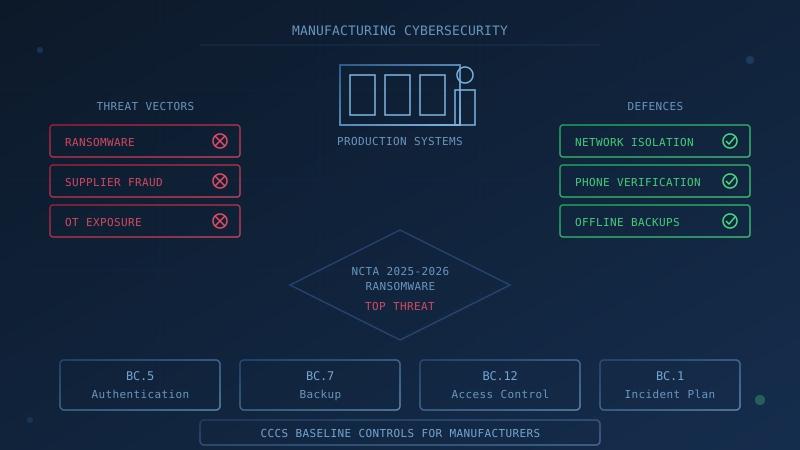
Manufacturing cybersecurity in Canada means protecting production systems, supplier relationships and intellectual property from the ransomware and payment fraud that increasingly target the sector. The Canadian Centre for Cyber Security's National Cyber Threat Assessment 2025-2026 states that "ransomware is the top cybercrime threat facing Canada's critical infrastructure." The assessment notes that Canadian ransomware incidents known to the Cyber Centre have grown, on average, 26% year over year since 2021, with 2024 figures based on a projection from the first six months of that year. For a small or mid-sized manufacturer, an attack that encrypts production data or halts a line creates immediate pressure to pay. This guide covers why manufacturers are targeted, what the Canadian Centre for Cyber Security's Baseline Controls recommend, and which practical steps matter most. This is informational context (not legal advice).
Why Are Manufacturers Targeted by Cybercriminals?
Manufacturers face a combination of factors that make them attractive targets for ransomware operators and fraud schemes. Three patterns stand out.
Downtime Pressure and Ransomware: A manufacturer that cannot access production schedules, inventory systems or design files cannot ship. That urgency creates pressure to pay ransoms that might be resisted in other industries. The CCCS National Cyber Threat Assessment 2025-2026 states that "ransomware directly disrupts critical infrastructure entities' ability to deliver critical services." For a plant with customer delivery commitments and just-in-time supply chains, even a few days offline can cascade into contract penalties and lost accounts.
Connected Production Equipment: Many manufacturers now connect industrial equipment to networks for monitoring, scheduling and remote diagnostics. The CCCS guidance Protect your operational technology (ITSAP.00.051) notes that "OT systems are becoming more connected to IT networks and potentially the internet, increasing the likelihood of cyber related attacks." If production equipment shares a network with office systems, ransomware that enters through a phishing email can reach the shop floor.
Supplier Payment Fraud: Manufacturers work with many suppliers and subcontractors, exchanging invoices and payment instructions regularly. The Canadian Anti-Fraud Centre's spear phishing guidance describes supplier/contractor swindles where "a fraudster targets businesses that have an existing relationship with a supplier, wholesaler or contractors" and sends "a spoofed email informing the business of a change in payment details." This pattern of business email compromise exploits the routine nature of vendor payments in manufacturing operations.
What Makes Operational Technology a Cybersecurity Risk?
Operational technology (OT) refers to hardware and software that monitors and controls physical processes. In a manufacturing context, this includes programmable logic controllers, SCADA systems, CNC machines and other equipment that runs production lines. The CCCS guidance ITSAP.00.051 states that "OT refers to hardware and software used to monitor and cause changes in processes that affect the physical world."
The core problem is that OT was designed for reliability and safety, not cybersecurity. The same CCCS guidance notes that "OT design prioritizes personal safety and process reliability over data security." Equipment that was never intended to be networked is now often connected for remote monitoring or maintenance by vendors. Without proper isolation, this creates pathways for attackers.
The CCCS guidance recommends several practices for OT security:
- Isolate OT from IT and the internet. The CCCS guidance states to "use firewalls, virtual private networks (VPN), and multi-factor authentication (MFA) on systems connected to your OT, including remote work access."
- Segment networks. The guidance recommends using "network zoning to separate areas with sensitive OT from remote access networks to offer isolation."
- Secure vendor remote access. If equipment vendors need remote access for maintenance, that access should require MFA and be logged and monitored.
- Test manual operations. The guidance states to "test your systems and processes in manual mode" and "be prepared under imminent threat to isolate OT components and services from the internet."
For a small manufacturer without dedicated OT security staff, the practical starting point is network separation: production equipment should not be on the same network segment as office computers and email.
How Does Payment Fraud Target Manufacturers?
Payment fraud against manufacturers typically follows the supplier impersonation pattern described by the CAFC. An attacker researches the company and its vendors, then sends an email that appears to come from a regular supplier, claims the supplier's banking details have changed, and requests that future payments go to a new account. The CAFC guidance states that fraudsters "send a spoofed email informing the business of a change in payment details" and provide "new banking information."
Manufacturing operations are particularly exposed because:
- Multiple suppliers and subcontractors means many payment relationships to impersonate
- Accounts payable staff may process vendor payment changes routinely
- Urgency around production schedules can override verification steps
- Purchasing staff may communicate primarily by email
The single most effective defence is verification through a separate channel. Before processing any request to change vendor payment details, call the supplier at a phone number you already have on file (not one provided in the email) and confirm the change is legitimate.
Which CCCS Baseline Controls Apply to Manufacturers?
The Canadian Centre for Cyber Security's Baseline Cyber Security Controls for Small and Medium Organizations provides a practical framework. Several controls directly address the threats facing manufacturers.
Multi-Factor Authentication (BC.5): BC.5.1 states that "organizations should implement two-factor authentication wherever possible" with priority on "financial accounts, system administrators, cloud administration, privileged users, and senior executives." For a manufacturer, this means MFA on email, ERP systems, accounting software and any remote access to production networks.
Backup and Encryption (BC.7): BC.7.1 states that "organizations should back up systems that contain essential business information, and ensure that recovery mechanisms effectively and efficiently restore these systems from back-ups." BC.7.2 requires that "long term backups (e.g. weekly backups) must be stored offline." For a manufacturer, backups must include production data, design files, inventory records and customer information. Tested, offline backups are the last line of defence against ransomware.
Access Control (BC.12): BC.12.3 states that "organizations should remove accounts and/or functionality when employees no longer require these for their tasks." Manufacturing operations often include shift workers, seasonal staff, contractors and equipment vendors with system access. When their engagement ends, so should their access.
Incident Response Plan (BC.1): BC.1.2 states that "organizations should have a written incident response plan that details who is responsible for handling incidents including any relevant contact information for communicating to external parties, stakeholders and regulators." For a manufacturer, the plan should address who isolates production systems, who contacts the bank if payment fraud is suspected, and how to notify customers if deliveries will be delayed. See our guide to building an incident response plan.
Do Manufacturers Face Supply Chain Certification Requirements?
Some do. The Canadian Program for Cyber Security Certification (CPCSC) is an official cyber security certification for defence suppliers in Canada, with Level 1 launched in April 2026. The PSPC page on meeting Level 1 requirements states that "Beginning in summer 2026, suppliers bidding on select defence contracts may need to obtain Level 1 certification."
Level 1 requires an annual self-assessment of 13 controls. The program applies to suppliers handling "specified information," which the same page defines as "sensitive, non-classified, government information that must be protected when handled, processed, or stored by non-Government of Canada organizations." This currently means manufacturers in the defence supply chain, not all manufacturers.
For manufacturers outside defence, customer and industry requirements may still apply. Large customers in aerospace, automotive or other regulated sectors may require suppliers to demonstrate cybersecurity practices as a condition of doing business. Implementing the CCCS Baseline Controls positions a manufacturer to respond to such requests.
Practical Checklist for Manufacturing Cybersecurity
These steps address the threats most relevant to small and mid-sized manufacturers:
- Verify supplier banking changes by phone to a number you already have on file, not one provided in the request
- Enable MFA on email, ERP and accounting systems so attackers cannot send payment instructions from inside your accounts
- Separate production networks from office IT so ransomware entering through email cannot reach shop floor equipment
- Secure remote vendor access with VPN and MFA, and log when vendors connect
- Maintain an inventory of connected equipment including production systems that may have been added to the network for monitoring
- Test backups regularly by restoring files to confirm recovery works before you need it
- Offboard departing staff and contractors promptly by removing their access to systems and facilities
What Should a Manufacturer Do After a Suspected Attack?
Time matters. If you suspect a cyber attack is underway or a payment has been misdirected:
- Isolate affected systems from the network to contain the spread, but do not power off machines unless necessary (forensic evidence in memory may be lost)
- Contact your bank immediately and request a recall of any fraudulent transfer
- Report to the Canadian Anti-Fraud Centre online at reportcyberandfraud.canada.ca or by phone at 1-888-495-8501
- File a report with local police to create a file number your bank or insurer may require
- Notify your cyber insurer as early as possible, since most policies require prompt notification
- Follow your incident response plan for next steps
For detailed reporting guidance, see our guide to how to report a cyber attack in Canada.
Assess Your Manufacturing Company's Cybersecurity
Our free cybersecurity assessment evaluates your organization against the Canadian Centre for Cyber Security's 13 Baseline Control areas. The assessment covers 50 questions, takes under 30 minutes, and is completely confidential. Progress is saved locally for 48 hours. No signup is required. The results show which control areas need attention, so you know where to focus your cybersecurity investment. The assessment is not a compliance audit or legal advice; for those questions, consult a qualified professional.
How prepared is your business?
Find out where you stand against Canada's 13 Baseline Cyber Security Controls. The assessment takes under 30 minutes and your answers stay in your browser.
Check Your ScoreFrequently Asked Questions
Why are manufacturers targeted by cybercriminals?
Manufacturers face downtime pressure that makes ransomware particularly effective, they operate connected production equipment that can be disrupted, they exchange payment details with many suppliers, and they hold valuable design files and intellectual property. The Canadian Centre for Cyber Security's National Cyber Threat Assessment 2025-2026 identifies ransomware as the top cybercrime threat facing Canada's critical infrastructure.
What is operational technology security in manufacturing?
Operational technology (OT) refers to hardware and software used to monitor and control physical processes, such as production lines and industrial equipment. The Canadian Centre for Cyber Security's guidance ITSAP.00.051 recommends isolating OT from IT networks and the internet, using firewalls and VPNs with multi-factor authentication for any remote access, and testing manual operating procedures in case systems must be disconnected.
What cybersecurity controls should a small manufacturer implement?
The Canadian Centre for Cyber Security's Baseline Controls for Small and Medium Organizations recommend multi-factor authentication wherever possible (BC.5), tested offline backups (BC.7), a written incident response plan (BC.1), and access controls that remove accounts when employees leave (BC.12). For manufacturers, this means MFA on email and ERP systems, backups that include production data, and offboarding procedures for shop floor staff and contractors.
What is the Canadian Program for Cyber Security Certification?
The Canadian Program for Cyber Security Certification (CPCSC) is an official cyber security certification for defence suppliers in Canada. Public Services and Procurement Canada introduced Level 1 in April 2026, requiring an annual self-assessment of 13 controls. Beginning in summer 2026, suppliers bidding on select defence contracts may need Level 1 certification at contract award. The program currently applies only to defence suppliers handling specified government information.
What should a manufacturer do after a suspected cyber attack?
Isolate affected systems from the network. Contact your bank immediately if a payment may have been misdirected. Report the incident to the Canadian Anti-Fraud Centre at reportcyberandfraud.canada.ca or 1-888-495-8501, and file a report with local police. If personal information was exposed and the breach creates a real risk of significant harm, organizations subject to PIPEDA must report to the Office of the Privacy Commissioner and notify affected individuals.
Cite This Page
Suggested citation:
Cybersecurity Canada (2026). Manufacturing Cybersecurity in Canada. Retrieved from https://cybersecuritycanada.ca/news/posts/manufacturing-cybersecurity-canada/
Permanent URL: https://cybersecuritycanada.ca/news/posts/manufacturing-cybersecurity-canada/ · Published November 10, 2026
Disclaimer: This article is intended for general informational purposes only and does not constitute professional cybersecurity, legal, IT, or compliance advice. While we strive to ensure accuracy, the cybersecurity landscape changes rapidly and information may become outdated. Organizations should consult with qualified cybersecurity professionals and legal counsel to assess their specific situation and develop appropriate security policies. Use of this information is at your own risk. See our Privacy Policy for more information.
Cybersecurity Canada is an independent resource and is not affiliated with, endorsed by, or connected to the Canadian Centre for Cyber Security, the Communications Security Establishment, or the Government of Canada.
How does your organization measure up?
Take our free cybersecurity assessment based on the Canadian Centre for Cyber Security's Baseline Controls. 50 questions, under 30 minutes, 100% confidential. Your answers never leave your browser.
Take the Free Assessment