Cybersecurity Services in Canada: What a Small Business Needs First
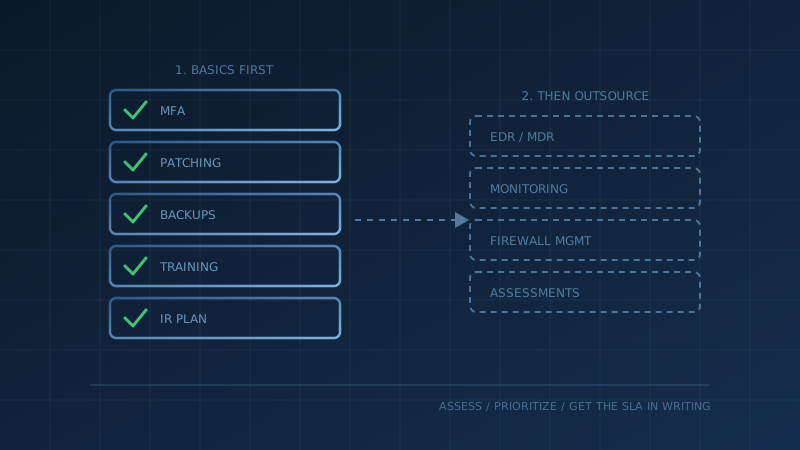
Cybersecurity services cover everything from a firewall add-on on your internet bill to a team watching your systems around the clock. For a Canadian small business, the Canadian Centre for Cyber Security's guide Choosing the best cyber security solution for your organization (ITSM.10.023) offers a useful rule of thumb: five basic controls can be implemented "with existing resources," and the more advanced controls "may be suitable for an MSSP or other third-party cyber security services to manage."
That split is the simplest way to decide what to buy. This guide walks through the main types of cybersecurity services, what each one covers, and which to put first.
What Cybersecurity Services Does a Small Business Need First?
The basics, whether you do them yourself or pay someone. ITSM.10.023 says organizations "lacking in-house IT support or have limited resources" should start with five controls:
- Strong user authentication, using two-factor or multi-factor authentication wherever possible.
- Patching operating systems and applications, with automatic updates where possible.
- Backing up and encrypting data, and testing that backups can be restored.
- Training employees on your security policies and procedures.
- An incident response plan, so you know who to call and what to do.
These overlap with the Cyber Centre's baseline cyber security controls for small and medium organizations, which aim to apply "the 80/20 rule (achieve 80% of the benefit from 20% of the effort)." Our overview of Canada's 13 baseline controls explains the full set. A service that skips these basics and sells advanced tooling is selling things out of order.
Which Services Are Worth Outsourcing?
The ones that need specialist tools or round-the-clock attention. ITSM.10.023 lists advanced controls that "require additional resources" and may suit a managed security provider, including security software such as firewalls, anti-malware and endpoint detection and response (EDR), DNS filtering, secure mobile devices, access control, perimeter defences and secure configuration.
It also lists services a managed security service provider (MSSP) can deliver:
- Managing firewalls, intrusion detection, threat defence technologies and VPNs.
- Continuous device and system monitoring, and security event management (SIEM).
- Managed detection and response (MDR): "monitoring, detecting, alerting, and managing response to potential attacks."
- Overseeing patch management and upgrades of security equipment and software.
- Security assessments, audits and vulnerability testing.
- Security awareness training.
ITSM.10.023 says organizations often choose an MSSP because they lack in-house expertise or "need security monitoring and management outside of normal operating hours."
What Is the Difference Between IT Services and Cybersecurity Services?
IT services keep systems running; cybersecurity services keep attackers out, and a contract can include one without the other. ITSM.10.023 says "an MSP offers information technology (IT) administration, whereas the MSSP takes care of cyber security," and that an MSP's network operations centre "may not provide security related monitoring as part of that service." Some MSPs do offer endpoint, network and cloud security, so it advises checking which security services your MSP actually provides.
Our guide to choosing a cybersecurity provider compares the provider types in more detail, including MSPs, MSSPs, virtual CISOs and consultants.
When Does a Consultant or Assessment Make Sense?
Before you buy anything ongoing. ITSM.10.023 says an IT or cyber security consultant can help identify which areas of security need attention and how to prioritize them, and is often hired to conduct a risk assessment, test current security measures and assess systems for vulnerabilities. It also notes that "many MSSPs will also do a preliminary assessment" to help you choose a level of service.
The guide puts a risk assessment first for a reason: it starts with questions such as whether you have a list of all assets connected to your network, who has access to them, and whether you have an incident response plan. A one-time assessment answers those questions and turns a vague shopping list into a short, ordered one.
What About Cheaper Options Like Your ISP?
They can cover part of the basics. ITSM.10.023 notes that if an MSSP is not affordable, many internet service providers "provide anti-virus, anti-malware, and firewall software to customers as an add-on service for an additional fee." It suggests asking whether they offer intrusion prevention, malware detection, and notifications of infections or intrusions.
Ask whether a person is involved. Software that blocks known threats is useful, but someone still has to investigate an alert and decide what to do next. Many Canadian businesses already pay for that expertise: Statistics Canada's 2023 Canadian Survey of Cyber Security and Cybercrime found consultant or contractor expenses were the third-largest prevention or detection cost, at $1.9 billion, after cyber security software ($2.9 billion) and employee salaries ($3.8 billion).
How Should You Compare Cybersecurity Service Providers?
Ask for specifics you can check. ITSM.10.023 lists criteria that include asking for an example service level agreement (SLA) "in terms of speed of detection, alerting, and resolution," how the provider protects your systems and its own logs, what remediation and incident response help it offers after a compromise, and "how much do the various services cost?" The Cyber Centre's guidance for consumers of managed services (ITSM.50.030) adds that an SLA should specify turnaround times, escalation processes and penalties for missing them.
Keep one point in mind throughout: outsourcing does not transfer responsibility. ITSM.10.023 says that when you engage an MSSP, "you ultimately own the risk," and ITSM.50.030 says your organization "is the data owner and is legally responsible for data security."
Where Should You Start?
Match services to the gaps you actually have, starting with the five basics. Patching is a good example of a basic that is often under-resourced; our guide to patch management best practices explains why the window between a vulnerability's disclosure and its exploitation is often measured in days.
The question to ask your IT lead or provider is: "Which of the five basic controls do we have in place today, and which of our services covers each one?" To find your gaps before comparing quotes, take our free cybersecurity assessment. It takes under 30 minutes and your answers stay in your browser.
How prepared is your business?
Find out where you stand against Canada's 13 Baseline Cyber Security Controls. The assessment takes under 30 minutes and your answers stay in your browser.
Check Your ScoreFrequently Asked Questions
What cybersecurity services does a small business need?
Start with the basics before buying advanced services. The Canadian Centre for Cyber Security says organizations lacking in-house IT support should start with five controls: strong user authentication, patching, encrypted backups, employee training and an incident response plan. Services like managed firewalls, endpoint detection and response, and 24/7 monitoring build on those and are where an outside provider often adds the most value.
What is the difference between an MSP and an MSSP?
The Canadian Centre for Cyber Security's guide ITSM.10.023 says a managed service provider (MSP) offers IT administration, such as help desk, endpoint management, backups and networks, whereas a managed security service provider (MSSP) takes care of cyber security, including security monitoring and managed detection and response. It notes that an MSP may not provide security monitoring as part of its service, and that some MSPs do offer security services.
Can my internet service provider provide cybersecurity services?
Some can, in a limited way. ITSM.10.023 notes that many internet service providers sell anti-virus, anti-malware and firewall software as paid add-ons, and suggests asking whether they offer intrusion prevention, malware detection and notifications of infections. Ask whether anyone actually reviews what those tools detect.
How should I compare cybersecurity service providers?
Ask for specifics in writing. ITSM.10.023 recommends asking for an example service level agreement covering response times, how alerts are delivered, how the provider protects your data and its own systems, what help it gives after a compromise, and how much each service costs. Remember that your business remains legally responsible for protecting its data when it outsources.
Cite This Page
Suggested citation:
Cybersecurity Canada (2026). Cybersecurity Services in Canada: What a Small Business Needs First. Retrieved from https://cybersecuritycanada.ca/news/posts/cybersecurity-services-canada-what-small-businesses-need-first/
Permanent URL: https://cybersecuritycanada.ca/news/posts/cybersecurity-services-canada-what-small-businesses-need-first/ · Published August 26, 2026
Disclaimer: This article is intended for general informational purposes only and does not constitute professional cybersecurity, legal, IT, or compliance advice. While we strive to ensure accuracy, the cybersecurity landscape changes rapidly and information may become outdated. Organizations should consult with qualified cybersecurity professionals and legal counsel to assess their specific situation and develop appropriate security policies. Use of this information is at your own risk. See our Privacy Policy for more information.
Cybersecurity Canada is an independent resource and is not affiliated with, endorsed by, or connected to the Canadian Centre for Cyber Security, the Communications Security Establishment, or the Government of Canada.
How does your organization measure up?
Take our free cybersecurity assessment based on the Canadian Centre for Cyber Security's Baseline Controls. 50 questions, under 30 minutes, 100% confidential. Your answers never leave your browser.
Take the Free Assessment