Cybersecurity for Advisors in Canada

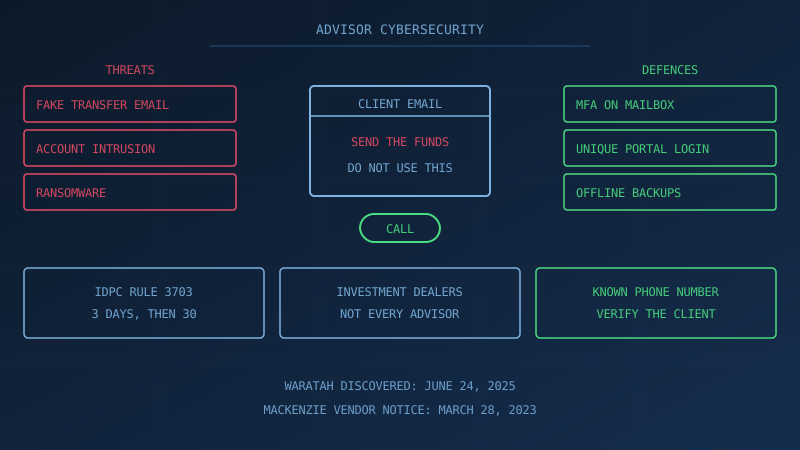
Cybersecurity for advisors in Canada means checking a withdrawal or transfer email before anyone moves a client's money. The Canadian Centre for Cyber Security's National Cyber Threat Assessment 2025-2026, based on information available as of September 20, 2024, lists a 157% increase in finance-sector ransomware incidents the Cyber Centre observed from 2022 to 2023. This is informational context (not legal or regulatory advice).
Why are Canadian advisory and investment firms targeted?
That 157% finance-sector increase is in the Cyber Centre's National Cyber Threat Assessment 2025-2026, based on information available as of September 20, 2024. The assessment says ransomware actors "are almost certainly opportunistic and do not target specific industries," and that ransomware "is almost certainly the top cybercrime threat facing Canada's critical infrastructure."
CIRO's account-intrusion page says the story is "based on actual events" and that names, locations and timelines may have changed to protect the victim's identity. The email was from someone "pretending to be his investment dealer." A sell order was placed, and a transfer went to a bank account that "did not belong to Isaac." CIRO says it "has seen a recent uptick in this kind of scam," and that intrusions from its surveillance and voluntary dealer reporting "seem to happen similar to" that story.
CSA Staff Notice 33-321, dated October 19, 2017, surveyed firms registered as investment fund managers, portfolio managers and exempt market dealers. About 51% had a cyber security incident in the year surveyed. Phishing was the most common (43% of firms). The notice says 15% of firms "had experienced an attempt to impersonate a client to transfer funds or securities of that client using fraudulent email."
The CSA's July 9, 2024 investor alert says some social-media scammers "might claim to be a registered professional or affiliated with a legitimate company or celebrity." Our guide to cybersecurity for accounting firms states a related point about client files: "Accounting and bookkeeping firms hold exactly what criminals want: sensitive personal and financial information, access to client financial systems, and involvement in financial transactions."
Which named incidents exposed Canadian client records?
On June 24, 2025, Waratah Capital Advisors Ltd. discovered unauthorized access through backup systems managed by a third-party IT provider. The firm said this was not a direct intrusion on its internal network. The Globe and Mail reported on July 22, 2025 that social insurance numbers may have been impacted. A notice filed with the Massachusetts Attorney General states the same June 24 discovery date and the same backup-system finding.
Mackenzie Investments is a separate case. The Globe and Mail reported on May 3, 2023 that Mackenzie told clients InvestorCOM informed it of the breach on March 28, and that names, addresses and social insurance numbers were revealed after a cyberattack at the end of January. A May 18, 2023 Globe and Mail follow-up says clients were notified by letter on April 27, and that hackers accessed names, addresses and SIN numbers through InvestorCOM Inc., a printing and delivery service provider that uses GoAnywhere software.
Who has to report a cybersecurity incident to CIRO?
IDPC Rule 3703 requires a Dealer Member to report a cybersecurity incident to CIRO in writing within three calendar days of discovery, and again within 30 calendar days unless CIRO agrees otherwise. CIRO's incident reporting summary says this duty applies to Investment Dealer Members. The Investment Dealer and Partially Consolidated Rules dated January 8, 2026 exclude Mutual Fund Dealer Members from the definition of Dealer Member.
The rule says a cybersecurity incident "includes any act to gain unauthorized access to, disrupt or misuse a Dealer Member's information system, or information stored on such information system, that has resulted in, or has a reasonable likelihood of resulting in" substantial harm to any person, a material impact on normal operations, invoking the business continuity or disaster recovery plan, or a legal duty to notify a government body, securities regulatory authority, or other self-regulatory organization. CIRO's compliance report of February 17, 2026 says "IDPC Rule 3703 mandates that investment dealers report any cybersecurity incidents that meet specific criteria." The filing duty is the Dealer Member's. A portfolio manager or exempt market dealer that is not an investment dealer member is outside this rule.
What does CSA Staff Notice 33-321 say about registered firms?
CSA Staff Notice 33-321, Cyber Security and Social Media, dated October 19, 2017, is staff guidance from a survey of investment fund managers, portfolio managers and exempt market dealers. It is not the CIRO three-day rule. The notice says registered firms should adopt preventative practices, staff training, and a response plan.
The notice quotes section 11.1 of National Instrument 31-103: a registered firm is required to "establish, maintain and apply policies and procedures that establish a system of controls and supervision" to "ensure compliance with securities legislation and manage the risks associated with its business in accordance with prudent business practices." It says these systems "should address the risks of cyber threats," and that "All registered firms should adopt cyber security and social media practices that include preventative practices, training to all staff and a response plan for when a cyber security incident occurs." Policies should cover "the verification of client instructions sent electronically."
What does PIPEDA require when client information is exposed?
PIPEDA Schedule 1, Principle 4.7, states: "Personal information shall be protected by security safeguards appropriate to the sensitivity of the information." Where PIPEDA applies, the Office of the Privacy Commissioner says organizations must report breaches that pose a real risk of significant harm, notify affected individuals, and keep a record of every breach.
The OPC breach guidance says "the law requires you to keep breach records of all breaches of security safeguards for two years." The Breach of Security Safeguards Regulations say an organization "must maintain a record of every breach of security safeguards for 24 months after the day on which the organization determines that the breach has occurred."
The OPC's questions and answers say PIPEDA applies to personal information in the course of a commercial activity, and that it "does not apply to employee information in provincially-regulated organizations." The same page says Quebec, British Columbia and Alberta have substantially similar private-sector legislation. Where the organization has to follow that provincial law, "PIPEDA only applies to interprovincial and international transactions." This article does not set those statutes out.
What risks show up in email, shared logins and personal devices?
CSA Staff Notice 33-321 says 15% of surveyed firms "had experienced an attempt to impersonate a client to transfer funds or securities of that client using fraudulent email." CIRO's February 17, 2026 compliance report says: "We have seen instances where employees have fallen victim to phishing attempts, allowing unauthorized access to dealer systems." The Canadian Anti-Fraud Centre says fraudsters "will infiltrate or spoof a business or individual's email account."
Our guide to business email compromise names the supplier version: "Criminals impersonate a real supplier your company already pays, claim the supplier changed banks, and redirect your next payment to a fraudulent account."
The Baseline Cyber Security Controls say organizations should "give all users unique individual accounts and minimize or eliminate the use of shared or shared-use accounts." BC.12.3 says organizations should "remove accounts and/or functionality when employees no longer require these for their tasks." Our employee offboarding checklist states that "Access should be disabled the same day the employee departs." A shared dealer-portal password cannot be removed for one person.
CSA Staff Notice 33-321 says policies should cover "use of public electronic devices or public internet connections to remotely access the firm's network and data, including to access client communications or client information." BC.8.2 says organizations should "enforce separation between work and personal data on mobile devices with access to corporate IT resources." The same CIRO report says there "has been an increase in cases involving third-party service providers affecting our dealers." BC.10.2 says organizations should "evaluate their comfort level with how their outsourced IT providers handle and access their sensitive information."
Which controls should cybersecurity for advisors in Canada put first?
The Baseline Cyber Security Controls for Small and Medium Organizations V1.2 are voluntary guidance the Cyber Centre intends for "organizations that have less than 500 employees." The callback below comes from CSA staff guidance and the Canadian Anti-Fraud Centre. It is not a line in the baseline controls.
Our guide to the baseline controls describes them as "13 cyber security practices that the Canadian Centre for Cyber Security (CCCS) recommends for small and medium organizations."
- Call the client back (BC.6). BC.6.1 says organizations should "invest in cyber security awareness and training for their employees." CSA Staff Notice 33-321 says procedures should cover "the verification of client instructions sent electronically." The Canadian Anti-Fraud Centre says to use "verbal authentication for any urgent requests or changes in payment details." Our Interac e-Transfer guide states that, before processing any change to payment details, you should "call the supplier or client at a phone number you already have on file, not one provided in the request."
- Two-factor authentication (BC.5). BC.5.1 says organizations should "implement two-factor authentication wherever possible" and require it for important accounts such as "financial accounts, system administrators, cloud administration, privileged users, and senior executives."
- One login per person (BC.12). Use the unique-account rule above, and apply BC.12.3 when someone leaves.
- Offline copies (BC.7). BC.7.2 says "Long term backups (e.g. weekly backups) must be stored offline." BC.7.1 says ensure that recovery mechanisms "effectively and efficiently restore these systems from back-ups."
- A printed plan (BC.1). BC.1.2 says keep "an up-to-date hard copy version of this plan." Our guide to building an incident response plan states that "when an incident hits, everything else depends on having a plan to follow."
- Personal phones (BC.8). Follow BC.8.2, quoted above, and BC.8.1: "decide on an ownership model for mobile devices and document the rationale and associated risks."
What should you do after a suspected incident?
If money may have moved, call the institution from a number already on file. The Canadian Anti-Fraud Centre says report to local police and to the Centre at 1-888-495-8501, or through its online reporting system. Where PIPEDA applies and there is a real risk of significant harm, use the test above. An investment dealer member uses the IDPC Rule 3703 timelines. This is general information, not legal advice.
Check the firm against the baseline controls
The free cybersecurity assessment for Canadian businesses states: "Evaluate your organization's security posture against the Canadian Centre for Cyber Security's Baseline Controls. 50 questions, under 30 minutes, completely confidential." It also states: "Your answers stay in your browser and are never transmitted. Progress is saved locally for 48 hours."
The same page says "No signup or email required," and that the information "does not constitute professional cybersecurity, legal, IT, compliance, or risk management advice."
How prepared is your business?
Find out where you stand against Canada's 13 Baseline Cyber Security Controls. The assessment takes under 30 minutes and your answers stay in your browser.
Check Your ScoreFrequently Asked Questions
Why are financial advisors and investment firms targeted in Canada?
The Canadian Centre for Cyber Security's National Cyber Threat Assessment 2025-2026, based on information available as of September 20, 2024, lists a 157% increase in finance-sector ransomware incidents the Cyber Centre observed from 2022 to 2023. The same assessment says ransomware actors are almost certainly opportunistic and do not target specific industries. CIRO states it has seen a recent uptick in investment account intrusions, including fake dealer emails that lead to unauthorized sell orders and transfers. CSA Staff Notice 33-321, dated October 19, 2017, says 15% of surveyed registered firms had seen an attempt to impersonate a client and move that client's funds or securities by fraudulent email.
Does CIRO's cybersecurity reporting rule apply to every advisor?
No. IDPC Rule 3703, in the Investment Dealer and Partially Consolidated Rules dated January 8, 2026, requires a Dealer Member to report a qualifying cybersecurity incident to CIRO in writing within three calendar days of discovery, and to file a further written report within 30 calendar days unless CIRO agrees otherwise. CIRO's incident reporting summary says this duty applies to Investment Dealer Members. Those rules exclude Mutual Fund Dealer Members from the definition of Dealer Member. A portfolio manager or exempt market dealer that is not an investment dealer member is outside this rule. This is general information, not legal advice.
What does CSA Staff Notice 33-321 say?
CSA Staff Notice 33-321, Cyber Security and Social Media, is dated October 19, 2017. Staff surveyed firms registered as investment fund managers, portfolio managers and exempt market dealers between October 11 and November 4, 2016. The notice says that under section 11.1 of National Instrument 31-103, a registered firm's compliance system should address cyber threats. It also says all registered firms should adopt cyber security and social media practices that include preventative practices, training to all staff, and a response plan. It tells firms to cover verification of client instructions sent electronically. It is staff guidance, not the CIRO three-day reporting rule.
What does PIPEDA require when client information is exposed?
PIPEDA Schedule 1, Principle 4.7, states that personal information shall be protected by security safeguards appropriate to the sensitivity of the information. Where PIPEDA applies, the Office of the Privacy Commissioner says organizations must report breaches of security safeguards that pose a real risk of significant harm, notify affected individuals, and keep records of every breach. The OPC says two years. The Breach of Security Safeguards Regulations say 24 months after the day the organization determines the breach occurred. Quebec, Alberta and British Columbia have their own private-sector privacy statutes. This article does not set those statutes out.
What should staff do with a client withdrawal email?
Do not move money from the email alone. CSA Staff Notice 33-321 says firm procedures should cover verification of client instructions sent electronically. The Canadian Anti-Fraud Centre says businesses should use verbal authentication for urgent requests or changes in payment details. Call the client at a phone number already on file, not a number in the message. The Canadian Centre for Cyber Security's baseline control BC.6.1 says organizations should invest in cyber security awareness and training for their employees. Put this callback in that training.
Cite This Page
Suggested citation:
Cybersecurity Canada (2026). Cybersecurity for Advisors in Canada. Retrieved from https://cybersecuritycanada.ca/news/posts/cybersecurity-for-advisors-in-canada/
Permanent URL: https://cybersecuritycanada.ca/news/posts/cybersecurity-for-advisors-in-canada/ · Published November 15, 2026
Disclaimer: This article is intended for general informational purposes only and does not constitute professional cybersecurity, legal, IT, or compliance advice. While we strive to ensure accuracy, the cybersecurity landscape changes rapidly and information may become outdated. Organizations should consult with qualified cybersecurity professionals and legal counsel to assess their specific situation and develop appropriate security policies. Use of this information is at your own risk. See our Privacy Policy for more information.
Cybersecurity Canada is an independent resource and is not affiliated with, endorsed by, or connected to the Canadian Centre for Cyber Security, the Communications Security Establishment, or the Government of Canada.
How does your organization measure up?
Take our free cybersecurity assessment based on the Canadian Centre for Cyber Security's Baseline Controls. 50 questions, under 30 minutes, 100% confidential. Your answers never leave your browser.
Take the Free Assessment