Burnaby School District Ransomware Attack Exposes Student and Staff Data: Lessons for Canadian Organizations
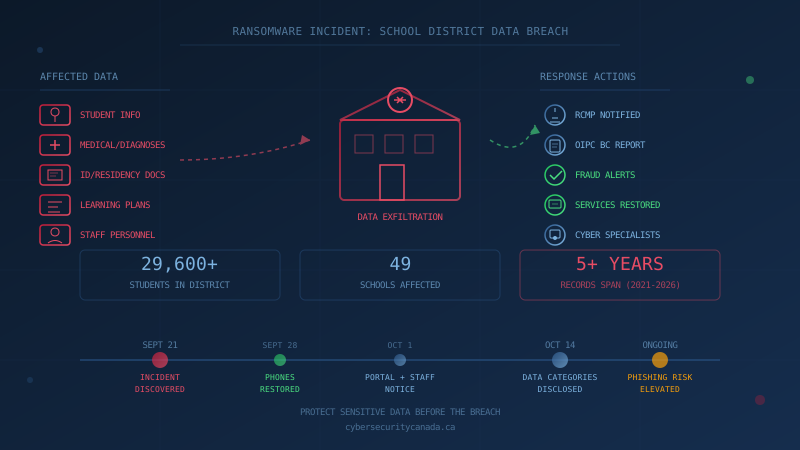
The Burnaby School District (SD41) confirmed on October 14, 2026 that a ransomware attack led to the theft of files containing personal information about students, parents, guardians, and staff. The Burnaby School District ransomware attack was discovered on September 21, according to the district's incident notice, and the district engaged cybersecurity specialists, notified the Burnaby RCMP, and reported the incident to B.C.'s Office of the Information and Privacy Commissioner.
For Canadian organizations that hold sensitive data about children, families, or employees, this incident illustrates what a breach disclosure looks like when the exposed information spans medical records, immigration documents, and other high-risk categories.
What Data Was Stolen in the Burnaby School District Attack?
According to the district's updated FAQ on October 14, 2026, attackers copied and stole files that may include multiple categories of personal information. CBC News reported on October 15 that the categories may include medical diagnoses and identifying documents. The affected data includes:
- General student, parent, and guardian information for 2024 and 2026: names, contact information, student Personal Education Numbers (PENs), birthdates, grades, school names, and Ministry designations
- Registration documentation for students who enrolled in 2024 or 2026: completed registration forms and residency documents, which may include citizenship documents, permanent resident cards, visas, leases, utility bills, or government-issued identification
- Kindergarten assessment notes from 2021 to 2025: information about student readiness and notes about needs and complexities
- Specialized learning assistance lists: records of students receiving learning support, including diagnosis information and descriptions of student needs
- Bus routing information, student intervention records, and other assessments in a limited number of cases
The Globe and Mail reported on October 15 that hackers may have obtained registration forms, kindergarten assessment notes, and detailed lists of students on specialized learning plans.
The district oversees 41 elementary schools and 8 secondary schools serving over 29,600 students, according to B.C. government figures cited by CBC's September 24 report. Staff were notified on October 1 that personnel records had been placed at risk; the district has not publicly detailed what categories of staff data were affected.
Why Is This Breach Particularly Sensitive?
Schools accumulate data that other organizations rarely hold in one place. Medical diagnoses, learning disability assessments, immigration documents, and records identifying children by name, age, and address create elevated risk when exposed.
Chester Wisniewski, director at security software company Sophos, told CBC that criminals use stolen personal data for "follow-on attacks" where phishing attempts appear more believable because they cite sensitive information: "They know your child's age, medical conditions, or different things that allow them to impersonate an official. So, you should be extra cautious."
The Canadian Anti-Fraud Centre (CAFC) warns that breach victims face elevated phishing risk: "If you have been part of a breach or a victim of identity theft, fraudsters will use the information as a tool to steal your money." A phishing email that references a child's school, medical condition, or immigration status is more likely to get opened and acted on than a generic message.
This risk is not hypothetical. The Canadian Mennonite University breach disclosed earlier this month exposed tax records going back 10 years. Our analysis of tax data retention lessons from the CMU incident explains why longer retention periods expand the number of people affected when a breach occurs. The Burnaby breach similarly spans multiple years of student and family records.
What Has the District Done in Response?
The district's incident notice outlines the following response actions:
- Immediate containment upon discovery on September 21
- Engagement of cybersecurity specialists to assist with investigation and response
- Notification to Burnaby RCMP and B.C.'s Office of the Information and Privacy Commissioner
- Restoration of services: phone service across all schools restored September 28; MyEducation family portal restored October 1
- TransUnion Fraud Alert Database registration offered to staff on October 1 and to students on October 14
The TransUnion fraud alert service notifies participating creditors when someone applies for credit in a registered individual's name, prompting additional identity verification before credit is extended. The district offered this service "in an abundance of caution," noting that not all students have high risk associated with their information.
Under B.C.'s Freedom of Information and Protection of Privacy Act (FIPPA), public bodies like school districts must notify the OIPC when a privacy breach could reasonably be expected to result in significant harm. The district has reported to the OIPC, and the Burnaby RCMP confirmed to CBC that it is actively investigating.
What Should Affected Families Do Now?
If you have a child enrolled in Burnaby Schools or have shared personal information with the district, consider the following steps:
-
Register for the TransUnion Fraud Alert Database if you have not already. The district offered this service to students on October 14. This adds a verification step when credit is applied for in your child's name.
-
Watch for phishing attempts that reference the incident. A fake email claiming to be from the school district, offering "important updates" or asking you to verify your identity, may be convincing because it references real details. The district encourages families to remain vigilant and exercise caution with any suspicious communications, including requests for personal information, unexpected emails, text messages, or phone calls.
-
Verify any communication directly. Contact the school using phone numbers or email addresses from the official district website, not from a message you received. Our phishing playbook for Canadian SMBs explains how to spot brand impersonation and what to do when a message looks suspicious.
-
Monitor accounts and credit reports. Review any accounts tied to information you shared with the district. Equifax Canada and TransUnion Canada both offer ways to check your credit report for free. If you see unfamiliar inquiries or accounts, report them immediately.
-
Report suspected fraud. If you believe your information or your child's information has been misused, report it to the Canadian Anti-Fraud Centre at 1-888-495-8501. For guidance on reporting options, see how to report a cyber attack in Canada.
What Should Canadian Organizations Learn from This Incident?
Organizations that hold sensitive personal information, especially about children, families, employees, or vulnerable populations, face elevated consequences when a breach occurs. Several lessons from the Burnaby incident apply broadly.
Sensitive Data Requires Stronger Access Controls
The breadth of data categories in this breach (medical diagnoses, immigration documents, learning assessments, personnel records) suggests records that accumulate across multiple departments and systems. The Canadian Centre for Cyber Security's 13 Baseline Controls include access control as a foundational requirement: staff should access only the records they need for their role, and systems should log who accessed what and when.
Breach Disclosure Creates Phishing Risk
Every public breach notice tells attackers what data may be available and who is expecting contact. Organizations should proactively warn affected individuals what a legitimate communication will and will not ask for. The Burnaby district's notice does this, encouraging the community "to remain vigilant and exercise caution in the event of any suspicious communications, including requests for personal information, unexpected emails, text messages, or phone calls."
Incident Response Readiness Shortens the Timeline
The district detected the incident on September 21, restored phone service by September 28, and restored the student portal by October 1. Full disclosure of affected data categories came on October 14. This timeline reflects an active response, but the gap between detection and full disclosure underscores the complexity of determining what was accessed.
An incident response plan prepared in advance reduces uncertainty and speeds the process. The plan should name who determines whether a privacy breach meets the notification threshold, who coordinates with law enforcement and regulators, and who communicates with affected individuals.
Provincial Public Bodies Face OIPC Oversight
School districts in British Columbia are subject to FIPPA, not PIPEDA. The B.C. Office of the Information and Privacy Commissioner oversees breach notification and investigation for public bodies. Organizations in other provinces should understand which privacy regime applies to them and what notification obligations they face.
One Question to Ask Your Team This Week
If your organization holds sensitive records about children, families, or employees (medical information, immigration documents, financial records, or personnel files), ask: "If our systems were compromised tomorrow, do we know which data categories exist, where they are stored, and who has access?"
If the answer is unclear, that is a starting point. Our free cybersecurity assessment evaluates your organization against all 13 Baseline Controls, including access control and incident response planning. It runs in your browser, collects no data, and gives you a prioritized view of where your security posture needs attention.
The Burnaby School District incident is a reminder that organizations holding sensitive data about children and families face consequences that extend far beyond system downtime. The time to prepare is before the breach, not after.
How prepared is your business?
Find out where you stand against Canada's 13 Baseline Cyber Security Controls. The assessment takes under 30 minutes and your answers stay in your browser.
Check Your ScoreFrequently Asked Questions
What happened in the Burnaby School District ransomware attack?
On September 21, 2026, Burnaby School District (SD41) discovered a ransomware attack on its systems. The district confirmed on October 14 that attackers copied and stole files containing personal information about students, parents, guardians, and staff. Affected data may include names, contact information, birthdates, Personal Education Numbers, registration documents, kindergarten assessments, specialized learning plans with medical diagnoses, and personnel records.
Who is affected by the Burnaby School District data breach?
The breach may affect students, parents, and guardians whose information was in district systems for 2024 and 2026, along with students who enrolled in either year. Staff members were notified separately on October 1 that personnel records were placed at risk. The district oversees 49 schools serving over 29,600 students, according to B.C. government figures cited by CBC.
What should families do if their child attends Burnaby Schools?
Register for the TransUnion Fraud Alert Database offered by the district on October 14. Watch for phishing attempts that reference the incident or your child's information. Monitor accounts for unusual activity. Do not respond to unsolicited messages asking for personal or financial information. Contact the school district directly using published contact information rather than clicking links in emails or texts.
Why do school data breaches pose special risks?
Schools hold sensitive categories of information that other organizations rarely have: medical diagnoses, specialized learning plans, immigration or residency documentation, and records about children. Attackers can use this data for identity fraud, targeted phishing against families, or follow-on attacks that appear credible because they reference real details about a child. The Canadian Anti-Fraud Centre warns that breach victims face elevated phishing risk because criminals use stolen personal information as a tool to steal money.
Cite This Page
Suggested citation:
Cybersecurity Canada (2026). Burnaby School District Ransomware Attack Exposes Student and Staff Data: Lessons for Canadian Organizations. Retrieved from https://cybersecuritycanada.ca/news/posts/burnaby-school-district-ransomware-attack-student-data-breach-lessons/
Permanent URL: https://cybersecuritycanada.ca/news/posts/burnaby-school-district-ransomware-attack-student-data-breach-lessons/ · Published October 15, 2026
Disclaimer: This article is intended for general informational purposes only and does not constitute professional cybersecurity, legal, IT, or compliance advice. While we strive to ensure accuracy, the cybersecurity landscape changes rapidly and information may become outdated. Organizations should consult with qualified cybersecurity professionals and legal counsel to assess their specific situation and develop appropriate security policies. Use of this information is at your own risk. See our Privacy Policy for more information.
Cybersecurity Canada is an independent resource and is not affiliated with, endorsed by, or connected to the Canadian Centre for Cyber Security, the Communications Security Establishment, or the Government of Canada.
How does your organization measure up?
Take our free cybersecurity assessment based on the Canadian Centre for Cyber Security's Baseline Controls. 50 questions, under 30 minutes, 100% confidential. Your answers never leave your browser.
Take the Free Assessment