Saskatoon Tribal Council Cyber Incident: Lessons for Canadian Organizations Holding Sensitive Data
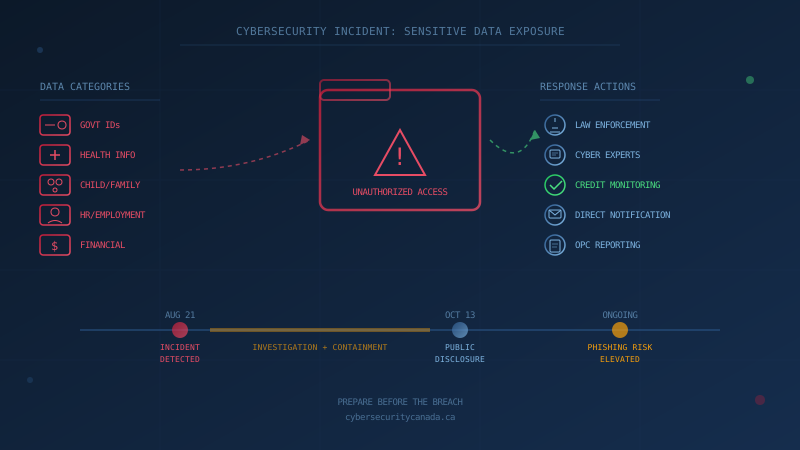
The Saskatoon Tribal Council (STC) disclosed a cybersecurity incident on October 13, 2026, that may have exposed government-issued identifiers, health information, child and family service records, employment and HR records, and financial information. The Saskatoon Tribal Council cyber incident was first identified on August 21, 2026, according to the organization's public notice. STC engaged law enforcement and third-party cybersecurity experts and is offering credit monitoring to affected individuals.
For Canadian organizations that hold similarly sensitive data (nonprofits, Tribal Councils, social service agencies, healthcare providers, educational institutions), this incident is a reminder of what breach disclosure looks like in practice and why it matters to prepare before something happens.
What Data May Have Been Accessed in the STC Incident?
According to STC's public notice, the categories of information that may have been impacted include:
- Government-issued identifiers (such as social insurance numbers, status cards, or other ID documents)
- Health information
- Child and family service records
- Employment and HR records
- Financial information
STC has not disclosed the number of individuals affected, the specific attack vector, or the identity of any threat actor. The investigation remains ongoing. MBC Radio reported on October 13, 2026, corroborating the details from STC's notice: the incident was identified on August 21, Saskatoon law enforcement was engaged, and impacted individuals will be contacted directly.
The breadth of data categories is notable. Organizations that provide social services, health programs, child and family support, and employment assistance often accumulate sensitive records across multiple domains. A single breach can therefore affect individuals in multiple capacities: as clients, employees, program participants, and community members.
Why Do Public Breach Notices Create Phishing Risks?
A public breach disclosure tells attackers exactly what information may be in play and who is expecting a notification. The Canadian Anti-Fraud Centre (CAFC) warns: "If you have been part of a breach or a victim of identity theft, fraudsters will use the information as a tool to steal your money."
Phishing campaigns that follow breaches are effective because the recipient is already expecting contact. Someone who shared their SIN, health card, or child and family records with STC may now be watching for an email about credit monitoring. A fake email that says "Saskatoon Tribal Council: Important Update About Your Data" is more likely to get opened and acted on than a random phishing attempt.
The Office of the Privacy Commissioner of Canada advises individuals who receive breach notifications to read the notice carefully, stay vigilant because "fraudsters may wait before trying to steal your information," and contact the organization directly if they have questions about the communication. A real breach notification explains what was exposed, describes steps the organization has taken, and provides advice on protecting yourself. It does not ask you to click a link to verify your identity, enter credentials, or provide your SIN or credit card number.
STC's own notice reinforces this point: "Be alert for phishing attempts, including suspicious emails, phone calls, or text messages requesting personal information."
What Should Affected Individuals Do Now?
If you have shared sensitive personal information with STC, take these steps:
-
Watch for the official notification. STC stated that individuals determined to have been impacted will be notified directly. If you have not received a notification but are concerned, contact response@sktc.sk.ca directly. Do not respond to unsolicited emails or calls claiming to be from STC without verifying them first.
-
Monitor accounts and credit reports. Review your bank statements, credit card transactions, and any accounts tied to the information you shared. The two major Canadian credit bureaus (Equifax Canada and TransUnion Canada) allow you to request a free credit report once a year. A fraud alert adds a verification step when new credit is applied for in your name.
-
Be skeptical of any communication referencing this incident. Attackers who know your government ID, health information, or financial details can craft convincing messages. If a message is urgent and asks you to click, call, or provide information, treat urgency as a red flag. Go directly to STC's website or call a published number rather than using contact information from the message.
-
Accept the credit monitoring if offered. STC is offering credit monitoring at no cost to affected individuals. This service can alert you to new accounts or inquiries on your credit file.
-
Report suspected fraud. If you believe your information has been misused, report it to the Canadian Anti-Fraud Centre at 1-888-495-8501. For more on reporting options, see our guide on how to report a cyber attack in Canada.
What Should Canadian Organizations Learn from This Incident?
Organizations that hold government IDs, health records, child and family service data, employment files, or financial information face elevated risk. This data is both highly sensitive and highly valuable to attackers. A few lessons from the STC incident apply broadly.
Know What Data You Hold and For How Long
The categories STC disclosed (government IDs, health information, child and family services, HR, financial) suggest records that accumulate over years of service delivery. Organizations should audit what data they retain, where it is stored, and whether retention is still necessary.
The CMU breach earlier this month illustrated this point starkly: employee T4 records dating back 10 years were exposed because no retention policy had prompted their deletion. Our analysis of the Canadian Mennonite University data breach explains why shorter retention windows reduce breach exposure.
Prepare for Breach Disclosure Before It Happens
STC's notice followed a structured format: what happened, when it was detected, what data was affected, what the organization is doing, and what individuals should do. That format reflects PIPEDA's breach notification requirements.
Under PIPEDA, organizations must report breaches involving personal information to the Office of the Privacy Commissioner of Canada when there is a "real risk of significant harm," notify affected individuals directly, and keep records of all breaches for at least 24 months. Significant harm includes financial loss, identity theft, damage to reputation, and loss of employment or business opportunities.
Having an incident response plan means knowing who determines whether the PIPEDA threshold is met, who drafts the notification, who handles media inquiries, and who coordinates with law enforcement and cybersecurity experts. The Canadian Centre for Cyber Security's guidance on developing your incident response plan provides a framework for building this capability.
Warn Your Community About Phishing Before the Fakes Arrive
STC's notice explicitly tells community members to be alert for phishing. This is the right call. Organizations that experience a breach should proactively educate affected individuals about what a legitimate communication will and will not ask for.
For Canadian businesses, the same principle applies after any breach disclosure involving your employees, customers, or partners. Share a clear message: "We will never ask you to click a link to verify your identity or enter your password." For a broader guide to brand-impersonation phishing, see our phishing playbook for SMBs.
How Does This Incident Connect to the Baseline Controls?
The STC disclosure does not reveal the specific technical vector used by the attackers. What it does reveal is the consequence when sensitive data is accessed without authorization. Several of the Canadian Centre for Cyber Security's 13 Baseline Controls are relevant to preventing or limiting this kind of breach:
- Access control: Limit who can access records containing government IDs, health information, child and family data, and financial details. Staff should have access only to the records they need for their role.
- Incident response: A documented plan reduces the time between detection and notification. STC detected the incident on August 21 and disclosed on October 13, roughly 53 days later. That timeline allowed for investigation and confirmation, but faster detection and containment generally limit exposure.
- Security training: Staff who handle sensitive records should understand phishing, credential theft, and the risks of poor data hygiene.
- Data backup and recovery: Reliable backups mean an organization can restore systems without paying a ransom if ransomware is involved.
One Question to Ask Your Team This Week
If your organization handles sensitive data (government IDs, health records, financial information, or records involving vulnerable populations), ask: "If we had a breach tomorrow, do we have a notification template ready, a list of who needs to be informed, and a process for warning affected individuals about phishing before the fakes arrive?"
If the answer is unclear, you have a starting point. Our free cybersecurity assessment evaluates your organization against all 13 Baseline Controls, including incident response, access control, and security awareness. It runs entirely in your browser, collects no data, and gives you a prioritized view of where your security posture needs attention.
The STC incident is a reminder that organizations serving communities with sensitive needs hold data that attackers want. The time to prepare for that reality is before the breach, not after.
How prepared is your business?
Find out where you stand against Canada's 13 Baseline Cyber Security Controls. The assessment takes under 30 minutes and your answers stay in your browser.
Check Your ScoreFrequently Asked Questions
What happened in the Saskatoon Tribal Council cybersecurity incident?
On August 21, 2026, the Saskatoon Tribal Council identified a cybersecurity incident that may have resulted in unauthorized access to personal information. The organization disclosed the incident publicly on October 13, 2026, stating that government-issued identifiers, health information, child and family service records, employment and HR records, and financial information may have been impacted.
Who is affected by the Saskatoon Tribal Council data breach?
According to STC's public notice, the breach may affect members of their community who shared sensitive personal information with the organization. This could include individuals who received services involving government-issued identification, health information, child and family services, employment records, or financial information. Impacted individuals will be notified directly and offered credit monitoring at no cost.
What should I do if I shared personal information with the Saskatoon Tribal Council?
STC advises being alert for phishing attempts (suspicious emails, phone calls, or text messages), monitoring accounts and credit reports for unusual activity, and contacting response@sktc.sk.ca if you have concerns. If you believe you may be affected and have not received a notification, reach out directly using the provided contact information rather than responding to unsolicited communications.
Why do breach disclosures create phishing risks for affected individuals?
The Canadian Anti-Fraud Centre warns that fraudsters use breach information as a tool to steal money. When attackers know what data was exposed and which organization was breached, they can craft convincing phishing messages that reference the real incident. Victims expecting a legitimate notification may lower their guard and respond to fake messages requesting credentials or financial information.
Cite This Page
Suggested citation:
Cybersecurity Canada (2026). Saskatoon Tribal Council Cyber Incident: Lessons for Canadian Organizations Holding Sensitive Data. Retrieved from https://cybersecuritycanada.ca/news/posts/saskatoon-tribal-council-cyber-incident-sensitive-data-lessons/
Permanent URL: https://cybersecuritycanada.ca/news/posts/saskatoon-tribal-council-cyber-incident-sensitive-data-lessons/ · Published October 14, 2026
Disclaimer: This article is intended for general informational purposes only and does not constitute professional cybersecurity, legal, IT, or compliance advice. While we strive to ensure accuracy, the cybersecurity landscape changes rapidly and information may become outdated. Organizations should consult with qualified cybersecurity professionals and legal counsel to assess their specific situation and develop appropriate security policies. Use of this information is at your own risk. See our Privacy Policy for more information.
Cybersecurity Canada is an independent resource and is not affiliated with, endorsed by, or connected to the Canadian Centre for Cyber Security, the Communications Security Establishment, or the Government of Canada.
How does your organization measure up?
Take our free cybersecurity assessment based on the Canadian Centre for Cyber Security's Baseline Controls. 50 questions, under 30 minutes, 100% confidential. Your answers never leave your browser.
Take the Free Assessment