Air Creebec Data Breach: SMB Lessons

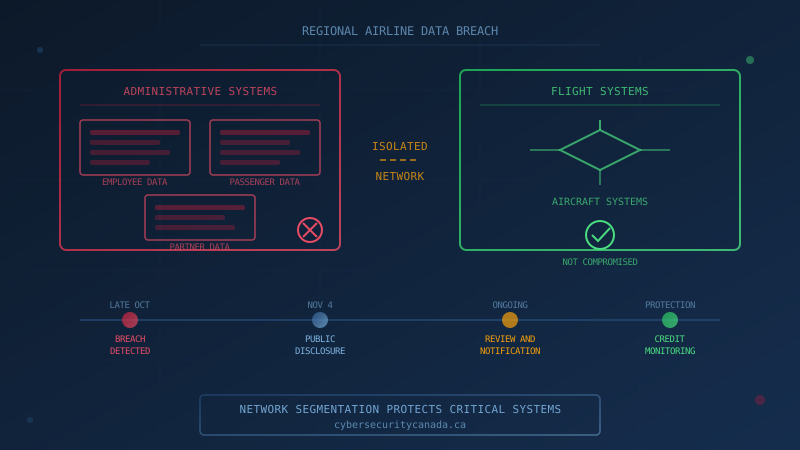
Air Creebec, a regional Quebec airline owned by the Cree Nation of Eeyou Istchee, disclosed on November 4, 2026, that an unauthorized intrusion into some of its administrative systems resulted in exfiltrated files that may contain personal information. The Air Creebec data breach affects current and former employees, passengers, and potentially customers and partners. The company stated that flight operations, aircraft, and flight systems were not compromised because they operate independently from the affected administrative systems. For Canadian small and medium businesses, the incident illustrates why separating operational systems from administrative networks matters, and what steps organizations should take when breach notifications start arriving.
What Did Air Creebec Disclose?
Air Creebec's official cybersecurity incident notice states: "Air Creebec has discovered an unauthorized intrusion targeting some of its administrative systems." The company brought in cybersecurity experts "as soon as the incident was discovered" to assess the scope and strengthen security on affected systems. According to the CNW press release dated November 4, 2026, the airline is "working with the appropriate authorities."
Air Creebec's notice describes what the exfiltrated files may contain:
- Personal information relating mainly to current and former employees
- Personal information relating to passengers
- Operational, administrative, or financial information related to customers and partners
The company stated: "Our review is ongoing." Speaking to TimminsToday, Edward Trahan, Air Creebec's director of marketing and business development, said the breach was detected "in the very last days of October" and that "we don't want to speculate as to how much has been leaked until we actually know for sure."
APTN News reported that Trahan said "the experts are still conducting their review, so there's no numbers [of victims] at this time that we can give."
Were Flights Affected?
No. Air Creebec explicitly stated that "the safety of our flights, aircraft and flight operations remains assured and has not been compromised in any way." The company's notice explains: "Our aircraft and flight systems operate independently, separately from the affected administrative systems. Our operations are continuing as normal."
This separation is significant. The breach affected systems that handle administrative data (employee records, passenger information, business files), but the systems that control aircraft operations were isolated from those networks. That architectural decision meant an intrusion into administrative systems did not create a safety risk.
Why Does System Separation Matter for Canadian SMBs?
The Air Creebec incident illustrates a principle from the Canadian Centre for Cyber Security's Baseline Cyber Security Controls: not all systems should be connected to each other. When critical operational systems are separated from general business networks, a compromise of one does not automatically compromise the other.
For a small or medium business, the equivalent might be:
- Keeping point-of-sale systems on a separate network from employee workstations
- Isolating operational technology (manufacturing equipment, HVAC controls) from office IT
- Separating backup infrastructure so ransomware that encrypts production systems cannot reach backups
The CCCS Baseline Controls address network security in BC.9, which recommends dedicated firewalls between the corporate network and the internet. Segmentation within internal networks extends that principle. Air Creebec's statement that its aircraft systems "operate independently" demonstrates that thoughtful separation can limit the blast radius of a breach.
What Protective Measures Is Air Creebec Offering?
Air Creebec stated it is "assessing appropriate protective measures, including the possibility of offering a credit monitoring and identity protection service, based on the nature of the information exposed and the risks identified." The company said: "Eligible individuals will be informed directly of the measures available to them and the steps to follow."
According to TimminsToday, Trahan said the airline is "finalizing the proposed protection packages with its cybersecurity experts and expects to begin offering them before the end of the week."
This approach is standard for data breaches involving personal information. Organizations determine what data was exposed, assess the risk of harm to affected individuals, and then offer protective services proportional to that risk. The fact that Air Creebec is still assessing what to offer suggests the full scope of the exfiltration is not yet known.
What Should Affected Individuals Watch For?
Air Creebec's notice warns: "Be especially vigilant with any unexpected email, text message or phone call requesting urgent action or confidential information. Air Creebec will never contact you to ask for your banking information or passwords."
Breach announcements create opportunities for scammers. Once attackers know an organization has been compromised, they may impersonate that organization or its breach response partners. Phishing emails and texts that claim to be "breach notifications" or "identity protection offers" can trick recipients into revealing additional information or clicking malicious links.
The Canadian Anti-Fraud Centre warns that "if you have been part of a breach or a victim of identity theft, fraudsters will use the information as a tool to steal your money." The Office of the Privacy Commissioner of Canada's guidance on receiving breach notifications advises recipients to "stay vigilant because fraudsters may wait before trying to steal your information."
Anyone who believes they may be affected by the Air Creebec breach should:
- Monitor bank accounts and credit statements for unusual activity
- Be skeptical of any unsolicited contact that references the breach
- Verify communications by going directly to Air Creebec's official website rather than clicking links in emails
- Report suspicious activity to financial institutions and the Canadian Anti-Fraud Centre
What Are the Privacy Notification Requirements?
Air Creebec stated it is "working with the appropriate authorities." Under Canada's federal privacy law, PIPEDA, organizations must report breaches of security safeguards involving personal information to the Office of the Privacy Commissioner of Canada when there is a "real risk of significant harm" to individuals. "Significant harm" includes financial loss, identity theft, damage to reputation, and loss of employment or business opportunities.
Organizations must also notify affected individuals and keep records of all breaches for at least 24 months, whether or not they met the reporting threshold. Our guide on how to report a cyber attack in Canada explains which agencies to contact and when.
Air Creebec is based in Val-d'Or, Quebec. Quebec has its own privacy framework under the Act Respecting the Protection of Personal Information in the Private Sector, enforced by the Commission d'acces a l'information (CAI). Under Law 25, Quebec organizations must notify the CAI and affected individuals promptly when a confidentiality incident presents a "risk of serious injury." This is general information, not legal advice; affected organizations should consult qualified counsel for their specific situation.
What Can Canadian SMBs Learn From This Incident?
The Air Creebec breach offers several takeaways for small and medium businesses that handle employee or customer personal information.
Separate critical systems from administrative networks. Air Creebec's flight systems were not affected because they operated independently. Consider which of your systems would cause the most damage if compromised and whether they are adequately isolated.
Have an incident response plan before you need it. Air Creebec stated it brought in cybersecurity experts "as soon as the incident was discovered." Having a relationship with an incident response provider, or at least knowing who to call, saves critical time. Our guide on building an incident response plan covers what to include.
Know your notification obligations. If your organization holds personal information of employees, customers, or partners, a breach may trigger reporting requirements under PIPEDA and provincial privacy laws. The thresholds and timelines differ, and penalties for non-compliance can be significant.
Prepare for post-breach phishing. When your organization or a vendor you work with discloses a breach, expect follow-on attacks. Warn your team to be skeptical of any unsolicited contact that references the incident.
Remove access promptly when employees leave. Air Creebec's notice mentions that exfiltrated files may contain personal information of "current and former employees." Organizations should follow the CCCS Baseline Control BC.12.3, which states that accounts and functionality should be removed when employees no longer require them. Our employee offboarding security checklist covers the process.
One Question to Ask Your IT Provider
"If an attacker gained access to our administrative network today, which of our critical systems would they also be able to reach, and what separates them?"
If the answer is that everything is on the same network, that conversation is where your security review should start.
Assess Your Organization's Cybersecurity Posture
The Air Creebec incident is a reminder to check your own security practices before a breach happens. Our free cybersecurity assessment evaluates your organization against the Canadian Centre for Cyber Security's 13 Baseline Control areas. The assessment covers 50 questions, takes under 30 minutes, and is completely confidential. Your answers stay in your browser and are never transmitted. Progress is saved locally for 48 hours. No signup is required. The results show which control areas need attention, so you know where to focus your cybersecurity investment.
How prepared is your business?
Find out where you stand against Canada's 13 Baseline Cyber Security Controls. The assessment takes under 30 minutes and your answers stay in your browser.
Check Your ScoreFrequently Asked Questions
What happened in the Air Creebec data breach?
Air Creebec disclosed on November 4, 2026, that attackers gained unauthorized access to some of its administrative systems and exfiltrated files. The files may contain personal information of current and former employees and passengers, plus operational, administrative, or financial information related to customers and partners. The airline's flight operations and aircraft systems were not affected because they operate independently from administrative systems.
Were Air Creebec flights affected by the cyberattack?
No. Air Creebec stated that the safety of its flights, aircraft, and flight operations remains assured and has not been compromised in any way. The company said its aircraft and flight systems operate independently, separately from the affected administrative systems, and that operations are continuing normally.
What should Air Creebec passengers and employees do?
Air Creebec advises everyone to be especially vigilant with unexpected emails, text messages, or phone calls requesting urgent action or confidential information. The company states it will never contact anyone to ask for banking information or passwords. Monitor accounts and statements and report any unusual activity to your financial institution. Eligible individuals will be contacted directly about credit monitoring and identity protection services.
How does network segmentation help protect against data breaches?
Network segmentation means separating critical systems so that access to one does not grant access to another. Air Creebec stated its aircraft and flight systems operate independently, separately from the affected administrative systems. This architecture meant the intrusion into administrative systems did not affect flight safety. Canadian SMBs can apply the same principle by separating operational systems from general business networks.
Does PIPEDA require reporting a data breach like Air Creebec's?
Under PIPEDA, organizations must report breaches of security safeguards involving personal information to the Office of the Privacy Commissioner of Canada when there is a real risk of significant harm. They must also notify affected individuals and keep records of all breaches for at least 24 months. Air Creebec stated it is working with the appropriate authorities. Quebec organizations may also have obligations under provincial law. This is general information, not legal advice.
Cite This Page
Suggested citation:
Cybersecurity Canada (2026). Air Creebec Data Breach: SMB Lessons. Retrieved from https://cybersecuritycanada.ca/news/posts/air-creebec-data-breach-smb-lessons/
Permanent URL: https://cybersecuritycanada.ca/news/posts/air-creebec-data-breach-smb-lessons/ · Published November 6, 2026
Disclaimer: This article is intended for general informational purposes only and does not constitute professional cybersecurity, legal, IT, or compliance advice. While we strive to ensure accuracy, the cybersecurity landscape changes rapidly and information may become outdated. Organizations should consult with qualified cybersecurity professionals and legal counsel to assess their specific situation and develop appropriate security policies. Use of this information is at your own risk. See our Privacy Policy for more information.
Cybersecurity Canada is an independent resource and is not affiliated with, endorsed by, or connected to the Canadian Centre for Cyber Security, the Communications Security Establishment, or the Government of Canada.
How does your organization measure up?
Take our free cybersecurity assessment based on the Canadian Centre for Cyber Security's Baseline Controls. 50 questions, under 30 minutes, 100% confidential. Your answers never leave your browser.
Take the Free Assessment