Who Is Responsible for Cybersecurity in a Canadian Small Business?
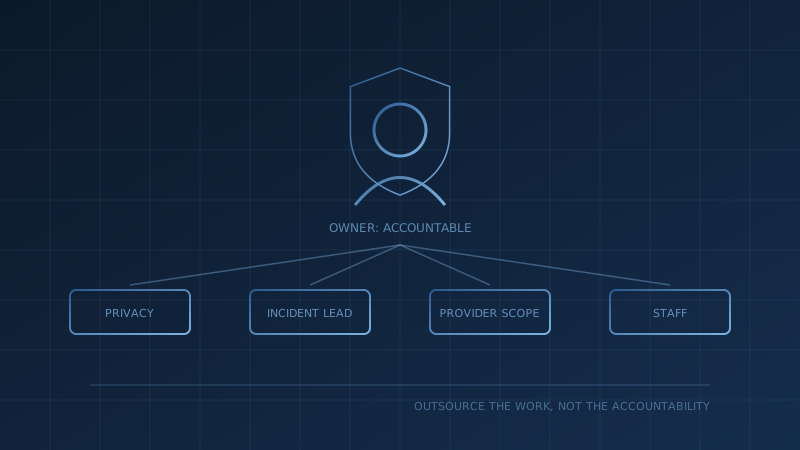
The business is responsible for its own cybersecurity, even when an outside company runs its IT. The Canadian Centre for Cyber Security says it plainly in its guidance for consumers of managed services: "Your organization is the data owner and is legally responsible for data security." For a Canadian small business, the practical question is not whether someone is responsible, but whether that someone has been named.
Many businesses never make that decision explicitly. Security becomes something "IT handles," and the gaps only show up during an incident. This guide sets out what Canadian guidance expects and the handful of roles a small business should assign.
Who Is Responsible for Cybersecurity in a Small Business?
The business is, and specifically its leadership. The Cyber Centre's baseline cyber security controls for small and medium organizations say "organizations should identify someone in a leadership role who is specifically responsible for their IT security," and recommend that larger organizations consider hiring a chief information security officer. The same document states that all risks related to the cyber security of IT systems "are the responsibility of system owners."
That person does not need to be technical. Their job is to make decisions, approve spending, and make sure the work is actually being done and checked. Our overview of Canada's baseline cyber security controls explains how the 13 control areas build on these organizational decisions.
Does Outsourcing IT Make Your Provider Responsible?
No. Outsourcing moves the work, not the accountability. The Cyber Centre's cyber security considerations for consumers of managed services (ITSM.50.030) says your organization and the provider "both have roles," but your organization "is the data owner and is legally responsible for data security." It adds that when you use a service provider, your organization "remains accountable for incident response."
The US guidance says the same. CISA's risk considerations for managed service provider customers states that outsourcing to MSPs "does not absolve an organization from risk management responsibilities," and that "outsourcing IT services does not absolve executives of risk management responsibilities."
There is also a scope problem. The Cyber Centre's guide ITSM.10.023 says a managed service provider (MSP) offers IT administration and "may not provide security related monitoring as part of that service." Even when you hire a dedicated managed security provider, ITSM.10.023 notes that "you ultimately own the risk."
What Does Canadian Privacy Law Expect?
Privacy law adds a named role. Under PIPEDA, the Office of the Privacy Commissioner of Canada's guidance on the accountability principle says to "appoint someone to be responsible for your organization's PIPEDA compliance" and to protect all personal information you hold, "including any personal information you transfer to a third party for processing."
ITSM.10.023 makes the link to security directly: as a business owner, you are legally responsible under PIPEDA or similar provincial legislation to protect clients' and customers' personal information and to report breaches that pose a risk of harm to the Office of the Privacy Commissioner. The OPC also says your designated privacy official should have "the support of senior management and the authority to intervene on privacy issues." This is general information, not legal advice, and depending on your province, similar provincial legislation may apply, as ITSM.10.023 notes.
How Many Businesses Have Someone Assigned?
About half have cyber security staff, and many of the rest rely on outside help. In Statistics Canada's 2023 Canadian Survey of Cyber Security and Cybercrime, which covers businesses with 10 or more employees, half (50%) reported having cyber security employees, down from 61% in 2021. The most reported reason for not having them was using consultants or contractors to monitor cyber security (47%).
The same survey found that just over 1 in 4 businesses (26%) had written cyber security policies, and 22% gave formal cyber security training to non-IT employees. Using a contractor is a reasonable choice. Using one without a written policy, an internal owner or a defined scope is where responsibility quietly falls through the cracks.
What Roles Should a Small Business Assign?
Four roles cover most of what Canadian guidance asks for. In a small business, one person may hold more than one, but each should have a name next to it:
- Executive owner. The leader the baseline controls call for: accountable for IT security decisions, budget and follow-up.
- Privacy contact. The person responsible for PIPEDA compliance, named internally and externally as the OPC recommends.
- Incident lead. The baseline controls say a written incident response plan should detail "who is responsible for handling incidents including any relevant contact information for communicating to external parties, stakeholders and regulators." Our guide to building an incident response plan covers roles, responsibilities and contact lists in detail.
- Provider contact and scope owner. Someone who knows exactly which security services your IT provider delivers, and checks them. ITSM.50.030 recommends a service level agreement that specifies "expected turnaround times, communication media, escalation processes, metrics for assessing performance, and penalties."
Two related controls make these roles workable. The baseline controls say every user should have a unique individual account "to ensure clear accountability," and that accounts should be revoked when people leave.
What If Nobody Inside Has the Expertise?
Then the owner's job is oversight, not implementation. ITSM.10.023 describes IT and cyber security consultants who conduct risk assessments, test current security measures and recommend priorities, and managed security providers who handle monitoring, detection and response. Our guide to choosing a cybersecurity provider explains the provider types, including a virtual CISO who provides strategic security leadership on a fractional basis.
Whichever you choose, keep the decision rights inside the business. A provider can recommend; only you can accept a risk on the company's behalf.
Where Should You Start?
Write the four names down this week, then check them against what you have in writing. The question to ask your IT lead or provider is: "Which security tasks are in our contract, and who on our side signs off that they were done?" To see how your business measures up against Canada's baseline controls, take our free cybersecurity assessment. It takes under 30 minutes and your answers stay in your browser.
How prepared is your business?
Find out where you stand against Canada's 13 Baseline Cyber Security Controls. The assessment takes under 30 minutes and your answers stay in your browser.
Check Your ScoreFrequently Asked Questions
Who is responsible for cybersecurity in a small business?
The business itself. The Canadian Centre for Cyber Security says an organization that uses a managed service provider is still the data owner and is legally responsible for data security, and its baseline controls recommend that organizations identify someone in a leadership role who is specifically responsible for IT security. An IT provider can do the technical work, but the accountability stays with the business.
If my IT is outsourced, is my provider responsible for security?
Only for what your contract says, and the risk stays with you. The Cyber Centre's guide ITSM.10.023 says that when you engage a managed security provider you ultimately own the risk, and that a regular managed service provider may not include security monitoring at all. CISA, the US cyber agency, similarly says outsourcing to an MSP does not absolve an organization of risk management responsibilities.
Does a Canadian small business need a privacy officer?
Businesses covered by PIPEDA must appoint someone responsible for compliance with the law. The Office of the Privacy Commissioner of Canada says to appoint someone responsible for your organization's PIPEDA compliance and to communicate that person's name or title internally and externally. In a small business this is often an owner or manager rather than a dedicated hire. This is general information, not legal advice.
What roles should a small business assign for cybersecurity?
At a minimum: an executive owner accountable for security, a privacy contact for PIPEDA, a named incident lead in a written incident response plan, and a clear contact at any IT or security provider. The Cyber Centre's baseline controls say the incident response plan should detail who is responsible for handling incidents, including contact information for external parties and regulators.
Cite This Page
Suggested citation:
Cybersecurity Canada (2026). Who Is Responsible for Cybersecurity in a Canadian Small Business?. Retrieved from https://cybersecuritycanada.ca/news/posts/who-is-responsible-for-cybersecurity-in-a-small-business/
Permanent URL: https://cybersecuritycanada.ca/news/posts/who-is-responsible-for-cybersecurity-in-a-small-business/ · Published June 13, 2026
Disclaimer: This article is intended for general informational purposes only and does not constitute professional cybersecurity, legal, IT, or compliance advice. While we strive to ensure accuracy, the cybersecurity landscape changes rapidly and information may become outdated. Organizations should consult with qualified cybersecurity professionals and legal counsel to assess their specific situation and develop appropriate security policies. Use of this information is at your own risk. See our Privacy Policy for more information.
Cybersecurity Canada is an independent resource and is not affiliated with, endorsed by, or connected to the Canadian Centre for Cyber Security, the Communications Security Establishment, or the Government of Canada.
How does your organization measure up?
Take our free cybersecurity assessment based on the Canadian Centre for Cyber Security's Baseline Controls. 50 questions, under 30 minutes, 100% confidential. Your answers never leave your browser.
Take the Free Assessment