Ransomware Claims Hit Canadian Peers: What Your Small Business Should Do Now
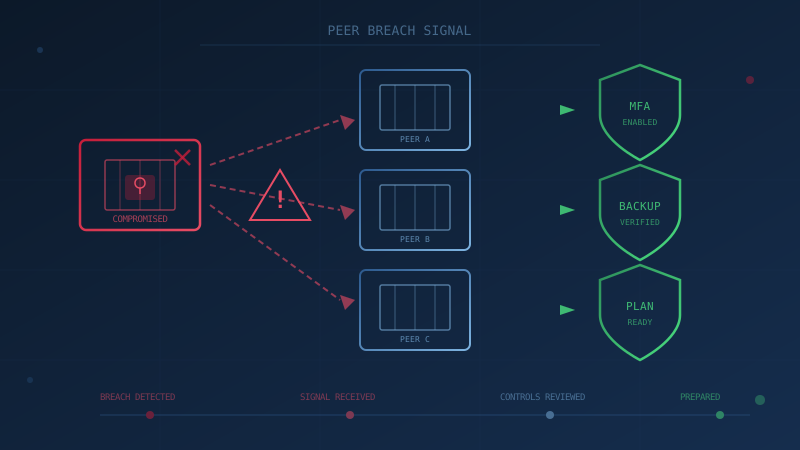
In the first week of October 2026, ransomware groups claimed multiple Canadian victims across different sectors. Franklin Empire, a Canadian electrical distributor, appeared on the BYOD ransomware group's leak site on October 5, with attackers claiming to have exfiltrated over 700 GB of data including cloud credentials and customer records. Days earlier, Nipigon District Memorial Hospital in Ontario confirmed a ransomware attack that forced the closure of outpatient laboratory and diagnostic imaging services. Montreal-based industrial distributor Rotamac and other Canadian organizations also appeared on ransomware leak sites during the same period.
These are unverified attacker claims in some cases, and confirmed incidents in others. What they share is a pattern: Canadian organizations of varying sizes and sectors are appearing on ransomware leak sites at a steady pace. The Canadian Centre for Cyber Security's Ransomware Threat Outlook 2025 to 2027 confirms that ransomware incidents known to the Cyber Centre grew by approximately 26% per year between 2021 and 2024.
If your business operates in the same sector as a recent victim, or if you simply read about a Canadian peer being hit, the question is not whether you should do something. The question is what.
Why Peer Breaches Are a Signal, Not Just News
When ransomware operators successfully compromise one organization, they often have intelligence that applies to similar targets. The same vulnerability that allowed initial access at one distributor may exist at another. The same credential-stuffing techniques that worked against one healthcare facility may work against another.
The CCCS assesses that ransomware actors are "opportunistic and do not target specific industries." Ransomware-as-a-Service (RaaS) operations scan thousands of networks simultaneously, looking for common weaknesses: unpatched software, weak or reused passwords, missing multi-factor authentication, and publicly exposed remote access services.
When a peer is hit, you have an advantage the victim did not: advance warning. Use it.
The Immediate Response Checklist
If you learn that a competitor, supplier, or industry peer has been claimed by a ransomware group, work through this checklist within the next 48 hours.
1. Confirm Your Incident Response Plan Exists and Is Current
The Canadian Centre for Cyber Security designates incident response planning as BC.1, the first of its 13 Baseline Cyber Security Controls. The positioning is deliberate: when an incident hits, everything else depends on having a plan to follow.
If you do not have a written plan, create one now. At minimum it should answer:
- Who is in charge? Name a specific person (and a backup) responsible for leading any response
- Who do you call? Include contact details for your IT provider, cyber insurance carrier, legal counsel, and the Canadian Centre for Cyber Security (1-833-CYBER-88)
- Where is the plan? If your network is encrypted, a plan stored only on that network is useless. Print a copy. Store it somewhere accessible offline.
The CCCS publishes a free Ransomware Playbook (ITSM.00.099) that provides a detailed framework.
2. Verify Your Backups Work
Reliable backups are the difference between a ransomware incident and a business-ending catastrophe. If you can restore your systems from clean backups, the attacker's leverage disappears.
The Baseline Controls (BC.7) require organizations to back up essential business information, store backups encrypted, and ensure recovery mechanisms actually work. Critically:
- Test your restores. A backup that has never been restored is a backup you are hoping works. Hope is not a strategy. Here are five backup assumptions that commonly fail when it matters most.
- Keep at least one copy offline. Modern ransomware specifically targets connected backup infrastructure. If your backup is always online and reachable from the same network, it will be encrypted alongside everything else.
3. Confirm MFA Is Enabled on All Critical Accounts
Stolen or weak credentials remain one of the primary ways attackers gain initial access to business networks. Multi-factor authentication (BC.5) makes a stolen password insufficient on its own.
The Baseline Controls require MFA wherever possible, with particular emphasis on:
- Email and cloud service accounts
- VPN and remote access portals
- Administrative and privileged accounts
- Financial systems and banking
The City of Hamilton's $18.3 million ransomware recovery in 2024, with a denied insurance claim because MFA was not fully deployed, illustrates the stakes.
4. Patch Outstanding Vulnerabilities
Unpatched software is one of the most common ways ransomware operators gain initial access. The CCCS prioritizes automatic patching (BC.2) as one of the most important security actions an organization can take.
Enable automatic updates for operating systems and applications wherever possible. For software that requires manual updates, establish a regular patching cadence. Do not let critical patches sit for weeks while you "evaluate" them.
5. Review Access Permissions
Follow the principle of least privilege: employees should only have access to the systems and data they need for their role. Administrative accounts should be used only for administrative tasks.
If ransomware compromises a user account with broad access, it can move laterally across your entire network. If that same account has only the minimum necessary permissions, the blast radius is contained.
The Broader Question: Where Do You Stand?
A peer breach is an opportunity to ask a harder question: what is your overall security posture against the threats facing Canadian small businesses today?
The Canadian Centre for Cyber Security's Baseline Cyber Security Controls provide the answer. These 13 control areas represent the Government of Canada's recommended minimum security standard, designed specifically for organizations that lack the resources for enterprise-scale security programmes.
The controls most directly relevant to ransomware preparedness are:
- BC.1 (Incident Response): Have a plan, assign responsibilities, keep a hard copy
- BC.2 (Patch Management): Enable automatic updates to close the vulnerabilities ransomware operators exploit
- BC.3 (Anti-Malware): Configure and enable protection with automatic updates on all devices
- BC.5 (Authentication): Implement MFA wherever possible
- BC.6 (Security Training): Train employees to recognize phishing, the most common ransomware delivery mechanism
- BC.7 (Data Backup): Back up essential systems, store them offline, and test restoration regularly
- BC.12 (Access Control): Follow least privilege to limit lateral movement
Statistics Canada's 2023 survey found that only 26% of Canadian businesses had written cybersecurity policies in place. Meanwhile, 14% of small businesses (10 to 49 employees) were impacted by a cybersecurity incident that year. The gap between threat exposure and preparedness remains wide.
The Pattern in Early October 2026
The incidents appearing in early October 2026 illustrate the breadth of ransomware targeting in Canada:
Nipigon District Memorial Hospital (Ontario): The hospital confirmed a ransomware attack in mid-September that encrypted files potentially containing personal and health information. Outpatient laboratory and diagnostic imaging services were closed. CEO Shannon Cormier stated that the hospital "immediately activated its incident response and business continuity procedures" and is working with external cybersecurity experts and law enforcement. The Storm ransomware group listed the hospital on its leak site on October 4.
Franklin Empire (Canadian electrical distributor): The BYOD ransomware group claimed on October 5 to have exfiltrated over 700 GB of data, including cloud credentials, customer records, and invoices. This is an unverified attacker claim; attackers routinely exaggerate or fabricate victims to pressure targets. What is known is that the organization appeared on a ransomware leak site.
Rotamac (Montreal industrial equipment distributor): Listed by the Thegentlemen ransomware group on October 3. The group has published nearly 1,000 victims globally.
Additional claims: A Canadian medical centre appeared on the Booba Project leak site October 2, and a Canadian financial services entity was claimed by the N0n group on October 5.
These are not outliers. The Cyber Centre's Ransomware Threat Outlook states that ransomware "will remain a significant threat to Canada" through at least 2027.
What the Cyber Centre Recommends
The Government of Canada's position is that organizations should not wait until they are targeted to act. The CCCS recommends:
- Develop and test an incident response plan before an incident occurs
- Implement the Baseline Cyber Security Controls as a minimum standard
- Report incidents to the Cyber Centre (1-833-CYBER-88), local police, and the Canadian Anti-Fraud Centre
- Do not pay ransoms, as payment fuels the ransomware model, does not guarantee recovery, and may mark you as a future target
In 2024, the Cyber Centre issued 336 pre-ransomware notifications to Canadian organizations, generating an estimated $6 to $18 million in economic savings. Early detection and early action make a measurable difference.
Assess Your Readiness Now
When a peer is hit, the worst response is to assume it cannot happen to you. The evidence says otherwise.
Our free Cybersecurity Canada assessment evaluates your organization against all 13 Baseline Control areas, including the ones most critical to ransomware preparedness: incident response planning, backup and recovery, authentication, patch management, and access control. It takes under 10 minutes, does not collect your data, and shows you exactly where your gaps are.
If a ransomware group claimed your competitor this week, the question is not whether you are next. The question is whether you would be ready if you were.
How prepared is your business?
Find out where you stand against Canada's 13 Baseline Cyber Security Controls. The assessment takes under 30 minutes and your answers stay in your browser.
Check Your ScoreFrequently Asked Questions
What should I do when I hear about a ransomware attack on a Canadian competitor or peer?
Treat it as a signal to act, not just a news story. The attackers who compromised your peer are likely scanning for similar vulnerabilities across the sector. Review your own defences against the Baseline Controls: confirm your incident response plan is current, verify backups are working and stored offline, enable MFA on all critical accounts, and patch any outstanding vulnerabilities. The Canadian Centre for Cyber Security recommends that organizations treat peer incidents as an opportunity to strengthen their own posture before they become targets.
Are small businesses really at risk from the same ransomware groups targeting larger organizations?
Yes. The Canadian Centre for Cyber Security's Ransomware Threat Outlook 2025 to 2027 states that ransomware actors are opportunistic and all Canadian organizations are at risk. Ransomware-as-a-Service (RaaS) operations scan thousands of networks simultaneously looking for unpatched software, weak passwords, and missing multi-factor authentication. They do not check your revenue before they encrypt your files. In 2023, 14% of Canadian small businesses (10 to 49 employees) were impacted by a cybersecurity incident.
How common are ransomware attacks in Canada?
Ransomware incidents known to the Cyber Centre grew by approximately 26% per year between 2021 and 2024. Statistics Canada's 2023 survey found that 13% of Canadian businesses impacted by cyber incidents identified ransomware as the method of attack. In 2024, the Cyber Centre issued 336 pre-ransomware notifications to Canadian organizations, generating an estimated $6 to $18 million in economic savings.
What is the first thing my business should do to prepare for ransomware?
Establish an incident response plan. The Canadian Centre for Cyber Security designates incident response planning as BC.1, the first of its 13 Baseline Cyber Security Controls. The plan should name who leads the response, who to call (IT provider, insurance carrier, Cyber Centre, police), which systems are critical, and where a hard copy of the plan is stored. If your network is encrypted, a plan stored only on that network is useless.
How do I know if my business has the same vulnerabilities as a breached peer?
A structured self-assessment against the 13 Baseline Controls will reveal gaps before attackers exploit them. Common vulnerabilities include missing multi-factor authentication, unpatched software, lack of offline backups, and no written incident response plan. Our free Cybersecurity Canada assessment evaluates your organization against all 13 control areas in under 10 minutes without collecting your data.
Cite This Page
Suggested citation:
Cybersecurity Canada (2026). Ransomware Claims Hit Canadian Peers: What Your Small Business Should Do Now. Retrieved from https://cybersecuritycanada.ca/news/posts/ransomware-peer-breach-canadian-small-business-response/
Permanent URL: https://cybersecuritycanada.ca/news/posts/ransomware-peer-breach-canadian-small-business-response/ · Published October 1, 2026
Disclaimer: This article is intended for general informational purposes only and does not constitute professional cybersecurity, legal, IT, or compliance advice. While we strive to ensure accuracy, the cybersecurity landscape changes rapidly and information may become outdated. Organizations should consult with qualified cybersecurity professionals and legal counsel to assess their specific situation and develop appropriate security policies. Use of this information is at your own risk. See our Privacy Policy for more information.
Cybersecurity Canada is an independent resource and is not affiliated with, endorsed by, or connected to the Canadian Centre for Cyber Security, the Communications Security Establishment, or the Government of Canada.
How does your organization measure up?
Take our free cybersecurity assessment based on the Canadian Centre for Cyber Security's Baseline Controls. 50 questions, under 30 minutes, 100% confidential. Your answers never leave your browser.
Take the Free Assessment