Cybersecurity Canada: The Readiness Gap and How to Close It
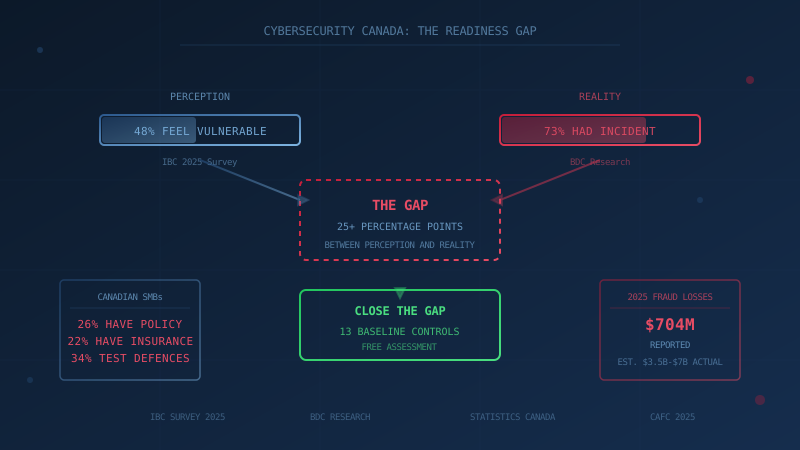
Most Canadian small and medium businesses believe they are protected from cyber attacks. The data tells a different story. According to the Business Development Bank of Canada (BDC), 73% of Canadian small businesses have already experienced a cybersecurity incident. Yet a 2025 survey by the Insurance Bureau of Canada (IBC) found that only 48% of SMB owners believe their business is vulnerable. This gap between perceived security and actual exposure is the cybersecurity readiness gap, and closing it starts with understanding where your organization actually stands.
How big is the cybersecurity readiness gap in Canada?
The gap is substantial. The IBC's 2025 Cyber Security Survey of 308 Canadian SMB owners and decision makers found that 66% are confident their business can withstand a data breach or website shutdown. Only 47% say their business is prepared for a cyber attack. Fewer than half (48%) have implemented any form of cyber defence.
Meanwhile, the evidence of actual incidents is clear. BDC's research found that 61% of Canadian SMBs have experienced a phishing attempt, 27% have faced a malware attack, 12% have been hit by ransomware, and 7% have experienced a data breach. The ESET 2026 SMB Cyber Readiness Index, surveying 200 Canadian SMBs in February 2026, reported that 46% experienced at least one incident in the past 12 months.
The numbers point to the same conclusion: many Canadian businesses have already been attacked, yet most do not believe they are vulnerable. This perception gap is not merely a matter of optimism. It directly affects how businesses allocate resources, whether they invest in security controls, and how quickly they respond when incidents occur.
Why do Canadian SMBs underestimate their risk?
Several factors contribute to the perception gap. One is the belief that size provides protection. In the IBC survey, only 6% of respondents strongly agreed that their business is vulnerable to a cyber attack. Many assume attackers focus on larger targets with bigger payouts.
That assumption is wrong. As BDC notes, for an attacker seeking CA$1 million in ransom, it is often easier to target 20 small businesses for CA$50,000 each than to breach a single large enterprise with mature defences. Small businesses are attractive precisely because they are perceived as easier targets.
Another factor is the lack of formal security practices. According to Statistics Canada's 2023 Canadian Survey of Cyber Security and Cybercrime, only 26% of Canadian businesses had written cybersecurity policies in place. That figure has not improved since 2021. Without documented policies, it is harder to identify gaps, train employees consistently, or measure readiness objectively.
A third factor is the nature of cyber incidents themselves. Many attacks are silent. Phishing attempts that employees ignore or block do not always get reported internally. Malware that antivirus software catches may not register as a near miss. The incidents that businesses remember are the ones that caused visible damage, which creates a survivorship bias that understates actual exposure.
What does the readiness gap cost Canadian businesses?
The financial impact is significant. The Canadian Anti-Fraud Centre recorded over CA$704 million in reported fraud losses in 2025, the highest year on record. Investment fraud led at CA$351 million, followed by relationship scams at over CA$63.3 million and job fraud at over CA$50.6 million.
These figures represent only a fraction of actual losses. The CAFC estimates that only 5 to 10 percent of fraud is reported, placing the true annual figure somewhere between CA$3.5 billion and CA$7 billion.
For businesses specifically, the IBC survey found that the top concerns among SMB owners are business interruption, the cost of recovering from a cyber attack, and the risk to customers. Yet only 22% carry cyber insurance, and only 12% have a standalone cyber insurance policy. Most businesses remain financially exposed.
What does the Government of Canada recommend?
The Canadian Centre for Cyber Security publishes the Baseline Cyber Security Controls for Small and Medium Organizations (ITSM.10.089). This document defines 13 control areas as the minimum recommended security standard for Canadian businesses with fewer than 500 employees.
The 13 Baseline Controls apply the 80/20 rule: achieve 80% of the benefit from 20% of the effort. They cover:
- Incident response planning
- Patch management
- Anti-malware protection
- Secure configuration
- Authentication and multi-factor authentication
- Security awareness training
- Data backup and encryption
- Mobile device security
- Network security
- Cloud services security
- Web application security
- Access control
- Portable media controls
The controls are voluntary guidance, not law. But implementing them meaningfully reduces the risk of a successful cyber attack and aligns your business with the benchmark that insurers, enterprise customers, and government contracting processes increasingly reference. For Canadian businesses seeking cyber insurance, familiarity with the Baseline Controls is increasingly relevant: insurers often ask about specific practices like MFA, backup testing, and incident response planning.
How can Cybersecurity Canada help close the readiness gap?
Closing the readiness gap starts with an honest assessment of where your organization stands. A self-assessment against the 13 Baseline Controls reveals which areas are strong and which need attention. Without that baseline measurement, improvement efforts are unfocused.
The IBC survey found that only 34% of SMBs have tested the strength of their cybersecurity measures. Seven in ten say they are doing what they can to reduce cyber risks, but without testing, that confidence may be misplaced.
Structured assessment provides clarity. It surfaces the gaps between current practices and the Government of Canada's recommended baseline. It produces prioritized recommendations rather than a generic checklist. And it establishes a starting point for measurable improvement.
What should a Canadian business do next?
The first step is understanding your current posture. The Cybersecurity Canada free assessment evaluates your organization against all 13 Baseline Controls in under 30 minutes. It runs entirely in your browser, collects no data, and produces a score with specific recommendations for every control area.
Once you have your results, focus on the control areas flagged as highest risk. For most Canadian SMBs, authentication (including phishing-resistant MFA), patch management, and backup practices are the areas where small improvements deliver outsized protection.
The cybersecurity readiness gap is not inevitable. It closes when businesses move from assumptions about their security to evidence about their actual practices. Start with the assessment, and build from there.
How prepared is your business?
Find out where you stand against Canada's 13 Baseline Cyber Security Controls. The assessment takes under 30 minutes and your answers stay in your browser.
Check Your ScoreFrequently Asked Questions
What is the cybersecurity readiness gap in Canada?
The cybersecurity readiness gap refers to the disconnect between how protected Canadian businesses believe they are and their actual exposure to cyber threats. According to the Insurance Bureau of Canada's 2025 survey, only 48% of Canadian SMB owners believe their business is vulnerable to a cyber attack. Yet BDC research shows 73% of Canadian small businesses have already experienced a cybersecurity incident. This gap between perception and reality leaves many businesses underprepared.
How many Canadian businesses have experienced a cyber attack?
According to the Business Development Bank of Canada (BDC), 73% of Canadian small businesses have experienced a cybersecurity incident, ranging from phishing attempts (61%) to malware attacks (27%) and ransomware (12%). Separately, the ESET 2026 SMB Cyber Readiness Index found that 46% of Canadian SMBs experienced at least one incident in the past 12 months, with 12% experiencing multiple incidents.
What percentage of Canadian businesses have a written cybersecurity policy?
Only 26% of Canadian businesses had written cybersecurity policies in place, according to Statistics Canada's 2023 Canadian Survey of Cyber Security and Cybercrime. This figure has remained unchanged since 2021, suggesting that most Canadian businesses still lack formal documentation of their security practices.
How can a Canadian business assess its cybersecurity readiness?
A Canadian business can assess its cybersecurity readiness by evaluating its practices against the Canadian Centre for Cyber Security's 13 Baseline Controls (ITSM.10.089). A structured self-assessment covers incident response planning, patch management, authentication, data backup, and nine other control areas. The Cybersecurity Canada free assessment takes under 30 minutes, runs entirely in your browser, and provides a score with prioritized recommendations.
Cite This Page
Suggested citation:
Cybersecurity Canada (2026). Cybersecurity Canada: The Readiness Gap and How to Close It. Retrieved from https://cybersecuritycanada.ca/news/posts/cybersecurity-canada-readiness-gap-how-to-close-it/
Permanent URL: https://cybersecuritycanada.ca/news/posts/cybersecurity-canada-readiness-gap-how-to-close-it/ · Published October 7, 2026
Disclaimer: This article is intended for general informational purposes only and does not constitute professional cybersecurity, legal, IT, or compliance advice. While we strive to ensure accuracy, the cybersecurity landscape changes rapidly and information may become outdated. Organizations should consult with qualified cybersecurity professionals and legal counsel to assess their specific situation and develop appropriate security policies. Use of this information is at your own risk. See our Privacy Policy for more information.
Cybersecurity Canada is an independent resource and is not affiliated with, endorsed by, or connected to the Canadian Centre for Cyber Security, the Communications Security Establishment, or the Government of Canada.
How does your organization measure up?
Take our free cybersecurity assessment based on the Canadian Centre for Cyber Security's Baseline Controls. 50 questions, under 30 minutes, 100% confidential. Your answers never leave your browser.
Take the Free Assessment