Managed Detection and Response in Canada: A Small Business Guide
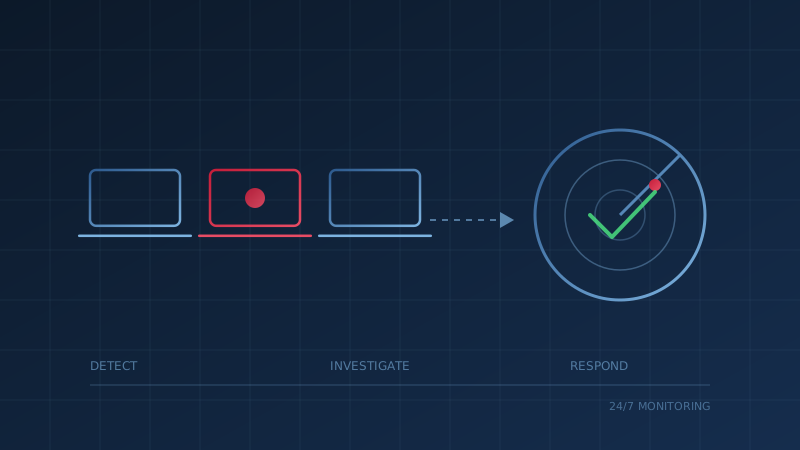
Managed detection and response (MDR) is a service in which an outside security team watches your computers, servers, and cloud accounts around the clock, investigates anything suspicious, and acts to contain an attack. For a Canadian small business without its own security staff, MDR is how you get someone looking at the alerts at 2 a.m. The Canadian Centre for Cyber Security lists MDR among the services a managed security service provider can offer, describing it as "monitoring, detecting, alerting, and managing response to potential attacks on your system."
Many smaller Canadian firms already rely on outside help for this. In Statistics Canada's 2023 Canadian Survey of Cyber Security and Cybercrime, the most common reason businesses gave for not having cyber security employees was that they used consultants or contractors to monitor cyber security (47%). The question is whether that monitoring is actually watching for attacks, or just keeping the lights on.
What Does Managed Detection and Response Include?
An MDR service combines detection software on your devices with a team of analysts who review what that software reports and respond to real threats. The Cyber Centre's guide Choosing the best cyber security solution for your organization (ITSM.10.023) groups MDR with continuous device and system monitoring as services a managed security service provider (MSSP) can deliver.
In practice, a typical MDR service covers:
- Detection: an endpoint detection and response (EDR) agent on each computer and server records activity and flags behaviour that looks like an attack.
- Investigation: analysts decide whether an alert is a real threat or noise, so your team is not asked to judge every warning.
- Response: depending on what you authorize, the provider can isolate a device from the network, stop a malicious process, or disable a compromised account.
- Reporting: a written account of what happened, what was done, and what you should fix.
Coverage varies. Some services watch only laptops and servers. Others also take in Microsoft 365 or Google Workspace sign-in activity, firewalls, and cloud logs. Ask which sources are included before comparing prices.
How Is MDR Different From Antivirus or EDR?
Antivirus and EDR are software. MDR is software plus people who act on what it finds. As our guide to antivirus and anti-malware for Canadian small businesses explains, MDR goes a step further than endpoint tools by adding a team that monitors alerts and responds on the business's behalf.
That difference matters because a tool can raise an alert that nobody reads. An EDR product sitting on 30 laptops will generate warnings. If they land in an inbox that someone checks on Monday, the software did its job and the business still lost the weekend. Anti-malware itself stays on the list either way: the Cyber Centre treats anti-malware protection as a Baseline Control and an essential defence for small and medium organizations, with or without MDR on top.
Why Does Response Speed Matter So Much?
Attackers often move from the first infected computer to the rest of the network within an hour. CrowdStrike's 2025 Global Threat Report put the average eCrime "breakout time," the time to move from the first compromised host to another inside the organization, at 48 minutes in 2024, with the fastest at 51 seconds. Most small businesses do not have anyone watching at that speed outside office hours.
Other attacks are slower and quieter, which is a different problem. In the Nova Scotia Power breach, the Office of the Privacy Commissioner's compliance letter says malware arrived on or around March 19, 2025, and the attacker began moving across systems around April 8, before deploying ransomware on April 25. Spotting that kind of activity during those weeks is the work MDR analysts are paid to do.
Is MDR the Same as an MSP or MSSP?
No. A managed service provider (MSP) runs your IT. An MSSP, or an MDR provider, focuses on security monitoring and response. The Cyber Centre puts it simply in ITSM.10.023: "An MSP offers information technology (IT) administration, whereas the MSSP takes care of cyber security." It adds that some MSPs do offer endpoint, network, and cloud security services, so check what your current contract includes.
Our article on choosing a cybersecurity provider for your Canadian small business covers the wider set of options, including MSSPs, which typically offer 24/7 threat monitoring and EDR. The risk to avoid is assuming that because an MSP manages your antivirus, someone is also watching for attacks overnight.
What Should You Ask an MDR Provider Before Signing?
Get the answers in writing, especially on response authority and speed. ITSM.10.023 suggests asking for an example service level agreement and reviewing it "in terms of speed of detection, alerting, and resolution." It also suggests asking where the provider stores its logs, how its staff connect to your systems, whether it can meet data residency requirements, and whether it offers emergency incident response after an intrusion.
A practical shortlist:
- What will you do without calling us first? Isolating a laptop at 3 a.m. is only useful if the provider is allowed to do it.
- What is your committed response time, and how is it measured?
- Which systems are covered? Laptops and servers only, or email, cloud accounts, and firewalls too?
- Where is our data stored and who can access it? This matters if contracts or privacy obligations require Canadian storage.
- What happens after you contain an attack? Ask whether investigation and recovery help is included or billed separately.
The Cyber Centre's guidance for consumers of managed services (ITSM.50.030) adds a caution worth remembering: providers are "attractive targets for cyber criminals because they have access to numerous client systems." Ask how the provider protects its own access to your network.
Where Does MDR Fit With the Baseline Controls?
MDR supports the Baseline Controls. It does not replace them. ITSM.10.023 notes that your organization remains legally responsible for protecting its data even when security is outsourced. An MDR provider can spot and contain an attack faster, but you still need an incident response plan that says who decides, who calls the insurer, and who talks to customers.
It also helps to know the basics are in place first: MFA on email and remote access, patched systems, and tested backups. Monitoring an unpatched network mostly produces a faster report of the same breach.
The question to put to your current IT provider is direct: "If an attacker got into one of our laptops on a Saturday night, who would see it, and what would they be allowed to do about it?" If the answer is unclear, start with our free cybersecurity assessment to see where your business stands against the Cyber Centre's 13 Baseline Controls.
How prepared is your business?
Find out where you stand against Canada's 13 Baseline Cyber Security Controls. The assessment takes under 30 minutes and your answers stay in your browser.
Check Your ScoreFrequently Asked Questions
What is managed detection and response (MDR)?
MDR is an outsourced service in which a provider's security team monitors your devices and systems, investigates suspicious activity, and helps respond to attacks, usually around the clock. The Canadian Centre for Cyber Security describes MDR services as including monitoring, detecting, alerting, and managing response to potential attacks on your system.
Is MDR the same as antivirus?
No. Antivirus and endpoint protection are software that blocks known threats on each device. MDR adds people: analysts who review the alerts that software raises, look into activity a tool cannot judge on its own, and act on it. Many MDR services run on top of an endpoint detection and response (EDR) tool installed on your computers.
Does a small business in Canada need 24/7 monitoring?
It depends on how quickly you could notice and stop an attack on your own. CrowdStrike's 2025 Global Threat Report measured an average eCrime breakout time of 48 minutes, so an intrusion that starts on a Friday evening can spread well before Monday. The Cyber Centre lists 24/7 security operations centres among the benefits of using a managed security service provider.
What should a Canadian business ask an MDR provider before signing?
Ask what the provider will do on its own authority when it finds a threat, how fast it commits to respond in writing, where your logs and data are stored, whether it can meet any data residency requirements, and what help it gives with recovery after an intrusion. The Cyber Centre's guidance ITSM.10.023 includes these questions.
Cite This Page
Suggested citation:
Cybersecurity Canada (2026). Managed Detection and Response in Canada: A Small Business Guide. Retrieved from https://cybersecuritycanada.ca/news/posts/managed-detection-and-response-canada-small-business-guide/
Permanent URL: https://cybersecuritycanada.ca/news/posts/managed-detection-and-response-canada-small-business-guide/ · Published September 2, 2026
Disclaimer: This article is intended for general informational purposes only and does not constitute professional cybersecurity, legal, IT, or compliance advice. While we strive to ensure accuracy, the cybersecurity landscape changes rapidly and information may become outdated. Organizations should consult with qualified cybersecurity professionals and legal counsel to assess their specific situation and develop appropriate security policies. Use of this information is at your own risk. See our Privacy Policy for more information.
Cybersecurity Canada is an independent resource and is not affiliated with, endorsed by, or connected to the Canadian Centre for Cyber Security, the Communications Security Establishment, or the Government of Canada.
How does your organization measure up?
Take our free cybersecurity assessment based on the Canadian Centre for Cyber Security's Baseline Controls. 50 questions, under 30 minutes, 100% confidential. Your answers never leave your browser.
Take the Free Assessment