AI Attack Tools Can Breach in Hours

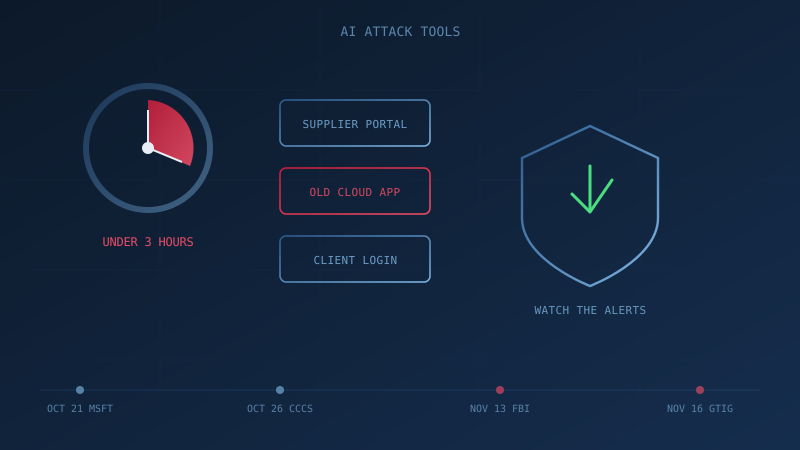
AI attack tools have already carried some intrusions from initial targeting to privileged access in under three hours. The FBI said so in a flash advisory dated November 13, 2026, about an open-source framework called ARTEX. On November 16, Google's Threat Intelligence Group described a separate system that automated the path from a published software fix to an exploit. Canada's Cyber Centre had already told organizations, on a bulletin last modified October 26, 2026, to plan for attacks that move in hours.
For a Canadian owner, the useful fact is the clock. The weaknesses in these reports are familiar: a weak or stolen password, an internet-facing system, a cloud app left trusted after the work ended. The change is how fast software chains them.
Privileged access means administrator-level control. Agentic AI means software that carries out a series of steps with limited human direction.
How fast have AI attack tools reached privileged access?
On November 13, 2026, the FBI flash said ARTEX "significantly reduces the time required to chain attack techniques, with some intrusions progressing from initial targeting to privileged access in under three hours." Microsoft's October 21 research post describes multiple Storm-0940 attacks that reached privileged access in less than three hours.
The Cyber Centre bulletin, last modified October 26, 2026, says some of that activity moved from selecting a target to privileged access to cloud systems in less than three hours. Microsoft assesses Storm-0940 as China-state aligned and says that, as early as September 2026, the group used ARTEX against hundreds of organizations. The FBI says that since at least August 2026 a variety of actors have used the framework, including financially motivated attacks.
The FBI says the tool generates high volumes of forensically noisy traffic that may trigger alerts, while the speed leaves limited time for a coordinated response before the objective is complete. The Cyber Centre says much of the activity is, for now, noisy enough for sophisticated defenders to detect, and assesses that it will likely become harder to detect as the tools improve.
What has the FBI said these tools already did?
The FBI's November 13 flash says that since at least August 2026 ARTEX has been used against organizations in financial services, government, technology, defense, semiconductor, energy, healthcare, manufacturing, telecommunications, and legal industries. The FBI also says people with minimal technical expertise can run complex, multi-target operations with it.
The FBI reports financially motivated attacks on South Korean financial institutions that exfiltrated personal information from approximately 67,000 individuals. TechCrunch's November 16 article reported theft of personal data from at least 68,000 people.
On the supply-chain case, the FBI says a compromise affecting ConnectWise Cloud Backup customers resulted in attempted sign-ins to more than 2,250 downstream tenants. Microsoft says Storm-0940 used ARTEX to attempt sign-ins to more than 2,250 tenants, and that a successful authentication does not necessarily mean customer data was accessed or exfiltrated. TechCrunch reported that a ConnectWise spokesperson said the company does not have the visibility to confirm the number of affected environments cited by the FBI.
The FBI says the public repository was removed on October 8, 2026, while copies and a commercial version, ARTEX PRO, stayed available. Citing Check Point, the FBI puts exposed consoles above 1,600 as of early November 2026. TechCrunch described the exposed systems as numbering in the hundreds, and said older open-source copies remained widely accessible.
The FBI says the tool is effective against peripheral systems that get less attention than the main application, including partner portals, employee apps, legacy services, and third-party integrations.
What did Google report on November 16 about automation?
On November 16, 2026, Google's Threat Intelligence Group wrote: "In the past quarter, GTIG identified threat actors using LLM frameworks to fully automate vulnerability discovery and exploitation without a human in the loop for the first time." Google calls that system exploit_agent.
It sat on an exposed staging server and compared popular web applications before and after patches, then drafted and ran exploits without a person intervening. Google says the victim data suggests the operator was interested in French websites in the media and entertainment industries and in education. The configuration file included Russian-language comments. In Google's English rendering, those comments label the keys for auto-exploitation in an exploit_agent pilot and tell the operator to enter them in the file.
CyberScoop wrote the same day that Google's analysts believe Russian-speaking hackers carried out the first cyberattack run end to end by artificial intelligence, with no person in the loop at any stage, and that researchers stopped short of naming a group or a state.
The Cyber Centre bulletin says: "Cyber attacks are not yet fully autonomous. Humans still choose the targets, set the objectives and oversee the operation." That October 26 page describes the ARTEX campaigns. Google's November 16 report describes a different system. On patching, Google says exploited zero-days rose from a 2025 average of 8 per month to 11 per month in 2026, then 22 in August. After patches for two PHP flaws on October 21, 2026, Google says hundreds of claimed but non-functional proofs of concept, likely produced with language models, appeared in the initial days after the patch. CyberScoop reported the same October 21 date and hundreds of purported exploits within days, most of them non-functional and likely AI-generated.
Why does that speed matter for a Canadian organization?
The FBI's November 13 list already names healthcare, manufacturing, telecommunications, energy, and legal services, and it puts some intrusions under three hours. Those sectors are ordinary Canadian employers. Two sketches below match peripheral systems the FBI describes. They are illustrations, and they are not a report of a named Canadian incident.
A law office's client portal still uses a shared password a contractor set. An accounting firm changed backup products and left the old cloud app authorized. The question for any supplier relationship is whether you understand what access those vendors have and what happens when one of them gets compromised.
Microsoft wrote that these agents can work around the clock, on weekends, and on holidays. Where the IT contract answers on the next business day, a Saturday intrusion can finish first. The Cyber Centre says some decisions may have to be made within minutes, and it says to practice incidents that unfold within hours. Who may isolate a mailbox, a cloud app, or a network link is a management choice. The incident response control says to assign an incident response lead and to write down how to isolate an affected system.
What should Canadian organizations do about AI attack tools this week?
The Cyber Centre bulletin, last modified October 26, 2026, says agentic AI makes established practices more important. The FBI flash of November 13 adds work on exposed apps and cloud integrations. The ten steps below follow those two documents and reduce the paths they describe.
- List every internet-facing system. The FBI's inventory includes partner and supplier portals, mobile backends, employee apps, sales tools, legacy services, third-party integrations, and apps from different business units.
- Require phishing-resistant multi-factor authentication on important accounts. The Cyber Centre names administrators, remote access, and other important accounts, and says weakly protected accounts remain a common way in. The authentication baseline identifies multi-factor authentication as one of the most effective measures any organization can implement to prevent unauthorized access, and it says the Cyber Centre recommends moving toward phishing-resistant methods where possible.
- Review cloud apps, including ones you stopped using. The Cyber Centre says to limit access for users, apps, and service accounts and to review third-party cloud access. Where the ConnectWise applications in the FBI flash were authorized, the FBI says to check every Microsoft 365 tenant, including old integrations, search by application ID, review activity from at least October 1, 2026, keep the connections disabled until ConnectWise provides formal restoration instructions, and preserve configuration and evidence before irreversible changes.
- Patch internet-facing systems and remove services you no longer need. The patch management baseline says the Cyber Centre recommends applying critical security patches as soon as possible, ideally within 48 hours of release, and that the window between patch release and exploitation can sometimes be measured in hours for critical vulnerabilities.
- Keep logs and name who acts on them after hours. The Cyber Centre says to retain logs and watch unusual sign-ins, new credentials, and unexpected access changes.
- Limit portal lookups. The FBI recommends alerts on sequential lookups and unusually high record counts, rate limits, and responses limited to the fields a task needs.
- Rotate embedded secrets. The FBI says to review configurations, deployment scripts, and pipelines for embedded secrets and to rotate exposed credentials, including vendor keys left behind after a contract ends.
- Separate important systems and test an offline or protected backup. The Cyber Centre bulletin includes both. Restore the copy in a drill.
- Decide who can isolate a system, and practice an hours-long incident. The bulletin asks for that authority in advance. Incident response, authentication, and patch management already sit inside the 13 baseline controls the Cyber Centre recommends for small and medium organizations.
- Report what you see. The FBI asks recipients to report suspicious activity to its Internet Crime Complaint Center. The Cyber Centre bulletin says to report suspicious or malicious activity through its online portal, and says victims of cybercrime should also report to local police and the Canadian Anti-Fraud Centre, as appropriate.
What should you ask your IT lead before the weekend?
The Cyber Centre bulletin says to decide in advance who can isolate an account, an application, a network, or a service, and to practice incidents that unfold within hours. Microsoft's October 21 research says the speed leaves very little time to remove access after the alerts fire. The FBI's November 13 flash places some ARTEX intrusions under three hours from the first targeting to privileged access.
Where support answers on the next business day, the Saturday window can close first. Ask your IT lead or provider this, and write the answer where more than one person can find it: if a privileged account is misused at 2 a.m. on a Saturday, who is authorized to disable it within the hour, and where is that authority written down?
Then see whether authentication, patching, logging, backups, and incident response are actually in place. The free assessment walks through the Cyber Centre's 13 Baseline Controls in 50 questions, takes under 30 minutes, and keeps your answers in the browser.
How prepared is your business?
Find out where you stand against Canada's 13 Baseline Cyber Security Controls. The assessment takes under 30 minutes and your answers stay in your browser.
Check Your ScoreFrequently Asked Questions
What are AI attack tools such as ARTEX?
The FBI's November 13, 2026 flash describes ARTEX as an open-source platform that connects to outside AI models and automates stages of an intrusion, from reconnaissance through data theft. The FBI says some intrusions using it reached privileged access in under three hours, and that people with limited technical skill can run complex operations against many targets at once. According to the FBI, the original public code repository was removed on October 8, 2026, while copies remained available.
Did Google report automation with no person steering each step?
On November 16, 2026, Google's Threat Intelligence Group said it had identified threat actors using language-model frameworks to fully automate vulnerability discovery and exploitation without a human in the loop for the first time. Google calls that system exploit_agent. CyberScoop described the research as an end-to-end automated cyberattack. The Cyber Centre's October bulletin, written about ARTEX activity, said humans still choose the targets and set the objectives.
What should a Canadian organization do first?
Use the list in the Cyber Centre bulletin last modified on October 26, 2026: phishing-resistant multi-factor authentication for administrators, remote access, and other important accounts; tighter access for users, apps, and service accounts; a review of third-party cloud apps; prompt patching of internet-facing systems; logs for unusual sign-ins and new credentials; a named person who can isolate an account or service; practice for incidents that unfold in hours; and separated systems with tested offline or protected backups.
Who does public reporting say is using these tools?
Microsoft assesses that a group it calls Storm-0940, which it describes as China-state aligned, used ARTEX from as early as September 2026 against hundreds of organizations, including in a ConnectWise Cloud Backup case. The FBI says a variety of actors have used the framework since at least August 2026, including financially motivated attacks on South Korean financial institutions. Google did not name a group or a state for exploit_agent. CyberScoop described those operators as Russian-speaking based on Russian-language comments in the files.
Does a three-hour intrusion mean basic security no longer matters?
The Cyber Centre says in its October bulletin that agentic AI makes established practices more important. The FBI and Microsoft both say the activity is often noisy enough to generate alerts, and that the constraint is how quickly someone can act on those alerts. Strong authentication, fewer exposed systems, current patches, retained logs, and a person authorized to isolate an account reduce the paths these reports describe. None of that is a guarantee that an intrusion will fail.
Cite This Page
Suggested citation:
Cybersecurity Canada (2026). AI Attack Tools Can Breach in Hours. Retrieved from https://cybersecuritycanada.ca/news/posts/ai-attack-tools-can-breach-in-hours/
Permanent URL: https://cybersecuritycanada.ca/news/posts/ai-attack-tools-can-breach-in-hours/ · Published November 18, 2026
Disclaimer: This article is intended for general informational purposes only and does not constitute professional cybersecurity, legal, IT, or compliance advice. While we strive to ensure accuracy, the cybersecurity landscape changes rapidly and information may become outdated. Organizations should consult with qualified cybersecurity professionals and legal counsel to assess their specific situation and develop appropriate security policies. Use of this information is at your own risk. See our Privacy Policy for more information.
Cybersecurity Canada is an independent resource and is not affiliated with, endorsed by, or connected to the Canadian Centre for Cyber Security, the Communications Security Establishment, or the Government of Canada.
How does your organization measure up?
Take our free cybersecurity assessment based on the Canadian Centre for Cyber Security's Baseline Controls. 50 questions, under 30 minutes, 100% confidential. Your answers never leave your browser.
Take the Free Assessment