PHP2Shell Vulnerability: Why Canadian Businesses Should Rethink Self-Managed PHP Hosting
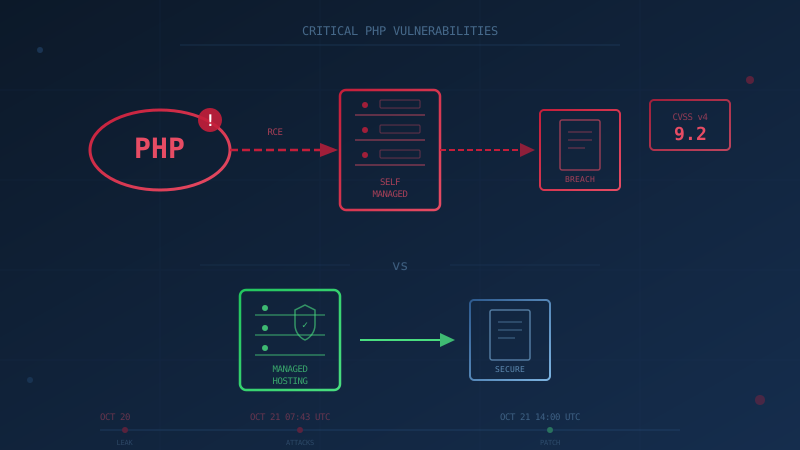
Two critical remote code execution vulnerabilities in PHP, tracked as CVE-2026-109618 and CVE-2026-109619, could affect all PHP versions from PHP 5 onwards, according to CERT-EU advisory 2026-018. On October 21, 2026, the PHP security team released fixed versions and urged all PHP users to update immediately. For Canadian small and medium businesses running websites on PHP (which powers platforms like WordPress, WooCommerce, Magento, and Drupal), this is not just a patching problem. It is a question of whether your business should be in the patching business at all.
What Is PHP2Shell and Why Is It Dangerous?
PHP2Shell is the name researchers have given to two critical vulnerabilities (CVE-2026-109618 and CVE-2026-109619) in PHP's core. Both are rated CVSS v4.0 9.2 by the PHP security team, according to Tenable's FAQ. According to W3Techs data cited by Tenable, PHP is used by 69.3% of websites whose server-side language is known. One security researcher estimates that over 1.3 million internet-exposed hosts are potentially vulnerable, and a separate search counts over 1.9 million internet-exposed hosts running PHP. Cloudflare CTO Dane Knecht confirmed on October 21 that the company is "seeing early attacks emerging," per the same Tenable report.
Which PHP Versions Get a Fix?
The PHP security advisory lists the fixed versions as PHP 8.5.12, 8.4.27, 8.3.36 and 8.2.35. PHP 8.1 and older no longer receive updates from the PHP project. The PHP security team published minimal source backports for PHP 7.4, 8.0 and 8.1 for people who build PHP from source, and some Linux distributions and long term support vendors provide backported fixes. As Huntress warned before the release, end of life PHP versions can otherwise be left exposed with no patch at all. If your website runs on an unsupported PHP version, upgrading to a supported version is the real fix.
Why This Matters More Than a Typical Patch
Most Canadian small businesses do not run their own email servers. They use Microsoft 365 or Google Workspace and let Microsoft or Google handle security updates. Yet many of these same businesses run their own WordPress site on a shared hosting account or a virtual private server where they (or their IT provider) are responsible for keeping PHP patched.
This incident illustrates why that model is increasingly difficult to sustain:
-
Speed matters. Sansec, an e-commerce security firm, says that with technical writeups and an exploit tool now public, mass exploitation is expected, and it advises temporary mitigations for anyone who cannot patch within the hour. A typical small business does not have a process to deploy patches within an hour.
-
End-of-life software cannot be fixed. If your hosting environment runs an unsupported PHP version, you have no path to a patch. The Canadian Centre for Cyber Security's ITSAP.10.096 guidance states: "We recommend that you replace systems and devices when the manufacturer no longer provides software support."
-
Configuration changes are not a fix. PHP core developer Gina Peter Banyard stated that "the only mitigation is patching / upgrading PHP," according to Tenable. The PHP security advisory lists temporary settings that reduce exposure to specific attack paths, but says they "do not make an installation safe."
What Does Canadian Guidance Say?
The Canadian Centre for Cyber Security has not issued a specific advisory for these PHP vulnerabilities as of this writing. However, the CCCS ITSAP.10.096 guidance on software updates states: "If a vendor issues a patch to resolve a security issue, your organization should take steps to apply it as soon as possible."
CERT-EU's advisory recommends that organizations unable to patch immediately "consider isolating internet-facing applications from public networks until a fix is available." Now that fixed versions are out, that means taking your website offline or placing it behind a VPN until you have updated PHP.
The CCCS Baseline Controls for small and medium organizations include automatic patching as a core recommendation. Control BC.2.1 states: "Organizations should enable automatic patching for all software and hardware OR establish full vulnerability and patch management solutions." The guidance also notes that "smaller organizations can achieve the same cyber security outcome as large organizations by simply accepting the risks of patching by default."
What Are the PIPEDA Implications If You Are Breached?
If an attacker exploits PHP2Shell to access customer data on your website, you may have a mandatory breach reporting obligation under PIPEDA.
The Office of the Privacy Commissioner of Canada states that organizations subject to PIPEDA must:
- Report to the Privacy Commissioner breaches of security safeguards involving personal information that pose "a real risk of significant harm" to individuals
- Notify affected individuals about those breaches
- Keep records of all breaches for two years
"Significant harm" includes identity theft, financial loss, and damage to reputation, according to the same OPC guidance. A breach that exposes customer names, email addresses, passwords, or payment information from your e-commerce site would likely meet this threshold.
Notification to affected individuals must be given "as soon as feasible" after you determine that a breach creating a real risk of significant harm has occurred, so assess any suspected compromise promptly.
Why Attackers Move Faster Than Most Businesses Can Patch
The Canadian Centre for Cyber Security's National Cyber Threat Assessment 2025-2026 notes that "cybercriminals driven by profit are increasingly benefiting from new illicit business models to access malicious tools and are using artificial intelligence to enhance their capabilities."
This is not speculation about some distant future. For a vulnerability like PHP2Shell, the gap between patch release and mass exploitation is now measured in hours, not days. Sansec reported that Cloudflare observed early attacks at 07:43 UTC on October 21, about six hours before the patch release. Automated scanning and exploitation tools mean that every internet-facing PHP server is being tested for vulnerabilities continuously.
A small business with a part-time IT contractor checking in weekly cannot compete with that pace.
The Case for Managed Hosting
One practical response to this reality is to move websites and web applications off servers where you are responsible for patching PHP.
A managed hosting platform (whether a managed WordPress host, a platform-as-a-service provider, or a website builder with built-in hosting) handles infrastructure updates as part of the service. When PHP releases an emergency patch, their operations team applies it across all customer sites, often within hours or less. You do not need to know the patch exists, understand how to apply it, or wake up in the middle of the night to deploy it.
This is not about whether you could patch your own server. It is about whether patching servers is the best use of your limited time and attention, and whether your business can afford the window of exposure when you are slower than the attackers.
What About Sites That Must Self-Host?
Some Canadian businesses have legitimate reasons to run their own infrastructure: custom applications, compliance requirements that mandate specific hosting environments, or specialized workloads that managed platforms cannot support.
For those organizations, the minimum steps from this incident are:
-
Inventory every PHP installation. Huntress recommends checking not just web servers but vendor appliances and Windows software that bundle
php.exeorphp-cgi.exe. You cannot patch what you do not know exists. -
Confirm you are on a supported PHP version. If you are running PHP 8.1 or earlier, plan an upgrade to a supported version; the PHP project no longer updates those branches.
-
Establish a process for emergency patches. The CCCS baseline guidance recommends automatic patching or a full patch management process. For a flaw with early attacks already reported and a CVSS of 9.2, plan to patch within hours, not days.
-
Consider network-level isolation. CERT-EU recommends isolating internet-facing applications from public networks if you cannot patch immediately, and the PHP security advisory lists temporary configuration changes that reduce exposure. That might mean placing your site behind a web application firewall like Cloudflare (which has deployed WAF rules for known exploits, per Tenable) or taking it offline until you can update.
The Bigger Picture: Exposure You Control vs. Exposure You Accept
This vulnerability is a useful moment to revisit a broader question: what internet-facing attack surface does your business actually need?
If your website collects customer data, processes payments, or hosts a customer portal, it is a target. Every unpatched day is a day that target is exposed to automated scanning by attackers who can weaponize vulnerabilities faster than most businesses can respond.
The CCCS Baseline Controls exist because the Cyber Centre recognizes that small and medium organizations need a practical path to security without enterprise-scale resources. For many businesses, the practical path for their website is to delegate infrastructure security to a provider whose job it is to keep PHP (and everything else) patched.
For businesses that keep sensitive data and applications reachable only on private networks, limiting what is exposed to the public internet reduces the surface area that vulnerabilities like PHP2Shell can exploit.
One Question to Ask Your IT Provider This Week
"If a critical vulnerability in our website's infrastructure is announced today, what is our process to have it patched, and how many hours will that take?"
If the answer is "we check in weekly" or "we wait for the hosting provider to get to it," this incident is a prompt to revisit whether that timeline matches the risk.
Next Step
Not sure where your organization stands on patch management, website security, or the other CCCS Baseline Controls? Our free cybersecurity assessment evaluates your business against all 13 control areas, runs entirely in your browser, and gives you specific recommendations without collecting your answers.
How prepared is your business?
Find out where you stand against Canada's 13 Baseline Cyber Security Controls. The assessment takes under 30 minutes and your answers stay in your browser.
Check Your ScoreFrequently Asked Questions
What is the PHP2Shell vulnerability?
PHP2Shell refers to two critical vulnerabilities in PHP, CVE-2026-109618 and CVE-2026-109619, both rated CVSS v4.0 9.2 by the PHP security team. According to CERT-EU, these remote code execution flaws could affect all PHP versions from PHP 5 onwards. The PHP security team released fixed versions PHP 8.5.12, 8.4.27, 8.3.36 and 8.2.35 on October 21, 2026.
Which PHP versions are affected by PHP2Shell?
CERT-EU advisory 2026-018 states these vulnerabilities could affect all PHP versions from PHP 5 onwards. The PHP security team fixed them in PHP 8.5.12, 8.4.27, 8.3.36 and 8.2.35. PHP 8.1 and older no longer receive updates from the PHP project, although the team published minimal source backports for PHP 7.4, 8.0 and 8.1 for people who build PHP themselves.
Do Canadian businesses have to report a breach caused by this vulnerability?
Yes, if the breach creates a real risk of significant harm. The Office of the Privacy Commissioner of Canada states that organizations subject to PIPEDA must report breaches involving personal information to the OPC and notify affected individuals when a breach poses a real risk of significant harm. Affected individuals must be notified as soon as feasible after you determine that such a breach has occurred.
What should a Canadian small business do about PHP2Shell right now?
The Canadian Centre for Cyber Security's ITSAP.10.096 guidance states that if a vendor issues a patch to resolve a security issue, your organization should take steps to apply it as soon as possible. For businesses that cannot patch immediately, CERT-EU recommends isolating internet-facing applications from public networks until a fix is available.
Cite This Page
Suggested citation:
Cybersecurity Canada (2026). PHP2Shell Vulnerability: Why Canadian Businesses Should Rethink Self-Managed PHP Hosting. Retrieved from https://cybersecuritycanada.ca/news/posts/php2shell-why-canadian-businesses-should-rethink-self-managed-php-hosting/
Permanent URL: https://cybersecuritycanada.ca/news/posts/php2shell-why-canadian-businesses-should-rethink-self-managed-php-hosting/ · Published October 21, 2026
Disclaimer: This article is intended for general informational purposes only and does not constitute professional cybersecurity, legal, IT, or compliance advice. While we strive to ensure accuracy, the cybersecurity landscape changes rapidly and information may become outdated. Organizations should consult with qualified cybersecurity professionals and legal counsel to assess their specific situation and develop appropriate security policies. Use of this information is at your own risk. See our Privacy Policy for more information.
Cybersecurity Canada is an independent resource and is not affiliated with, endorsed by, or connected to the Canadian Centre for Cyber Security, the Communications Security Establishment, or the Government of Canada.
How does your organization measure up?
Take our free cybersecurity assessment based on the Canadian Centre for Cyber Security's Baseline Controls. 50 questions, under 30 minutes, 100% confidential. Your answers never leave your browser.
Take the Free Assessment