Third-Party Vendor Data Breach: Lessons from the Crime Stoppers Hack
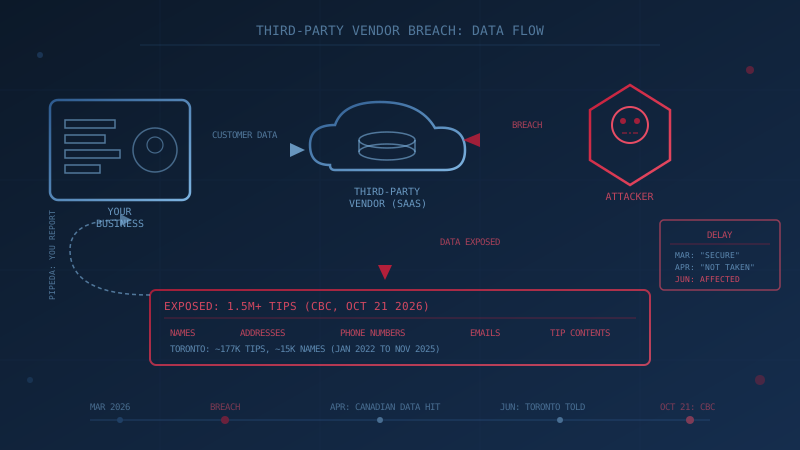
A third-party vendor data breach in March 2026 exposed over 1.5 million Canadian Crime Stoppers tips, according to a CBC investigation published October 21, 2026. The breach demonstrated how sensitive data entrusted to a SaaS platform can be compromised even when the customer organization believes the system is secure. For Canadian small and medium businesses that rely on third-party software to handle customer data, the incident offers a direct lesson: your vendor's security posture is part of your own risk.
The compromised platform was P3, a tip management system owned by U.S.-based Navigate360 and used by Crime Stoppers programs across Canada. Toronto Crime Stoppers, according to CP24 reporting on October 21, 2026, stated that Navigate360 told it from March onward that the platform was secure, and in April that Toronto's data had not been taken. It was not until June that Navigate360 informed Toronto that its data had been affected. This gap between initial reassurance and eventual disclosure is the vendor risk scenario Canadian businesses need to plan for.
How Many Canadian Tips Were Exposed?
CBC's investigation, based on analysis of the breached data, found that more than 1.5 million tips submitted to Canadian Crime Stoppers programs over approximately 25 years were captured in the hack. Roughly half of those tips contained personally identifiable information, including names, addresses, phone numbers, and email addresses.
Toronto Crime Stoppers, according to its October 21, 2026 statement as reported by CP24, said Navigate360 confirmed that 176,859 tips submitted between January 2022 and November 2025 were stolen. Those tips included 14,973 names. Toronto Crime Stoppers also said, as CityNews reported, that Navigate360 has not told it whether those names belong to people who submitted tips, people named in those tips, or both.
The Toronto Police Service issued a statement the same day, noting that it had temporarily suspended its use of Crime Stoppers while it reviews the information and assesses additional safeguards.
Why Did the Vendor's Reassurance Fail?
Toronto Crime Stoppers' timeline, as reported by CP24, shows a pattern that should concern any organization relying on third-party software:
- March 25, 2026: Navigate360 confirmed hackers accessed P3 using a stolen customer account login but stated the system was "safe and fully operational."
- April 2026: Navigate360 advised that some Canadian data was stolen but not Toronto's.
- June 9, 2026: Navigate360 informed Toronto Crime Stoppers that its data was affected after all.
The delay between a vendor's initial reassurance and the later disclosure of actual impact is not unusual. Breach investigations take time, vendors may not immediately know the full scope, and vendors have incentives to minimize early disclosures. The practical result is that you may operate under a false sense of security for months while your data has already been compromised.
What Canadian Businesses Should Learn About Vendor Risk
The Crime Stoppers breach illustrates several vendor risk principles that apply directly to Canadian SMBs.
Reassurance Is Not Evidence
When Toronto Crime Stoppers asked Navigate360 about the breach, the vendor said the platform was secure and, in April, that Toronto's data was not affected. That turned out to be incorrect. A vendor's verbal or written assurance is not the same as evidence. When a vendor reports a breach, ask for specifics: what systems were affected, what data was accessed, what logs were reviewed, what forensic analysis was performed. If the vendor cannot answer, their reassurance is not yet grounded in fact.
Your Data Retention Is Their Data Retention
CBC's investigation noted that the breached data included decades of historical tips, suggesting that detailed records were retained on the P3 platform long after tips were processed and sent to investigators. For Canadian businesses, this raises the question: what happens to your data on a vendor's system after you no longer need it there?
Under PIPEDA, the Office of the Privacy Commissioner advises organizations to keep personal information only as long as it is needed to serve the purposes for which it was collected, and PIPEDA's accountability principle makes your organization responsible for personal information under its control. But if your vendor retains a copy of that data indefinitely, your data minimization efforts are undermined. Your contract with the vendor should specify when and how data is deleted, and you should periodically verify that deletion actually occurs.
Your Breach Notification Obligation Does Not Disappear
The Office of the Privacy Commissioner of Canada has published guidance on mandatory breach reporting that addresses exactly this scenario. The OPC states that when an organization transfers personal information to a third party for processing and a breach occurs with that processor, the principal organization remains responsible for breach reporting.
In the OPC's words: "PIPEDA's accountability principle provides that an organization remains responsible for the personal information it has transferred to a third party for processing." The organization must have "sufficient contractual arrangements in place with the processor to address compliance with the breach provisions set out in PIPEDA."
For Canadian SMBs, this means that when your SaaS vendor is breached and your customer data is exposed, you may still be required to report the breach to the OPC if there is a real risk of significant harm. You may also be required to notify affected individuals. Your vendor's breach is, in this sense, your breach too.
Contractual Terms Matter Before the Breach
Most vendor contracts include service level agreements for uptime but say little about security incident response. The Crime Stoppers case illustrates what can go wrong: months passed between the breach, the first notification, and the confirmation of impact. Organizations that want timely notification need to specify it in advance.
Key contract terms to negotiate, as we covered in our guide on vendor and third-party risk:
- Breach notification timeline: Require the vendor to notify you within 24 to 72 hours of discovering a breach affecting your data.
- Scope disclosure: Require the vendor to disclose what data was affected and what forensic steps were taken.
- Data retention and deletion: Specify when your data is deleted from the vendor's systems and require confirmation.
- Subcontractor disclosure: Require the vendor to disclose if your data is shared with subcontractors.
If these terms are not in your contract before a breach, you have limited recourse after one.
What Canadian SMBs Should Do Now
If the Crime Stoppers breach has prompted a review of your own vendor relationships, here are practical steps to take.
1. List Your Vendors That Hold Sensitive Data
Start with an inventory of every SaaS platform, managed service provider, and third-party tool that stores or processes customer data, employee data, or financial information. For each vendor, note what data they hold, how long they retain it, and what your contract says about breach notification.
2. Ask Vendors for Evidence, Not Reassurance
For your most critical vendors, request documentation of their security practices. This might include SOC 2 reports, penetration test summaries, or their incident response procedures. If a vendor cannot provide any documentation, that is information worth having.
3. Confirm Data Retention and Deletion Policies
Ask each vendor: what happens to my data after our contract ends? What happens to processed records that are no longer needed? If the vendor retains data indefinitely "for backup purposes," understand what that means for your data minimization obligations.
4. Review Your Own Breach Response Plan
If a vendor you rely on is breached tomorrow, do you know who in your organization determines whether the breach meets PIPEDA's reporting threshold? Do you have the OPC's breach report form bookmarked? Do you know what you would tell affected customers? These questions are easier to answer before an incident than during one. Our guide on building an incident response plan covers the fundamentals.
5. Assess Your Vendor Risk Posture
If you are not certain which vendors represent the greatest risk, our free cybersecurity assessment can help identify gaps. It reviews all 13 of the Canadian Centre for Cyber Security's Baseline Controls, including securing cloud and outsourced IT services, and takes under 30 minutes.
One Question to Ask Your IT Provider
The Crime Stoppers breach exposed data that tipsters assumed was protected by a system built for anonymity. The underlying cause was a breach at a third-party vendor that Crime Stoppers trusted to secure its data.
Before your next meeting with your IT provider or managed service provider, ask this question:
"Which of our vendors or SaaS platforms store our customer data, and what contractual terms do we have for breach notification?"
If the answer is "I don't know" or "we'd have to check," that is where your vendor risk work should start.
The Crime Stoppers hack is a reminder that your security posture includes the security posture of every vendor that touches your data. You cannot outsource accountability. When a vendor is breached, the obligation to notify customers and regulators may still fall on you.
How prepared is your business?
Find out where you stand against Canada's 13 Baseline Cyber Security Controls. The assessment takes under 30 minutes and your answers stay in your browser.
Check Your ScoreFrequently Asked Questions
What happened in the Crime Stoppers data breach?
In March 2026, hackers breached P3, a tip management platform owned by Navigate360 and used by Crime Stoppers programs across Canada. According to CBC's October 21, 2026 investigation, more than 1.5 million Canadian tips were exposed, with roughly half containing personally identifiable information. Toronto Crime Stoppers reported that approximately 177,000 tips from January 2022 to November 2025 were stolen, including nearly 15,000 names.
Who is responsible when a third-party vendor is breached?
Under PIPEDA, the organization that controls the personal information remains responsible even when that data is processed by a third party. The Office of the Privacy Commissioner of Canada states that the principal organization has control and therefore responsibility for breach reporting when a breach occurs at a third-party processor. Organizations must have contractual arrangements in place to address breach notification and compliance.
How can Canadian businesses reduce third-party vendor data breach risk?
Practical steps include: require contractual breach notification timelines (24 to 72 hours), ask vendors for evidence of security practices rather than accepting reassurance, define data retention and deletion requirements, limit the data you share with vendors to what is operationally necessary, and verify what information remains with the vendor after processing is complete.
What should a business do when its vendor is breached?
First, determine the scope of data affected and assess whether the breach poses a real risk of significant harm. Under PIPEDA, you may be required to report the breach to the Privacy Commissioner and notify affected individuals. Document your assessment, preserve communications from the vendor, and review whether your contractual breach notification terms were met. Consult legal counsel if personal information was involved.
Cite This Page
Suggested citation:
Cybersecurity Canada (2026). Third-Party Vendor Data Breach: Lessons from the Crime Stoppers Hack. Retrieved from https://cybersecuritycanada.ca/news/posts/third-party-vendor-data-breach-canada-crime-stoppers-lessons/
Permanent URL: https://cybersecuritycanada.ca/news/posts/third-party-vendor-data-breach-canada-crime-stoppers-lessons/ · Published October 22, 2026
Disclaimer: This article is intended for general informational purposes only and does not constitute professional cybersecurity, legal, IT, or compliance advice. While we strive to ensure accuracy, the cybersecurity landscape changes rapidly and information may become outdated. Organizations should consult with qualified cybersecurity professionals and legal counsel to assess their specific situation and develop appropriate security policies. Use of this information is at your own risk. See our Privacy Policy for more information.
Cybersecurity Canada is an independent resource and is not affiliated with, endorsed by, or connected to the Canadian Centre for Cyber Security, the Communications Security Establishment, or the Government of Canada.
How does your organization measure up?
Take our free cybersecurity assessment based on the Canadian Centre for Cyber Security's Baseline Controls. 50 questions, under 30 minutes, 100% confidential. Your answers never leave your browser.
Take the Free Assessment