Idunno.AntiCsrf CVE: An SMB Checklist

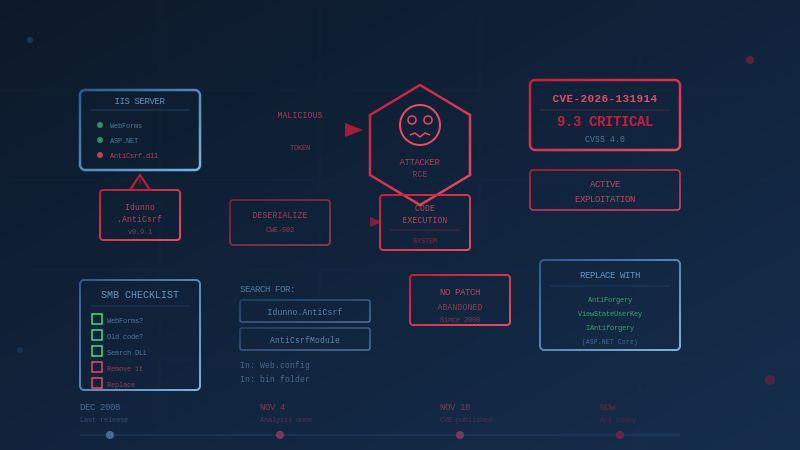
CVE-2026-131914 is a critical flaw in Idunno.AntiCsrf, a free add-on for older ASP.NET WebForms websites, and Mandiant's advisory published on November 18, 2026 says "active exploitation in the wild has been observed." The flaw scores 9.3 out of 10. One web request, with no password, can let an attacker run code on the Windows server hosting the site. The add-on was last released in December 2008 and will never be patched.
For most Canadian small and medium businesses this will be a quick check with a "no" at the end. For the few running older custom web applications, it may be urgent. The hard part is knowing which group you are in.
What is CVE-2026-131914?
CVE-2026-131914 is an insecure deserialization flaw (CWE-502) in Idunno.AntiCsrf.dll version 0.9.1.0, also called 0.9.1 Beta. The CVE record published by NVD describes it as affecting "Idunno.AntiCsrf versions through 0.9.1 Beta on ASP.NET" and allowing "remote unauthenticated attackers to execute code." Mandiant rates it 9.3, Critical, under CVSS 4.0.
The add-on was built to protect WebForms sites from cross-site request forgery, a trick where a malicious page submits a form using a visitor's logged-in session. According to Mandiant, the add-on reads the protection token it receives without checking that it is genuine. An attacker can hide instructions inside that token, and the server runs them as the IIS worker process, which Mandiant calls "complete compromise of the web application server."
Is anyone exploiting it yet?
Mandiant says yes, based on its own incident response work. Google Cloud's FLARE team found the flaw while investigating an intrusion with Mandiant, finished its analysis on November 4, 2026, and Mandiant published the CVE on November 18. The Hacker News reported that Google did not disclose further details and had nothing more to share.
What is not yet known:
- Who is behind it. Mandiant has not named an attacker.
- How many organizations were hit. No victim count has been published, and no Canadian cases have been reported publicly.
- Government listing. As of November 24, 2026, the flaw was not in the US Cybersecurity and Infrastructure Security Agency (CISA) Known Exploited Vulnerabilities catalog.
None of those gaps make it safe to wait. A flaw that needs no login and has no patch is the kind attackers tend to look for at scale.
Is my business affected?
Only websites and web applications built on ASP.NET WebForms that include the Idunno.AntiCsrf add-on are affected. This is not a flaw in Microsoft's ASP.NET itself, and Microsoft's own anti-forgery features are among the replacements Mandiant recommends. A typical WordPress or Shopify site does not use this add-on.
Work through three questions with whoever builds or hosts your web applications:
- Do we run any ASP.NET WebForms applications? Pages ending in ".aspx" are a common sign. Think beyond the main website: customer portals, online quoting or booking tools, intranets and staff time-entry systems.
- Were any of them first built many years ago? The add-on was last released in 2008 on the now-retired CodePlex site, so it is most likely to appear in older code that has been carried forward.
- Has someone searched for it by name? Mandiant says to search every Web.config file and bin folder for "Idunno.AntiCsrf" and "AntiCsrfModule." Copies that were recompiled in-house will not match known file fingerprints, so a name search is the reliable test.
If a web developer or agency maintains your application, ask them to confirm the search in writing. Under the shared responsibility model, your hosting provider looks after the servers, but the code on your site is still your business's risk.
What should you do if it turns up?
Remove it, replace it, then look for signs of attack. Mandiant's advisory sets out the steps:
- Remove the add-on completely. Delete its entries from Web.config, remove any code references to it, and delete Idunno.AntiCsrf.dll from the bin folder.
- Replace the protection with a supported option: System.Web.Helpers.AntiForgery, Page.ViewStateUserKey with MAC-verified ViewState, or ASP.NET Core's IAntiforgery.
- Review IIS logs for unusual POST requests to .aspx pages that returned HTTP 302 or 500 with larger than normal request sizes.
- If you find evidence of exploitation, rotate every secret stored in Web.config and applicationHost.config (machine keys, encryption keys and database passwords) and check the web folders for files nobody recognizes.
A web application firewall can help filter attack traffic, but our web application security control page notes it is an additional layer, not a replacement for fixing the code. Removing the add-on is the fix.
What if customer data may have been exposed?
Treat a confirmed match on an internet-facing system as a possible incident. Removing the file does not remove anything an attacker may already have planted, such as a web shell. GBHackers notes that attackers in this position can steal secrets from configuration files, including database credentials, and install persistent footholds.
If the application holds personal information about customers or staff, your obligations may extend beyond the technical cleanup. As our guide on how to report a cyber attack in Canada explains, PIPEDA may require a report to the Office of the Privacy Commissioner when personal information was exposed, and provincial privacy laws may also apply. Get qualified legal advice on your specific situation. Having a contact list and incident response plan ready before you need it makes those first calls much faster.
How this fits Canada's baseline controls
The Canadian Centre for Cyber Security's baseline controls treat old, unsupported software as a priority risk. Our patch management control page notes that the Cyber Centre recommends identifying and replacing end-of-life software as a priority, because it no longer receives security updates from its vendor.
Idunno.AntiCsrf shows why that list has to include more than operating systems and office software. A single file added to a website in 2008 can sit unnoticed for years. Ask your IT lead or web developer one question this week: "Which of our web applications contain third-party code that is no longer maintained, and how would we know?"
These facts are accurate as of November 24, 2026, based on Mandiant advisory MNDT-2026-0048, the CVE record published by NVD, and reporting from The Hacker News and GBHackers.
How prepared is your business?
Find out where you stand against Canada's 13 Baseline Cyber Security Controls. The assessment takes under 30 minutes and your answers stay in your browser.
Check Your ScoreCite This Page
Suggested citation:
Cybersecurity Canada (2026). Idunno.AntiCsrf CVE: An SMB Checklist. Retrieved from https://cybersecuritycanada.ca/news/posts/idunno-anticsrf-cve-2026-131914-canadian-smb-checklist/
Permanent URL: https://cybersecuritycanada.ca/news/posts/idunno-anticsrf-cve-2026-131914-canadian-smb-checklist/ · Published November 24, 2026
Disclaimer: This article is intended for general informational purposes only and does not constitute professional cybersecurity, legal, IT, or compliance advice. While we strive to ensure accuracy, the cybersecurity landscape changes rapidly and information may become outdated. Organizations should consult with qualified cybersecurity professionals and legal counsel to assess their specific situation and develop appropriate security policies. Use of this information is at your own risk. See our Privacy Policy for more information.
Cybersecurity Canada is an independent resource and is not affiliated with, endorsed by, or connected to the Canadian Centre for Cyber Security, the Communications Security Establishment, or the Government of Canada.
How does your organization measure up?
Take our free cybersecurity assessment based on the Canadian Centre for Cyber Security's Baseline Controls. 50 questions, under 30 minutes, 100% confidential. Your answers never leave your browser.
Take the Free Assessment