Bell Breach Scams to Watch For

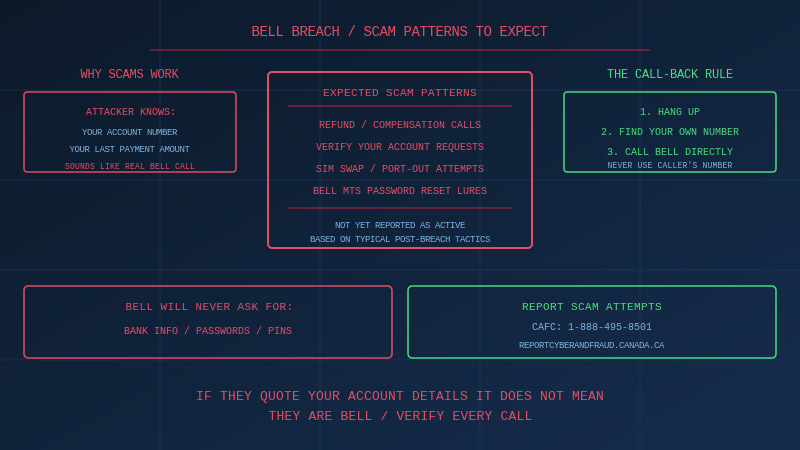
The Bell breach may have exposed data that makes scam calls and messages more convincing. According to Bell's notice page, impacted data may have included account numbers, product information, and the date and amount of the last payment. A caller who quotes these details sounds informed. This page explains the scam patterns to expect and how to protect yourself.
Why account number and last payment matter
A generic scam call says "there is a problem with your account." A targeted call quotes your real account number and the date and amount of your last payment, and says the payment did not process. That detail can make the call sound like it came from Bell's billing system. Knowing your account details does not prove the caller is Bell.
The Cyber Centre's guidance on social engineering (ITSAP.00.166) says spear phishing messages "often include personalized details to make them appear more convincing." The Cyber Centre's guidance on voice phishing (ITSAP.00.102) says that in targeted vishing attempts, threat actors look for "personal, work-related or role-specific details to make the call interaction more believable." An account number and payment amount are exactly that kind of detail.
Scam patterns to expect
The following patterns have not been reported as active Bell campaigns. They are what attackers typically do with this type of data, based on Cyber Centre guidance and past breach follow-ons.
Refund or compensation calls: A caller claims Bell is offering a refund or compensation for the breach. They ask for your bank account to process the refund, or they ask you to confirm your identity by reading back a code they just sent. Bell has not announced any refund or compensation for this incident, and Bell says it will never contact you to ask for bank account information, passwords or PINs.
Account verification requests: A caller or text says there is unusual activity on your Bell account and asks you to verify your identity. They quote your account number and last payment to sound legitimate, then ask for your PIN, password, or a one-time code. This is not Bell. Hang up and call Bell directly.
SIM swap or port-out attempts: An attacker contacts Bell (or another carrier) pretending to be you, using your name, address, and account number to authorize a SIM swap or number transfer. If successful, they receive your calls and texts, including two-factor authentication codes. Add a carrier PIN to your wireless account if you have not already. Our guide to SIM swapping explains how this attack works.
Bell MTS password reset lures: Bell confirmed a separate incident involving Bell MTS email, with account lockouts and password resets. Some users may expect a password reset email. Attackers may send fake reset emails. Go to the Bell MTS login page directly rather than clicking any link in a message.
The call-back rule
Hang up and call Bell using a number you found yourself. The Cyber Centre's ITSAP.00.102 says: "Hang up and call back using a known, trusted number" and "Do not use numbers provided by the caller or your phone's callback option."
Where to find a trusted number:
- Your last Bell bill (paper or PDF)
- The Bell website at bell.ca under Contact Us
- The number you have saved in your contacts from before this week
Do not use any number the caller gives you, any link in a text message, or any callback button on your phone.
What Bell says it will never ask for
Bell's notice page says: "Bell will never contact you to ask for bank account information, passwords or PINs."
If a call or message asks for your bank account information, your Bell password or a PIN, it is not Bell. Treat a request for a one-time code, a verification code or your Social Insurance Number the same way: end the call, then call back on a number you found yourself and report it.
Where to report
The Canadian Anti-Fraud Centre says you can report a fraud or cybercrime online at reportcyberandfraud.canada.ca, whether you are a victim or a witness. The CAFC phone line is 1-888-495-8501, Monday to Friday, 10 AM to 4:45 PM Eastern.
Report suspicious calls or texts to Bell through their official channels. If you gave out bank information, contact your bank immediately. If you lost money or personal information, also contact your local police.
Related guides
- Bell Data Breach: Were You Affected? for verification steps
- Bell Canada Breach: Client Steps for business customers
- When Cyber Attacks Become Physical Threats covers SIM swapping
How prepared is your business?
Find out where you stand against Canada's 13 Baseline Cyber Security Controls. The assessment takes under 30 minutes and your answers stay in your browser.
Check Your ScoreFrequently Asked Questions
Why does the Bell breach make scams more believable?
The exposed data includes account numbers, product information, and the date and amount of the last payment, according to Bell. A scammer who quotes your account number and last payment can sound like a real Bell representative. That personal detail is why the call-back rule matters: hang up and call a number you already had on file.
What scam patterns should Bell customers expect?
Based on the data exposed, expect refund or compensation calls, account verification requests that quote your last payment, SIM swap or port-out attempts, and password reset lures for Bell MTS email users. These patterns have not been reported as active Bell campaigns, but they match what attackers do with this type of data.
How do I verify a call that claims to be from Bell?
Hang up and call Bell using a number you already had, such as the one on your last bill or the official Bell customer service number. Do not use any number the caller gives you or any callback button on your phone. Bell says it will never contact you to ask for bank account information, passwords, or PINs.
What is the call-back rule?
The call-back rule means hanging up and calling the organization back on a number you found yourself, not one provided by the caller. The Canadian Centre for Cyber Security says to hang up and call back using a known, trusted number. This protects against caller ID spoofing and social engineering.
Where do I report a Bell scam attempt?
Report to the Canadian Anti-Fraud Centre at 1-888-495-8501 or online at reportcyberandfraud.canada.ca. You can report whether you are a victim or a witness. If you lost money or personal information, also contact your local police and your bank.
Will Bell ask me for my PIN or password?
No. Bell's notice page says Bell will never contact you to ask for bank account information, passwords, or PINs. Any call or message requesting these is not from Bell.
Cite This Page
Suggested citation:
Cybersecurity Canada (2026). Bell Breach Scams to Watch For. Retrieved from https://cybersecuritycanada.ca/news/posts/bell-breach-scams-to-watch-for/
Permanent URL: https://cybersecuritycanada.ca/news/posts/bell-breach-scams-to-watch-for/ · Published November 24, 2026
Disclaimer: This article is intended for general informational purposes only and does not constitute professional cybersecurity, legal, IT, or compliance advice. While we strive to ensure accuracy, the cybersecurity landscape changes rapidly and information may become outdated. Organizations should consult with qualified cybersecurity professionals and legal counsel to assess their specific situation and develop appropriate security policies. Use of this information is at your own risk. See our Privacy Policy for more information.
Cybersecurity Canada is an independent resource and is not affiliated with, endorsed by, or connected to the Canadian Centre for Cyber Security, the Communications Security Establishment, or the Government of Canada.
How does your organization measure up?
Take our free cybersecurity assessment based on the Canadian Centre for Cyber Security's Baseline Controls. 50 questions, under 30 minutes, 100% confidential. Your answers never leave your browser.
Take the Free Assessment