A Brief History of Cybersecurity in Canada: From Cold War Signals Intelligence to the Canadian Centre for Cyber Security
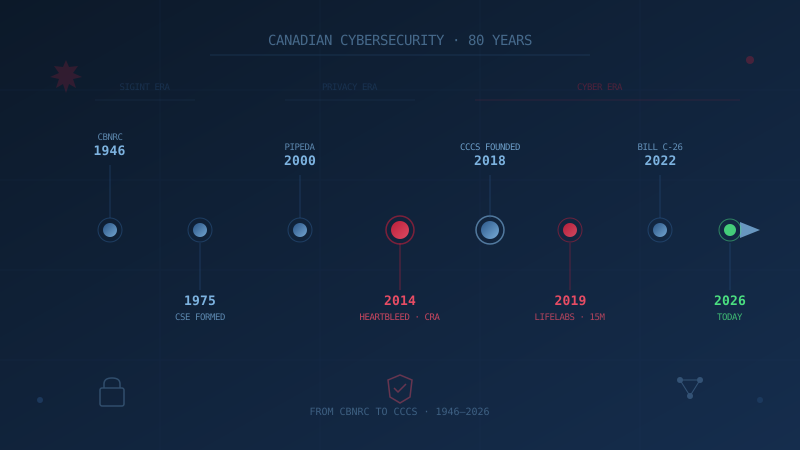
Canadian cybersecurity did not begin in 2018 with the establishment of the Canadian Centre for Cyber Security. It is the latest chapter in an institutional history that stretches back to the signals intelligence agencies of the Second World War, through the early internet era, and into the modern regulatory landscape that Canadian businesses operate in today.
Understanding that history is useful. It explains why Canadian cybersecurity policy is shaped the way it is, why certain agencies have the mandates they do, and why the country's cyber legal framework is a patchwork of federal and provincial legislation rather than a single statute. This article is a plain-language timeline.
1941–1975: Signals Intelligence and the Origins of CSE
Canada's modern cybersecurity institutions trace back to the Examination Unit, established in 1941 as a civilian signals intelligence organization cooperating with British and American counterparts during the Second World War. After the war, Canadian signals intelligence work continued under the National Research Council as the Communications Branch of the National Research Council (CBNRC), founded in 1946.
On April 1, 1975, CBNRC was transferred from the National Research Council to the Department of National Defence and renamed the Communications Security Establishment (CSE). CSE's dual mandate — foreign signals intelligence and the protection of Government of Canada electronic information and infrastructure — is the foundation of Canadian cybersecurity to this day.
1988–2001: The Birth of the Public Internet and the First Canadian Cyber Laws
Through the 1980s and into the 1990s, Canada's cybersecurity work was almost entirely a government-to-government concern. Civilian awareness of the field was limited. That began to change with the public adoption of the internet.
Two pieces of legislation from this era remain foundational:
- The Criminal Code amendments of 1985 and later updates introduced the Canadian offences for unauthorized use of a computer (section 342.1) and mischief in relation to computer data (section 430(1.1)). These provisions remain the legal basis for cybercrime prosecution in Canada.
- The Personal Information Protection and Electronic Documents Act (PIPEDA) received Royal Assent on April 13, 2000, and came into force in stages between 2001 and 2004. PIPEDA established Canada's federal framework for private-sector privacy and would later become the default statute under which Canadian businesses must safeguard personal information.
In the same period, the first provincial private-sector privacy statutes began to emerge — Quebec's original private-sector privacy act dates to 1993 and was the first of its kind in North America.
2001–2013: Early-Era Threats and the Advisory State
The decade after 9/11 saw the rapid growth of the commercial internet in Canada and a corresponding rise in cybercrime. Canadian cybersecurity policy during this period was largely advisory. CSE and Public Safety Canada published guidance, but there was no single national cyber strategy until 2010, when the federal government released Canada's Cyber Security Strategy — a three-pillar policy document focused on securing government systems, partnering with industry, and helping Canadians.
In 2010, Canada also enacted Canada's Anti-Spam Legislation (CASL), among the strictest anti-spam and anti-malware laws in the world. CASL came into force in stages starting July 1, 2014, and remains jointly enforced by the CRTC, the Competition Bureau, and the OPC.
Public Safety Canada's Canadian Cyber Incident Response Centre (CCIRC) was established during this period to coordinate response to cyber incidents affecting Canadian critical infrastructure.
2014: Heartbleed and a Canadian Watershed
On April 7, 2014, researchers publicly disclosed Heartbleed, a vulnerability in the widely used OpenSSL cryptographic library. Within days, the Canada Revenue Agency announced that its systems had been compromised as a result, with approximately 900 Social Insurance Numbers exfiltrated. The CRA extended the tax filing deadline, an unprecedented measure.
The CRA Heartbleed incident was a turning point. For the first time, a Canadian federal cybersecurity event became a top national news story, demonstrating to both government and the public that cyber risk was not theoretical. The RCMP's investigation led to the arrest of a 19-year-old London, Ontario man — one of the first high-profile cybercrime prosecutions in Canada.
2015–2018: Rising Threats, Rising Institutions
The years after Heartbleed brought a steady stream of high-impact incidents affecting Canadian organizations and a corresponding institutional response.
- Digital Privacy Act (2015): PIPEDA was amended to strengthen consent, add mandatory breach notification (which came into force in November 2018), and introduce record-keeping obligations.
- Canadian Centre for Cyber Security (2018): On October 1, 2018, the federal government consolidated cybersecurity operations from CSE, Public Safety Canada (CCIRC), and Shared Services Canada into a single, unified authority — the Canadian Centre for Cyber Security (CCCS). The CCCS became Canada's single authoritative source for cyber security advice, guidance, services, and support.
- Baseline Cyber Security Controls (2019): The CCCS published the first version of the Baseline Cyber Security Controls for Small and Medium Organizations — the 13-control framework that has since become the foundation for Canadian SMB cybersecurity practice and for the CyberSecure Canada certification program.
- CSE Act (2019): The Communications Security Establishment Act, enacted as part of Bill C-59 and coming into force in August 2019, gave CSE its first stand-alone statutory mandate, including explicit authority for defensive and active cyber operations abroad.
2019: LifeLabs — The Largest Canadian Privacy Breach
In December 2019, LifeLabs — one of Canada's largest medical diagnostic laboratory companies — disclosed a cyberattack that exposed the personal and health information of approximately 15 million Canadians. Data accessed included names, addresses, dates of birth, health card numbers, and lab test results going back to 2016.
The joint investigation by the Information and Privacy Commissioner of Ontario and the Office of the Information and Privacy Commissioner for BC concluded that LifeLabs had failed to take reasonable steps to protect the personal health information in its custody. The incident remains, by volume of affected individuals, the largest privacy breach in Canadian history.
For Canadian regulators and businesses, the LifeLabs incident reinforced that PIPEDA and provincial privacy laws apply at real scale, that the Office of the Privacy Commissioner of Canada and its provincial counterparts are willing to investigate jointly, and that the cost of cyber incident response and litigation can be substantial.
2020–2022: Pandemic, Ransomware, and the Municipal Wave
The COVID-19 pandemic accelerated digital transformation across Canadian organizations, pushed remote work into nearly every sector, and expanded the attack surface accordingly. The same period saw the rise of ransomware-as-a-service and a wave of high-impact attacks on Canadian municipalities, hospitals, and critical infrastructure:
- Saint John, NB (2020): ransomware shut down the city's IT systems for weeks
- Newfoundland and Labrador Health (2021): cyberattack on the provincial health system disrupted services for months
- Several Ontario municipalities: a recurring pattern of local-government ransomware incidents throughout 2020–2022
- Global Affairs Canada (2022): cyberattack disrupted internet-based services
- Indigo Books & Music (2023): ransomware attack, publicly disclosed refusal to pay the ransom
These incidents shaped Canadian cybersecurity policy discussion through the early 2020s and informed the direction of federal legislation that followed.
2022: Quebec's Law 25 Raises the Bar
Quebec tabled Bill 64 in June 2020 and passed it in September 2021, with phased entry-into-force beginning September 2022. The resulting amendments to Quebec's private-sector privacy act — now widely known as Law 25 — introduced privacy obligations that exceed PIPEDA in several areas, including mandatory privacy impact assessments, data portability rights, and administrative monetary penalties reaching into the tens of millions of dollars.
Law 25 effectively set a new de facto standard for private-sector privacy in Canada and accelerated federal discussion of PIPEDA modernization.
2022–2024: Bill C-26 and the Critical Cyber Systems Protection Act
On June 14, 2022, the federal government introduced Bill C-26, creating two new regimes: amendments to the Telecommunications Act and the new Critical Cyber Systems Protection Act (CCSPA). The CCSPA, once in force, will impose cyber security program requirements and mandatory incident reporting on designated operators in federally regulated telecommunications, finance, energy, and transportation sectors.
Bill C-26 represented the most significant federal cybersecurity legislation in Canadian history — the first statutory obligation on private-sector critical infrastructure operators to implement a defined cyber security program. We cover the implications in depth in What Canadian Businesses Need to Know About Bill C-26.
2023–2026: AI, Supply Chain, and the Modern Threat Landscape
The most recent years of Canadian cybersecurity history are still being written. Three themes define the current period:
- Generative AI and the phishing arms race: AI-generated phishing emails, voice clones, and deepfakes have dramatically raised the quality and scale of social engineering attacks, as we cover in AI-Powered Phishing: What's Changed for Canadian Businesses.
- Supply chain compromises: The SolarWinds (2020), Kaseya (2021), 3CX (2023), and Notepad++ (2025) compromises demonstrated that attackers reaching Canadian organizations through trusted software channels is now the norm, not the exception.
- Regulatory convergence: The proposed Consumer Privacy Protection Act (Bill C-27), the proposed Artificial Intelligence and Data Act (AIDA), and the operationalization of Bill C-26 are pulling Canadian privacy and cybersecurity law toward a more integrated, more enforceable framework — one that is closer to the European Union's GDPR and NIS2 regimes than the historically lighter-touch Canadian approach.
Where Things Stand Today
As of April 2026, the Canadian cybersecurity landscape that businesses operate in is defined by:
- The Canadian Centre for Cyber Security as the federal authority for cyber advice and defensive operations
- A layered legal framework — PIPEDA, CASL, Bill C-26's CCSPA, provincial privacy legislation, sector-specific regulation — covered in detail in our 2026 guide to Canadian cybersecurity laws
- The Baseline Controls as the most practical framework for SMB cybersecurity, and CyberSecure Canada as its certification expression
- A mature but underused civilian reporting ecosystem — the CCCS, the Canadian Anti-Fraud Centre, the RCMP's National Cybercrime Coordination Unit (NC3), and provincial privacy commissioners
Cybersecurity Canada was built to help Canadian businesses navigate this landscape. Our free cybersecurity assessment evaluates your business against the CCCS Baseline Controls, the framework that sits at the centre of this history and defines the expectations applied to Canadian businesses today.
Frequently Asked Questions
When was the Canadian Centre for Cyber Security established?
The Canadian Centre for Cyber Security (CCCS) was established on October 1, 2018, as part of the Communications Security Establishment. It consolidated the cybersecurity functions of CSE's IT Security Program, Public Safety Canada's Canadian Cyber Incident Response Centre (CCIRC), and Shared Services Canada's Security Operations Centre into a single federal authority for cyber advice and defensive operations.
What was the first major cybersecurity incident in Canada?
Cybercrime affecting Canadian organizations predates public awareness of "cybersecurity" as a category, but the first incident to become a top national news story was the 2014 Canada Revenue Agency breach caused by the Heartbleed OpenSSL vulnerability. Approximately 900 Social Insurance Numbers were exfiltrated, the CRA extended the tax filing deadline, and the RCMP arrested a 19-year-old Canadian who was subsequently charged under section 342.1 of the Criminal Code.
What is the largest privacy breach in Canadian history?
By the number of affected individuals, the 2019 LifeLabs breach is the largest privacy incident in Canadian history, exposing personal and health information for approximately 15 million Canadians. A joint investigation by the Ontario and British Columbia privacy commissioners concluded that LifeLabs had failed to take reasonable steps to protect the information.
When did PIPEDA come into force?
PIPEDA received Royal Assent on April 13, 2000, and came into force in stages between 2001 and 2004. Mandatory breach notification to the Office of the Privacy Commissioner of Canada was added by the Digital Privacy Act (2015) and came into force on November 1, 2018.
What is the difference between CSE and CCCS?
The Communications Security Establishment (CSE) is Canada's foreign signals intelligence and communications security agency, established in its current form in 1975. The Canadian Centre for Cyber Security (CCCS) is a part of CSE established in 2018 and is the public-facing federal authority for cybersecurity advice, defence, and partnership with industry. In everyday usage, CSE is the agency; CCCS is the specific arm of CSE that Canadian businesses and the public interact with on cyber security matters.
How prepared is your business?
Find out where you stand against Canada's 13 Baseline Cyber Security Controls. The assessment takes under 30 minutes and your answers stay in your browser.
Check Your ScoreCite This Page
Suggested citation:
Cybersecurity Canada (2026). A Brief History of Cybersecurity in Canada: From Cold War Signals Intelligence to the Canadian Centre for Cyber Security. Retrieved from https://cybersecuritycanada.ca/news/posts/history-of-cybersecurity-in-canada/
Permanent URL: https://cybersecuritycanada.ca/news/posts/history-of-cybersecurity-in-canada/ · Published April 4, 2026
Disclaimer: This article is intended for general informational purposes only and does not constitute professional cybersecurity, legal, IT, or compliance advice. While we strive to ensure accuracy, the cybersecurity landscape changes rapidly and information may become outdated. Organizations should consult with qualified cybersecurity professionals and legal counsel to assess their specific situation and develop appropriate security policies. Use of this information is at your own risk. See our Privacy Policy for more information.
Cybersecurity Canada is an independent resource and is not affiliated with, endorsed by, or connected to the Canadian Centre for Cyber Security, the Communications Security Establishment, or the Government of Canada.
How does your organization measure up?
Take our free cybersecurity assessment based on the Canadian Centre for Cyber Security's Baseline Controls. 50 questions, under 30 minutes, 100% confidential. Your answers never leave your browser.
Take the Free Assessment