Frontier AI and Cyber Security: What Canada's Cyber Centre Wants Businesses to Do Now
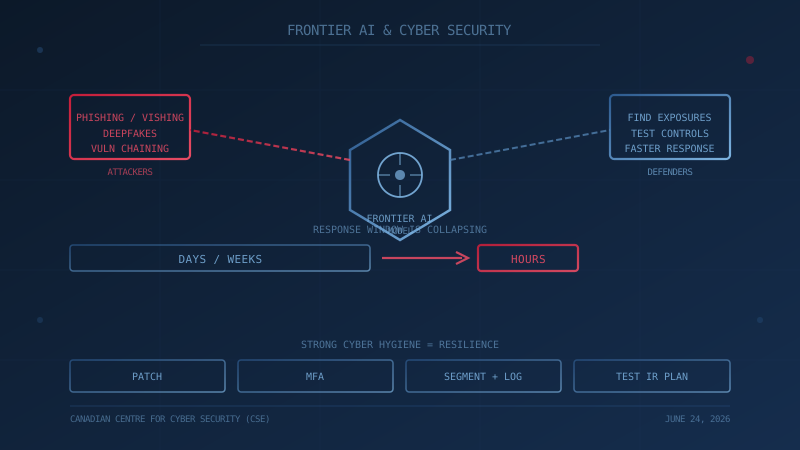
On June 24, 2026, the Canadian Centre for Cyber Security (Cyber Centre) — the operational arm of the Communications Security Establishment (CSE) — issued a public statement urging every organization in Canada to strengthen its cyber defences now, before AI-enabled attacks outpace them. The headline figure: frontier AI is helping attackers find and exploit weaknesses so quickly that the window defenders have to respond is collapsing "in some cases from days or weeks to hours."
The statement follows a joint warning from the leaders of the Five Eyes cyber security agencies, and it lands a specific message on Canadian decision-makers: this is a leadership problem, not just an IT problem. "Strengthening cyber resilience requires sustained leadership attention, not just IT action," the Cyber Centre writes. This post translates the statement for Canadian small and medium-sized business owners and executives — what frontier AI actually changes, and the eight concrete steps the Cyber Centre is asking you to take.
What Did the Cyber Centre Actually Say About Frontier AI?
The Cyber Centre's core claim is that frontier AI — the most recent and capable AI models — is reshaping the cyber threat landscape fast enough to demand action now, not later. According to the statement, these models help threat actors find and exploit vulnerabilities, including software flaws and weaknesses in security controls, far faster than before. That compresses the defender's response window from days or weeks down to hours and raises the odds that an attack succeeds.
Two of the Cyber Centre's own assessments — the National Cyber Threat Assessment 2025-2026 and the Ransomware Threat Outlook 2025-2027 — conclude that AI is also lowering the barrier to entry for cybercrime. In plain terms, attacks that once required skill and time are becoming cheaper, faster, and available to less capable actors. The statement is signed by Rajiv Gupta, Head of the Canadian Centre for Cyber Security, who frames strong cyber hygiene as "your most powerful and effective advantage in a rapidly evolving threat landscape."
How Are Attackers Already Using AI?
The Cyber Centre is specific that this is not a future risk — threat actors are using AI today. The statement names three patterns Canadian businesses are already exposed to, plus a set of risks that originate inside the organization.
- Faster, more convincing social engineering. AI is being used to produce phishing emails, vishing (voice scam) calls, and deepfake impersonation that are more convincing, produced faster, and deployed at greater scale. Our breakdown of AI-powered phishing covers why the old "look for spelling mistakes" advice no longer holds.
- Vulnerability chaining. AI helps attackers find and combine multiple smaller weaknesses into a single working attack path — a technique the Cyber Centre calls vulnerability chaining.
- Lower skill required. AI makes it easier for less-skilled actors to carry out more sophisticated attacks than they could on their own, which expands the pool of people who can hurt you.
The statement also flags risks that come from inside the business: unapproved use of AI tools (often called shadow AI), exposure of sensitive data through those tools, and the danger of relying on AI outputs that are inaccurate or have been deliberately manipulated. This is exactly the gap a clear AI usage policy is meant to close.
Why Is This a Leadership Issue and Not Just an IT Problem?
The Cyber Centre is deliberate in addressing leaders rather than technical teams, because the consequences of an AI-enabled incident land on the business, not just the IT department. The statement warns that these incidents can disrupt operations, expose sensitive data, damage trust, and create financial and regulatory risk — outcomes a CIO cannot own alone.
There is also an upside the statement asks leaders to act on: the same technology works for defenders. The Cyber Centre encourages organizations to use AI to identify exposures earlier, test their controls, and improve response times — including building AI into software development so vulnerabilities are caught earlier in the lifecycle. The framing is even-handed: frontier AI is a threat you must defend against and a tool you can defend with, and deciding how your organization does both is a leadership call.
The Eight Cyber Hygiene Actions the Cyber Centre Recommends
The most practical part of the statement is a checklist. The Cyber Centre's position is that no single measure eliminates risk, but organizations with strong cyber hygiene are "significantly more resilient, even as threats evolve." Here are the eight actions it asks every Canadian organization to take, with where each maps onto Canada's 13 Baseline Controls.
- Apply security patches promptly and keep systems up to date. When AI shortens the time between a flaw being disclosed and exploited, unpatched systems become the easiest target. See patch management.
- Limit internet exposure and reduce your attack surface. Every service exposed to the internet is something AI-assisted scanning can find faster than ever.
- Implement strong authentication, including phishing-resistant multi-factor authentication. Multi-factor authentication remains the single highest-value control most SMBs can add; the Cyber Centre specifically calls for the phishing-resistant kind. See authentication.
- Centralize logs across systems so unusual activity can be detected sooner — part of network security.
- Separate key systems (segmentation) so an attack is easier to contain and less likely to spread.
- Address unsupported or legacy systems, which cannot receive the patches that step 1 depends on.
- Test your incident response plans and plan for containment and recovery. If you do not have a plan yet, start with our guide to building an incident response plan and the broader incident response control.
- Build internal awareness and clear guidance on appropriate, responsible use of AI tools — including how staff handle sensitive information.
The Cyber Centre adds a supply-chain note that matters for almost every SMB: if you rely on third-party providers, make sure they apply strong security too, because "cyber resilience is a shared responsibility that extends across the entire supply chain." Our piece on vendor and third-party risk walks through how to assess a supplier without a procurement team.
What Is Project Glasswing, and Why Does the Statement Mention It?
The statement notes that the Cyber Centre engages directly with industry — including AI vendors — to track how frontier AI is evolving, and cites its participation in Project Glasswing as an example. Project Glasswing is one of the initiatives through which Canadian agencies and AI developers share information about how advanced models could be misused and how to defend against it. We covered the background in Claude, Mythos and Project Glasswing. For a business owner, the takeaway is simply that the threat picture here is being shaped by direct collaboration between government and frontier AI labs — which is also why the Cyber Centre's guidance on this topic is likely to keep changing.
What Should a Canadian SMB Do This Quarter?
For a small or medium-sized business without a dedicated security team, the statement is less about new spending and more about reinforcing fundamentals before the threat curve steepens. A reasonable 90-day response looks like this:
- Run the eight-point hygiene checklist as an audit. Score yourself honestly on each item; the gaps are your roadmap.
- Make MFA phishing-resistant where you can. Prioritize email, banking, and remote-access accounts first.
- Write or update an AI usage policy. Decide which AI tools staff may use, what data must never be pasted into them, and who approves new ones — closing the shadow-AI and data-exposure risks the statement names.
- Tabletop one ransomware scenario. Walk through who does what in the first hour, given that the response window is now measured in hours.
- Ask your top three vendors one question: "What are you doing about AI-enabled threats?" Their answer tells you a lot about your own exposure.
The Cyber Centre also points organizations to its Top 10 IT security actions and Top 10 artificial intelligence security actions (ITSAP.10.049) for prioritized, free guidance, and urges early reporting of suspected incidents so threats can be assessed and contained faster.
If you are not sure where your organization stands today, our free cybersecurity assessment walks through all 13 Baseline Control areas in about 10 minutes and produces a prioritized list of gaps — which is effectively the same eight-point hygiene audit the Cyber Centre is asking you to run, mapped to the Canadian framework.
Frequently Asked Questions
Who issued the frontier AI statement, and when?
The Canadian Centre for Cyber Security, part of the Communications Security Establishment (CSE), published the statement on June 24, 2026, from Ottawa. It followed a joint statement by the leaders of the Five Eyes cyber security agencies and was issued under Rajiv Gupta, Head of the Cyber Centre.
What does "frontier AI" mean in this context?
Frontier AI refers to the most recent and most capable AI models. The Cyber Centre's concern is that as these models become more powerful and more widely available, they help attackers find and exploit weaknesses much faster — while also being usable by defenders to find and fix those weaknesses earlier.
Does this mean my small business is now a target?
The statement's central warning is that AI lowers the barrier to entry for cybercrime, which generally widens the pool of potential targets rather than narrowing it to large enterprises. The Cyber Centre's recommended response — strong, basic cyber hygiene — is squarely within reach of a small or medium-sized business and does not require advanced tooling.
Is AI only a threat, or can it help defend my business?
Both. The Cyber Centre explicitly encourages organizations to use AI defensively — to identify exposures earlier, test security controls, improve response times, and catch vulnerabilities earlier in software development. The statement frames how you balance defending against AI-enabled threats and defending with AI as a leadership decision.
Where can I read the original statement?
The full statement is published on Canada.ca under the Communications Security Establishment, titled "Statement from the Canadian Centre for Cyber Security on frontier artificial intelligence models and their impact on cyber security," dated June 24, 2026.
How prepared is your business?
Find out where you stand against Canada's 13 Baseline Cyber Security Controls. The assessment takes under 30 minutes and your answers stay in your browser.
Check Your ScoreCite This Page
Suggested citation:
Cybersecurity Canada (2026). Frontier AI and Cyber Security: What Canada's Cyber Centre Wants Businesses to Do Now. Retrieved from https://cybersecuritycanada.ca/news/posts/frontier-ai-cyber-security-cyber-centre-statement/
Permanent URL: https://cybersecuritycanada.ca/news/posts/frontier-ai-cyber-security-cyber-centre-statement/ · Published June 25, 2026
Disclaimer: This article is intended for general informational purposes only and does not constitute professional cybersecurity, legal, IT, or compliance advice. While we strive to ensure accuracy, the cybersecurity landscape changes rapidly and information may become outdated. Organizations should consult with qualified cybersecurity professionals and legal counsel to assess their specific situation and develop appropriate security policies. Use of this information is at your own risk. See our Privacy Policy for more information.
Cybersecurity Canada is an independent resource and is not affiliated with, endorsed by, or connected to the Canadian Centre for Cyber Security, the Communications Security Establishment, or the Government of Canada.
How does your organization measure up?
Take our free cybersecurity assessment based on the Canadian Centre for Cyber Security's Baseline Controls. 50 questions, under 30 minutes, 100% confidential. Your answers never leave your browser.
Take the Free Assessment