Anthropic's Call for a Global AI Pause: What It Means for Canadian Businesses
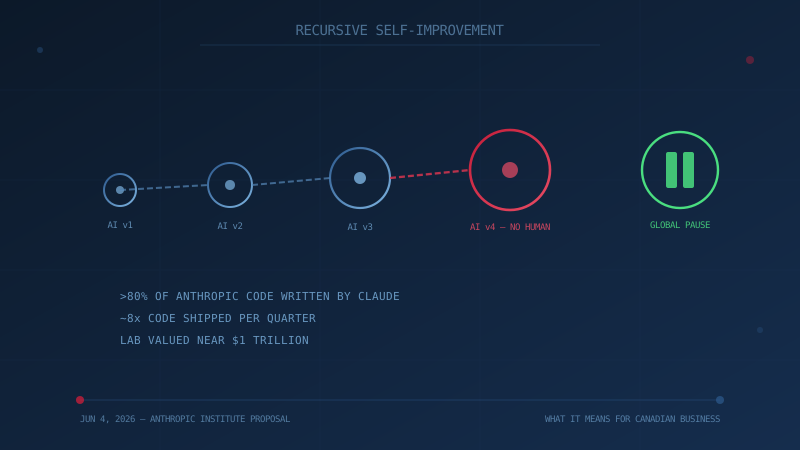
On June 4, 2026, Anthropic — the AI lab behind Claude, now valued at close to $1 trillion — published a proposal through its Anthropic Institute calling for a coordinated global slowdown, or outright pause, in frontier AI development. The reason: the company believes AI systems may soon be able to improve themselves without meaningful human involvement, a milestone it calls recursive self-improvement. When the company building one of the world's most capable models asks the industry to consider tapping the brakes, it is worth Canadian business owners understanding why — and what, if anything, it changes for them.
This is an unusual moment. The warning is not coming from outside critics or regulators; it is coming from a leading developer about its own technology. This post explains what Anthropic actually said, the risks it is flagging, and what the news does and does not mean for Canadian businesses already using AI.
What Did Anthropic Actually Announce?
Anthropic asked frontier AI developers to prepare for a coordinated pause or slowdown, warning that AI is now fast enough at building AI that the industry lacks a reliable way to stop. In its June 4, 2026 publication, the company reported that more than 80% of the code merged into its own codebase is now written by Claude, and that its engineers ship roughly eight times as much code per quarter as in prior years. The concern is the trajectory: if an AI system can autonomously design, build, and train its own successor, development could accelerate beyond human oversight.
Co-founder Jack Clark framed the problem as an industry with an accelerator but no brake pedal and, as reported by CNN, compared the coordination challenge to Cold War nuclear arms control, where rival powers had to cooperate on verification despite deep mistrust. Anthropic says the Anthropic Institute will research the technical systems a credible pause would require: ways for one developer to verify that competitors have genuinely slowed, so that no "bad actor" can quietly race ahead under the cover of a coordinated halt. Anthropic itself acknowledges that a unilateral pause by a single lab would only change who leads the race, not solve the underlying problem.
What Is Recursive Self-Improvement, in Plain Terms?
Recursive self-improvement is when an AI system becomes capable of designing and building a more capable version of itself, with little or no human direction. Today, humans design each new model. The worry Anthropic raises is a future in which the AI does that design work itself, each generation producing a smarter successor faster than people can review it.
Anthropic is clear that this capability has not been achieved and that, used well, self-improving AI could deliver enormous benefits in science, medicine, and productivity. The flagged risk is one of control: if systems advance without humans able to follow the reasoning or intervene, organizations lose the ability to predict, audit, or correct what the technology does. For a business, "losing the thread" of how an automated system reaches its decisions is a familiar governance problem — just at an unfamiliar scale.
Does This Change Anything for Canadian Businesses Right Now?
For day-to-day operations, no — this is a long-horizon policy debate, not an emergency. No Canadian regulator has changed any rule, and the AI tools your business uses today work exactly as they did last week. The practical near-term risk for most Canadian small and medium-sized businesses is not a runaway superintelligence; it is the much more ordinary problem of adopting powerful AI faster than you put governance around it.
That distinction matters. The headline risk Anthropic describes is industry-wide and years out. The risks that will actually affect a Canadian business this year are concrete and manageable: staff pasting confidential client data into public chatbots, AI-written content going out unchecked, autonomous "agentic" tools being given more access than they need, and AI-powered phishing that is far harder to spot than the clumsy scams of a few years ago. Treating the Anthropic news as a prompt to get those basics right is the most useful response available to a business owner.
What Should Canadian Businesses Take From This?
The signal to take from Anthropic's announcement is governance, not alarm: match the autonomy and access you grant AI to the controls you have around it. The same principle Canada's Cyber Centre applies to AI agents applies to the AI your business already runs. A few practical steps put you on solid footing regardless of how the bigger debate plays out.
- Write down where AI is allowed — and where it isn't. A short, clear AI usage policy is the single highest-value step for most organizations. It tells staff what tools are approved, what data must never be entered into them, and who signs off on AI-assisted decisions that affect customers or money.
- Inventory the AI you already have. Many SaaS products quietly added AI and autonomous "agent" features in 2025 and 2026. Treat each one as a system that needs a privilege review, not a free upgrade. Our guide to agentic AI security for Canadian businesses walks through what to check.
- Keep a human in the loop for anything that spends money, sends communications, or touches personal information. Autonomy is fine for low-risk, reversible tasks. It is not appropriate for actions you could not easily undo.
- Train your team. Most AI risk enters a business through everyday use, so security awareness training that covers AI tools, data handling, and AI-enhanced scams pays for itself quickly.
- Build the basics first. Adding AI on top of weak fundamentals magnifies the risk. The Cyber Centre's 13 Baseline Controls — strong authentication, patching, backups, and a tested incident response plan — are the foundation any AI adoption should sit on.
What to Expect Next
Expect more debate than action in the short term. Coordinated slowdowns require verification systems and international agreement that, by Anthropic's own account, historically took decades to build — and competitors have not all endorsed the call. For Canadian businesses, the realistic expectation is a continued stream of guidance rather than sudden new obligations. Canada's Cyber Centre has already published its Top 10 AI security actions (ITSAP.10.049) and joint Five Eyes guidance on AI agents; further direction is likely as the technology matures and as Bill C-26 obligations come into force.
The steadiest position is the one Cybersecurity Canada recommends for almost every emerging-technology story: adopt the tools that help your business, but put the same discipline around AI that you would around any other system with access to your data and your money. The companies that handle the next few years well will be the ones that paired enthusiasm for AI with a clear policy, a real inventory, and solid cyber hygiene underneath.
If you are unsure where your organization stands, our free cybersecurity assessment covers all 13 Baseline Control areas in about 10 minutes and produces a prioritised list of gaps — a sensible first step before expanding how much your business relies on AI.
Frequently Asked Questions
Is Anthropic shutting down or pausing Claude?
No. Anthropic continues to operate and develop Claude. Its June 4, 2026 proposal calls for the broader industry to prepare for a coordinated slowdown of frontier development and to build systems that could verify such a pause — it is not an announcement that Anthropic is stopping its own products or services.
Should Canadian businesses stop using AI because of this warning?
No. Anthropic's concern is about a future capability — AI improving itself without human oversight — not about the everyday AI tools businesses use today. The sensible response is stronger governance: an AI usage policy, an inventory of the AI features already in your software, human approval for high-impact actions, and solid cyber hygiene underneath.
What is recursive self-improvement?
Recursive self-improvement is when an AI system can autonomously design and build a more capable version of itself, generation after generation, without humans directing each step. Anthropic says this has not happened yet but warns it could arrive sooner than most institutions are prepared for, raising the risk of humans losing the ability to oversee or control the systems.
Does this create any new legal obligations in Canada?
No new rules have been introduced as a result of Anthropic's announcement. Canadian businesses remain governed by existing frameworks such as PIPEDA and the forthcoming Bill C-26 regime. This guidance is informational and is not legal or compliance advice; consult a qualified professional for your specific obligations.
How prepared is your business?
Find out where you stand against Canada's 13 Baseline Cyber Security Controls. The assessment takes under 30 minutes and your answers stay in your browser.
Check Your ScoreCite This Page
Suggested citation:
Cybersecurity Canada (2026). Anthropic's Call for a Global AI Pause: What It Means for Canadian Businesses. Retrieved from https://cybersecuritycanada.ca/news/posts/anthropic-global-ai-pause-what-it-means-for-canadian-businesses/
Permanent URL: https://cybersecuritycanada.ca/news/posts/anthropic-global-ai-pause-what-it-means-for-canadian-businesses/ · Published June 6, 2026
Disclaimer: This article is intended for general informational purposes only and does not constitute professional cybersecurity, legal, IT, or compliance advice. While we strive to ensure accuracy, the cybersecurity landscape changes rapidly and information may become outdated. Organizations should consult with qualified cybersecurity professionals and legal counsel to assess their specific situation and develop appropriate security policies. Use of this information is at your own risk. See our Privacy Policy for more information.
Cybersecurity Canada is an independent resource and is not affiliated with, endorsed by, or connected to the Canadian Centre for Cyber Security, the Communications Security Establishment, or the Government of Canada.
How does your organization measure up?
Take our free cybersecurity assessment based on the Canadian Centre for Cyber Security's Baseline Controls. 50 questions, under 30 minutes, 100% confidential. Your answers never leave your browser.
Take the Free Assessment