Bell Canada Breach: Client Steps

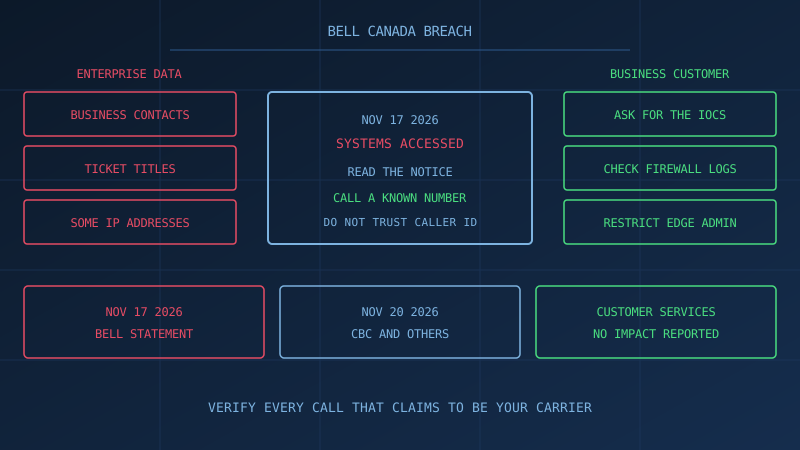
Bell told CBC News that an "agentic" threat actor accessed some of its systems, including one used for ordering and supplying telecommunication networks, and that some enterprise customer data was stolen. The Bell Canada breach was dated November 17 in statements Bell gave BleepingComputer and The Globe and Mail. CBC News said on November 20, 2026 that the attack took place on Tuesday and that customer services were not affected. This is general information for a Canadian small or mid-sized business that buys telecom or IT services, not legal advice.
What did Bell say happened in the Bell Canada breach?
On November 20, 2026, CBC News reported that a Bell spokesperson confirmed an "agentic" threat actor accessed some systems, including one used for ordering and supplying telecommunication networks, and that some enterprise customer data was stolen. Bell told BleepingComputer the incident occurred on November 17. CBC News said there has been no impact to customer services.
Bell told BleepingComputer: "Bell is investigating a cybersecurity incident that occurred on November 17 in which an agentic threat actor accessed some of our systems, including a system used for ordering and provisioning circuits, and exfiltrated some enterprise customer data." The Globe and Mail quoted spokesperson Ellen Murphy with "provisioning business circuits" instead of "provisioning circuits." CBC News attributed these sentences to public affairs manager Zoe Chapman: "Upon learning of the breach, we immediately contained the incident and secured our systems. There has been no impact to customer services."
"Agentic" is Bell's word. BleepingComputer wrote that it "suggests that AI-powered tools were used during the breach." The Globe and Mail wrote that a spokesperson "did not provide further details on what made the incident agentic, but the use of the word suggests that artificial intelligence was involved." That is the reporters' reading, not a method Bell described. Bell told BleepingComputer: "We currently do not know the attribution."
Le Journal de Montréal dated the intrusion to November 17 and reported a pre-production environment of Bell's Maximo system. It said Bell refused to say how many customers were affected.
CBC News and BleepingComputer reported that Bell is sharing indicators of compromise with enterprise customers and the Cyber Centre. CBC News said Bell contacted the RCMP cybercrime unit. BleepingComputer said those indicators were not published and that Bell has not stated how many customers were affected.
Which enterprise customer data was reported as taken?
CBC News said stolen client data included "business contact information like names, corporate email addresses, phone numbers, as well as IP addresses," and that files and PDFs, "which would contain more sensitive information, were not affected." BleepingComputer described a wider list in a notice from Bell's Information Security Team. Read the notice sent to your organization. News lists are what outlets said Bell described, not a finding that every customer lost every field.
The notice, as BleepingComputer reported it, said information "may have been stolen," including:
- Names, job titles, corporate email addresses, phone numbers and business addresses
- Information in ticket titles
- Some IP addresses associated with network elements or systems, plus limited contextual information
BleepingComputer reported that Bell said this dataset did not contain credentials, highly sensitive personal information, PDFs, file attachments, or other supplementary information stored in Maximo. The Globe and Mail quoted Murphy saying the data does not include "highly-sensitive private information." Le Journal de Montréal reported business addresses, service-ticket content, and that Bell said no passwords and no sensitive documents were affected.
Why do contacts, ticket titles and IP addresses matter?
A name, a job title, a ticket title, or a network address can make a fake provider message look informed, even when passwords and files were not in the dataset. The Cyber Centre's ITSAP.00.166 (July 2026) says spear phishing is directed at "a specific individual or small group" and that messages "often include personalized details to make them appear more convincing." Threat actors "often impersonate trusted individuals or reputable organizations."
ITSAP.00.102 (July 2026) says "data breaches expose phone numbers, contact lists and personal or organizational information that may later be sold or shared among scammers," and that targeted calls look for "work-related or role-specific details to make the call interaction more believable." A job title shows who can approve a circuit. A ticket title, read back on a call, makes the contact sound like an open job with your carrier.
The Canadian Anti-Fraud Centre says perpetrators "take their time to collect information on their intended targets so they can send convincing emails from a seemingly trusted source." One example on that page is an email "from existing contractor providing new payment directions." BleepingComputer reported that Bell's notice urged caution about people "impersonating the telecommunications provider."
ITSM.80.101 says edge devices "have public IP addresses that can be reached from anywhere" and are "particularly susceptible to exploitation." Network management interfaces "should not be directly exposed to the Internet." The CAFC page lists "exposing the systems to the internet unnecessarily or without robust security and maintenance measures." If a notice names an address, check whether it is yours and whether a management page answers on it. A listed address is not proof the device was broken into.
What should a business customer do in the first week?
Confirm whether you were notified, ask for the indicators Bell said it is sharing, and do not treat a circuit or ticket call as already verified. CBC News said Bell is contacting affected customers directly. BleepingComputer said the indicators were not published. Le Journal de Montréal said Bell would not give a customer count, so an empty inbox is not proof you were omitted.
- Search the account mailbox, including junk. BleepingComputer said a customer shared a notice from Bell's Information Security Team. Read the fields it names for you.
- If none is there, call the number already on file. Ask if you are included, which fields apply, and where any notice went.
- Ask for the indicators. CBC News and BleepingComputer said Bell is sharing them with enterprise customers. Compare them with firewall and router logs, and keep the logs. Our guide to the first 24 hours after a cyber attack says that for a data breach or exfiltration, including a notification from a third party, you should preserve logs and evidence.
- Match a listed IP address to the firewall, VPN or routers. If it is yours, see whether a management page is open to the internet. ITSM.80.101 says to install edge-device patches "as quickly as possible after testing for reliability on a standby or test device."
- Brief reception, whoever opens tickets, and accounts payable. ITSAP.00.101 (November 2025) says to establish "protocols and procedures for your employees to verify and report suspicious communications internally." Do not use a link or number from the unexpected email. For mail that claims to be from an internet provider, that publication's example is the provider's web form.
- If a circuit, billing contact or remote session was already changed after a contact that staff did not start, stop and call the known number. Save the message. Our guide to how to report a cyber attack in Canada states that the Canadian Anti-Fraud Centre says you can report a fraud or cybercrime online at reportcyberandfraud.canada.ca, whether you are a victim or a witness. The CAFC page says to tell local police and to call 1-888-495-8501.
If you are told you were not affected, brief staff anyway, and keep the call-back rule if the answer is not yet in writing.
What call-back rule should staff follow?
Hang up, then call a number the business stored before this week. ITSAP.00.102 says: "Hang up and call back using a known, trusted number," and "Do not use numbers provided by the caller or your phone's callback option." Our guide to IT help desk impersonation in Canada states that this July 2026 Cyber Centre note says to hang up and call back using a known, trusted number.
The Canadian Anti-Fraud Centre says to use "verbal authentication for any urgent requests or changes in payment details" and "a verification step for unusual requests." Our guide to business email compromise states: "Call the vendor directly using a phone number you already had on file, never a number from the email itself."
Keep this with the vendor file:
- Do not change a circuit, approve a ticket, share a password, or allow remote access from a contact you did not start.
- A ticket title, name, job title, or IP address is not proof the caller is your provider.
- Call the number on the last invoice. Do not use a number from the message or the phone's callback button.
- If that call does not confirm the request, make no change and tell the vendor-file owner.
ITSAP.00.102 says to use "a shared word, code or call-back procedure." The lines above are that procedure, including when the caller claims to be your IT company. Our guide to vendor and third-party risk states: "Your managed service provider likely has administrative access to your network."
What should the vendor file and the contract say?
Write down the carrier, the IT provider, what each can reach, and how each must warn you. ITSAP.00.070 (March 2025) says: "You should create an inventory of all third parties that interact with your organization, including vendors, contractors and service providers." Contracts should include "stipulations" that vendors "notify your organization within a specified time frame in the event of security incidents and vulnerabilities."
For the carrier and for the company that runs the firewall, record the legal name, the account number, the phone number you already use, who may approve a change, and the answer you got about this incident.
Ask the question ITSAP.00.070 prints: "Will you inform me if there has been a cyber event? If so, how quickly?" The vendor guide linked above asks, "What happens to my data if you're breached? Will they notify you? How quickly?" It also says the vendor should be required to notify you within a specific period (24-72 hours) of discovering a breach affecting your data. That hour range is the guide's negotiation point, not a figure in ITSAP.00.070, and it is not legal advice.
What does PIPEDA say about business contact information?
Section 2 of PIPEDA defines business contact information as information used to communicate with someone "in relation to their employment, business or profession," with examples such as name, position name or title, work address, work telephone number, work fax number and work electronic address. Section 4.01 limits that exclusion to information an organization collects, uses or discloses solely for that purpose. The wording is on the Justice Laws site.
Personal information in the same section "means information about an identifiable individual." Ticket titles and IP addresses are not in the business-contact examples. This article does not decide whether section 4.01 applies to any record from this incident. This is general information, not legal advice.
Where can a small business check these controls?
The free cybersecurity assessment for Canadian businesses states: "Evaluate your organization's security posture against the Canadian Centre for Cyber Security's Baseline Controls. 50 questions, under 30 minutes, completely confidential." It also states: "Your answers stay in your browser and are never transmitted. Progress is saved locally for 48 hours." The same page says "No signup or email required." It also states: "It is not a security audit, penetration test, compliance certification, or professional consultation."
How prepared is your business?
Find out where you stand against Canada's 13 Baseline Cyber Security Controls. The assessment takes under 30 minutes and your answers stay in your browser.
Check Your ScoreFrequently Asked Questions
What happened in the Bell Canada breach?
CBC News reported on November 20, 2026 that a Bell spokesperson confirmed an agentic threat actor accessed some Bell systems, including one used for ordering and supplying telecommunication networks, and that some enterprise customer data was stolen. Bell told BleepingComputer the incident occurred on November 17 and that the actor exfiltrated some enterprise customer data. The Globe and Mail quoted spokesperson Ellen Murphy dating the same incident to November 17. CBC News said there has been no impact to customer services. This is general information, not legal advice.
What enterprise customer data did reporting say was taken?
CBC News said Bell reported theft of business contact information such as names, corporate email addresses and phone numbers, as well as IP addresses, and that files and PDFs were not affected. BleepingComputer, describing a customer notification, also listed job titles, business addresses, ticket titles and some IP addresses tied to network elements or systems. That notification, as BleepingComputer reported it, said the dataset did not contain credentials, highly sensitive personal information, PDFs or file attachments. The Globe and Mail reported that Bell said the data does not include highly-sensitive private information.
Did Bell explain what agentic means?
No. Bell used the words agentic threat actor in statements reported by CBC News, BleepingComputer and The Globe and Mail. The Globe and Mail wrote that a spokesperson did not provide further details on what made the incident agentic, but that the use of the word suggests artificial intelligence was involved. BleepingComputer wrote that the description suggests AI-powered tools were used during the breach. Bell told BleepingComputer: We currently do not know the attribution.
What should a Bell business customer do first?
Check whether a notice arrived and read the fields it names for your organization. CBC News said Bell is reaching out to affected customers directly. BleepingComputer reported that Bell has not publicly released indicators of compromise, and that it is sharing them with enterprise customers. Ask your account representative, using a number you already had, for those indicators and have firewall and router logs compared with them. Treat unexpected calls or emails about circuits or tickets as unverified until you call back on a known number.
Does PIPEDA ignore business contact information?
Not as a blanket rule. PIPEDA section 2 defines business contact information as information used to communicate with someone in relation to their employment, business or profession, and gives examples such as name, position name or title, work address, work telephone number, work fax number and work electronic address. Section 4.01 says Part 1 does not apply to an organization in respect of that information when the organization collects, uses or discloses it solely for that communication purpose. Ticket titles and IP addresses are not in that list of examples. This article does not decide whether section 4.01 applies to any record. This is general information, not legal advice.
Cite This Page
Suggested citation:
Cybersecurity Canada (2026). Bell Canada Breach: Client Steps. Retrieved from https://cybersecuritycanada.ca/news/posts/bell-canada-breach-client-steps/
Permanent URL: https://cybersecuritycanada.ca/news/posts/bell-canada-breach-client-steps/ · Published November 21, 2026
Disclaimer: This article is intended for general informational purposes only and does not constitute professional cybersecurity, legal, IT, or compliance advice. While we strive to ensure accuracy, the cybersecurity landscape changes rapidly and information may become outdated. Organizations should consult with qualified cybersecurity professionals and legal counsel to assess their specific situation and develop appropriate security policies. Use of this information is at your own risk. See our Privacy Policy for more information.
Cybersecurity Canada is an independent resource and is not affiliated with, endorsed by, or connected to the Canadian Centre for Cyber Security, the Communications Security Establishment, or the Government of Canada.
How does your organization measure up?
Take our free cybersecurity assessment based on the Canadian Centre for Cyber Security's Baseline Controls. 50 questions, under 30 minutes, 100% confidential. Your answers never leave your browser.
Take the Free Assessment