How to Choose a Cybersecurity Provider for Your Canadian Small Business
Most Canadian small businesses don't have a dedicated cybersecurity team. For businesses with fewer than 50 employees, cybersecurity is typically managed internally — often meaning one IT generalist or the business owner themselves.
At some point, that stops being enough. Whether it's a near-miss phishing incident, a cyber insurance application requiring controls you can't implement alone, or the realization that nobody is actually monitoring your systems, many businesses reach a point where outside help makes sense.
The challenge is that the cybersecurity services market is confusing. Terminology varies, sales pitches are heavy on fear and acronyms, and it's difficult to evaluate providers when you don't have deep security expertise yourself. Here's how to navigate it.
Understanding the Types of Providers
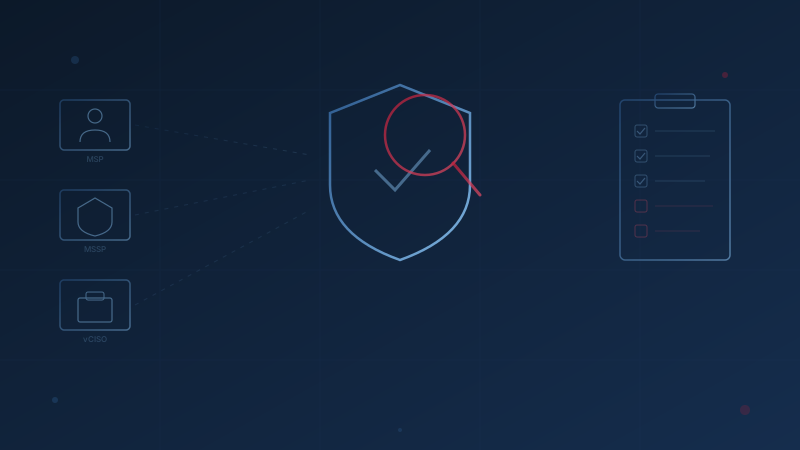
The first decision is understanding what kind of help you actually need. The terms are used loosely in the industry, but here's what they generally mean:
Managed Service Provider (MSP)
An MSP manages your IT infrastructure — computers, network, email, cloud services, backups, and helpdesk support. Most MSPs include some level of security as part of their standard offering: antivirus, firewalls, patching, and basic monitoring.
For many small businesses, an MSP is the starting point. The risk is assuming that general IT management equals adequate cybersecurity. An MSP that sets up your firewall is not necessarily monitoring it for threats at 2 a.m.
Managed Security Service Provider (MSSP)
An MSSP focuses specifically on security. Services typically include 24/7 threat monitoring, security information and event management (SIEM), endpoint detection and response (EDR), vulnerability scanning, and incident response support.
MSSPs are more specialized and more expensive than general MSPs. For businesses that already have basic IT management in place but need dedicated security monitoring, an MSSP fills that gap.
Virtual CISO (vCISO)
A virtual Chief Information Security Officer provides strategic security leadership on a fractional basis. Rather than monitoring your systems, a vCISO helps you develop security policies, assess risk, plan your security roadmap, manage compliance requirements, and make informed decisions about where to invest.
A vCISO is useful when you need someone to answer "what should we be doing?" rather than "is anyone watching our network right now?"
Cybersecurity Consultants
Consultants typically engage on a project basis — conducting security assessments, penetration testing, compliance gap analyses, or helping you respond to a specific incident. They don't provide ongoing monitoring or management.
What to Look for in a Provider
Regardless of which type of provider you need, several factors are worth evaluating:
Canadian Data Residency and Privacy Knowledge
If your business is subject to PIPEDA — and most are — your provider should understand Canadian privacy obligations. Ask where your data will be stored, whether any tools or platforms they use route data through US servers, and whether they're familiar with federal and provincial privacy requirements.
This isn't about rejecting all US-based tools. It's about ensuring your provider understands the implications and can help you meet your obligations under PIPEDA, provincial privacy laws, and any sector-specific regulations that apply to your business.
Alignment with the Baseline Controls
The Canadian Centre for Cyber Security's Baseline Controls provide a practical framework for small and medium organizations. A provider that understands these controls — and can map their services to them — is more likely to deliver security that's appropriate for your organization's size and risk profile.
Ask potential providers: "Which of the 13 Baseline Control areas do your services address, and which ones will we still need to manage ourselves?" A good provider will answer this clearly rather than claiming to cover everything.
Incident Response Capability
When something goes wrong, speed matters. The first 24 hours after an incident are critical. Ask potential providers:
- Do you provide incident response support, and is it included in your contract or billed separately?
- What is your average response time for critical security incidents?
- Do you have a documented incident response process?
- Will you help us meet our breach notification obligations under PIPEDA?
A provider that takes hours to respond to a ransomware alert on a Saturday morning is not providing the protection you're paying for.
Transparency About What's Included
Cybersecurity services pricing can be opaque. Ensure you understand:
- What's included in the base contract versus what's billed as an add-on
- Whether incident response hours are included or charged at a premium rate
- What happens if you need to scale up (add users, devices, or locations)
- Whether there are long-term lock-in clauses and what the exit process looks like
- Who owns your data and configurations if you leave
Their Own Security Practices
Your cybersecurity provider has privileged access to your systems — which makes them a high-value target. The Kaseya VSA attack in 2021 demonstrated what happens when a service provider is compromised: ransomware was deployed to approximately 1,500 businesses through a single vulnerability in the provider's remote management tool.
Ask providers about their own security posture:
- Do they use MFA on all administrative access to your systems?
- Do they have cyber insurance?
- Have they undergone any third-party security assessments or certifications (SOC 2, ISO 27001)?
- How do they vet their own employees who will have access to your environment?
Red Flags to Watch For
The cybersecurity services market includes highly competent providers and others that rely more on marketing than substance. Be cautious of:
Guaranteed protection. No provider can guarantee you won't be breached. A provider that claims otherwise is either misleading you or doesn't understand the threat landscape. Honest providers talk about reducing risk and improving response capability, not eliminating all threats.
Fear-based sales tactics. If the sales conversation is primarily about how devastating an attack will be and how urgently you need to sign, that's a warning sign. Good providers educate and explain. They don't pressure.
No clear service level agreements. If a provider can't tell you their response time commitments, escalation procedures, or what happens when they miss a target, their service is difficult to hold accountable.
Reluctance to explain what they do. Security is technical, but a competent provider should be able to explain their approach in terms a business owner can understand. If every answer is jargon without substance, that's a concern.
No references from similar businesses. A provider that works primarily with enterprises may not understand the constraints and priorities of a 20-person company. Ask for references from businesses similar in size and industry to yours.
Questions to Ask During Evaluation
Here's a practical list of questions to ask any cybersecurity provider you're considering:
- Which of the 13 Baseline Control areas do your services cover?
- How do you handle incident detection and response outside business hours?
- What is your average response time for critical alerts?
- Where will our data be stored, and do any tools you use route data outside Canada?
- Do you carry cyber insurance, and what does it cover?
- Can you provide references from Canadian businesses of similar size?
- What does your onboarding process look like, and how long does it typically take?
- How do you handle employee offboarding and access revocation when our staff changes?
- What reporting do we receive, and how often?
- What does the exit process look like if we decide to change providers?
The Cost Question
Cybersecurity services pricing varies widely. As a rough guide for Canadian small businesses:
- MSP with basic security: $100-250 per user per month is common, though some MSPs offer monthly retainers based on overall company needs rather than per-user pricing — pricing models vary
- MSSP (dedicated security monitoring): Often starts at $2,000-5,000 per month for small environments
- vCISO: $2,000-8,000 per month depending on hours and scope
- Security assessments: $3,000-15,000 as a one-time engagement
These ranges are approximate and vary significantly by provider, region, and complexity. The point is not to find the cheapest option — it's to understand what you're getting for your investment and whether it addresses your actual risk.
For a more detailed look at how to think about cybersecurity spending relative to your business size and risk, see our guide on how much Canadian small businesses should budget for cybersecurity.
Starting the Search
If you're not sure where to start:
-
Run our free assessment to understand where your security gaps are. This gives you a clear picture of what you actually need help with, so you can evaluate providers against your specific requirements rather than their generic pitch.
-
Talk to your industry peers. Other Canadian businesses in your sector have faced the same decision. Word-of-mouth referrals from businesses with similar needs are often more useful than online reviews.
-
Start with an assessment engagement. If you're not ready for ongoing managed services, hiring a consultant for a one-time security assessment gives you a roadmap and helps you evaluate whether a longer-term relationship makes sense.
The Baseline Controls Connection
Choosing the right cybersecurity provider connects to several areas of the Canadian Centre for Cyber Security's Baseline Controls:
- BC.1 (Incident Response) — Your provider should support or deliver your incident response capability
- BC.2 (Patch Management) — If your provider manages your systems, patching should be part of the service
- BC.3 (Anti-Malware) — EDR and threat monitoring are core MSSP services
- BC.6 (Security Awareness) — Some providers include employee training as part of their offering
- BC.10 (Cloud Services) — Providers should help you secure your cloud environment, not just manage it
Our free assessment evaluates your organization across all 13 Baseline Control areas. The results can serve as a starting point for conversations with potential providers — showing them exactly where you need help and giving you a way to evaluate whether their recommendations align with your actual gaps.
Disclaimer: This article is intended for general informational purposes only and does not constitute professional cybersecurity, legal, IT, or compliance advice. While we strive to ensure accuracy, the cybersecurity landscape changes rapidly and information may become outdated. Organizations should consult with qualified cybersecurity professionals and legal counsel to assess their specific situation and develop appropriate security policies. Use of this information is at your own risk. See our Privacy Policy for more information.
Cybersecurity Canada is an independent resource and is not affiliated with, endorsed by, or connected to the Canadian Centre for Cyber Security, the Communications Security Establishment, or the Government of Canada.
How does your organization measure up?
Take our free cybersecurity assessment based on the Canadian Centre for Cyber Security's Baseline Controls. 50 questions, under 30 minutes, 100% confidential — your answers never leave your browser.
Take the Free Assessment