How Much Should a Canadian Small Business Spend on Cybersecurity?
"How much should we be spending on cybersecurity?" is one of the most common questions Canadian small business owners ask — and one of the hardest to answer with a single number. The honest answer is that it depends on your industry, your size, the data you handle, and your current security posture. But that doesn't mean there isn't a practical framework for thinking about it.
What most Canadian SMBs discover is that the biggest security improvements don't come from the biggest spending. The gap between "doing nothing" and "covering the fundamentals" is where the most risk reduction happens — and that gap is more affordable to close than many business owners expect.
The Industry Benchmarks
Various industry surveys suggest that organizations should spend between 5% and 20% of their total IT budget on cybersecurity. The wide range reflects differences in industry, regulatory requirements, and risk tolerance.
For context:
- Gartner historically reported that the average organization spent approximately 5-6% of its IT budget on cybersecurity, though more recent data suggests this figure has risen as organizations increase their security investment
- The Canadian Internet Registration Authority (CIRA) found in its 2024 Cybersecurity Survey that Canadian organizations planned to increase cybersecurity spending, with many acknowledging their current investment was insufficient
- Statistics Canada's 2023 survey found that Canadian businesses collectively spent $11 billion on cybersecurity — but spending was heavily skewed toward larger organizations
These benchmarks are useful as reference points, but they're less practical for a 15-person company that doesn't have a formal IT budget line item. A percentage-of-IT-spend framework assumes you know what your total IT spend is, which many small businesses don't track precisely.
A More Practical Framework
Rather than starting with percentages, it's more useful to think about cybersecurity spending in terms of what you're trying to protect, what the realistic threats are, and where the highest-impact investments lie.
What Are You Protecting?
The value at risk is different for every business:
- A medical clinic handling patient health records has different exposure than a retail shop processing credit card transactions
- A professional services firm with client financial data has different obligations than a construction company
- A business subject to PIPEDA breach notification requirements faces regulatory risk on top of operational risk
Consider what a breach would actually cost your business. The real cost of cyber downtime includes not just technical recovery but lost revenue, customer notification, legal costs, reputational damage, and potential regulatory penalties. For many Canadian SMBs, a single ransomware incident can cost $100,000 to $500,000 — far more than years of preventive investment.
The Tiered Approach
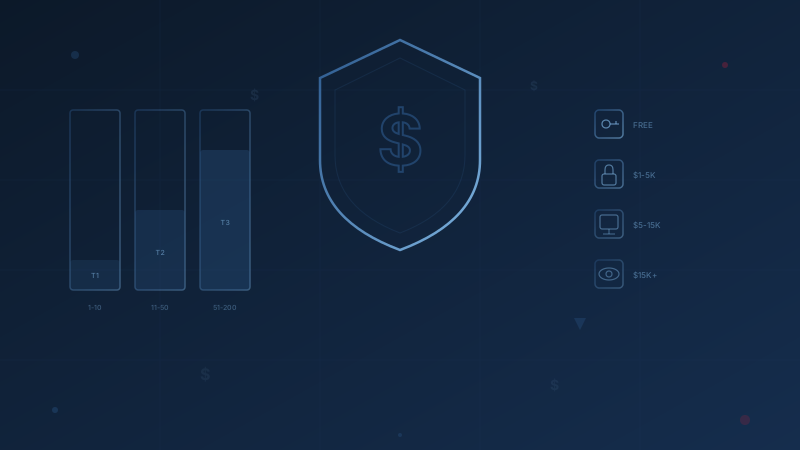
Here's a practical framework based on company size and complexity. These are annual estimates and include both tools and services:
Tier 1: Micro Business (1-10 employees) — $2,000-6,000/year
At this level, the goal is covering the fundamentals with minimal complexity:
- Business-grade email security with built-in spam and phishing filtering — often included in Microsoft 365 Business Premium or Google Workspace Business
- Multi-factor authentication on all business accounts — most platforms include this at no extra cost
- Password manager — $3-8 per user per month
- Automatic patching and updates — built into most operating systems, just needs to be enabled and not deferred
- Cloud backup for critical business data — $10-50 per month depending on volume
- Basic endpoint protection — Windows Defender (included) or a business antivirus solution at $3-6 per device per month
- Annual security assessment — our free assessment covers this at no cost
Most of these items cost little or nothing individually. The total investment is modest, but the risk reduction is substantial. The difference between a business with MFA enabled and one without is enormous — and MFA is free on most platforms.
Tier 2: Small Business (11-50 employees) — $8,000-30,000/year
As headcount and complexity grow, so do the requirements:
- Everything in Tier 1, plus:
- Managed endpoint detection and response (EDR) — $8-20 per device per month
- Security awareness training with phishing simulations — $3-10 per user per month
- Managed firewall or network security — $100-500 per month depending on complexity
- Backup solution with tested recovery and offsite/immutable copies — $200-800 per month
- Written incident response plan — can be developed internally using free templates or with a consultant ($2,000-5,000 one-time)
- Annual penetration test or vulnerability assessment — $3,000-10,000 depending on scope
- Cyber insurance — $1,500-5,000 per year for basic coverage
At this tier, many businesses benefit from working with a managed service provider or MSSP that bundles several of these services. The per-unit costs decrease when services are bundled, and you get consistent coverage rather than managing multiple point solutions.
Tier 3: Medium Business (51-200 employees) — $40,000-120,000+/year
At this scale, cybersecurity typically requires dedicated attention:
- Everything in Tier 2, plus:
- Managed security monitoring (MSSP or SOC-as-a-service) — $2,000-8,000 per month
- Virtual CISO or security leadership — $2,000-8,000 per month on a fractional basis
- Compliance management for PIPEDA, provincial privacy laws, or industry-specific requirements
- Advanced email security with sandboxing and URL rewriting
- SIEM or log management — centralized logging and alerting
- Regular tabletop exercises to test incident response readiness
- More comprehensive cyber insurance with higher limits
Organizations at this tier that handle data subject to Bill C-26 or sector-specific regulations will likely be at the higher end of this range.
Where to Spend First
If you're starting from zero or near-zero, the order of investment matters more than the total amount. Based on the Canadian Centre for Cyber Security's Baseline Controls and the patterns behind most successful attacks on Canadian SMBs, here's where to prioritize:
Priority 1: The Free and Near-Free Wins
These cost little to nothing but address the most common attack vectors:
- Enable MFA everywhere — email, cloud services, banking, remote access. This single action blocks the vast majority of credential-based attacks. It's free on most platforms.
- Turn on automatic updates — stop deferring operating system and application patches
- Review admin access — remove unnecessary administrative privileges from user accounts
- Enable built-in security features — Windows Defender, email filtering, login alerts
Priority 2: Low-Cost, High-Impact Investments ($1,000-5,000)
- Deploy a password manager — eliminates password reuse, the second most common entry point after phishing
- Set up proper backups — cloud backup with tested recovery. Follow the 3-2-1 rule
- Run a security assessment — our free assessment maps your posture against the 13 Baseline Controls
Priority 3: Building Real Capability ($5,000-15,000)
- Security awareness training with phishing simulations — addressing the human element
- Endpoint detection and response — upgrade from basic antivirus to EDR
- Written incident response plan — know what to do in the first 24 hours
- Cyber insurance — once you have the controls in place to qualify
Priority 4: Ongoing Security Operations ($15,000+)
- Managed security monitoring — someone watching your environment 24/7
- Regular assessments and testing — annual penetration tests, quarterly vulnerability scans
- Security leadership — a vCISO or fractional security advisor to guide your roadmap
The ROI Question
Cybersecurity spending doesn't generate revenue. It prevents losses. That makes ROI calculations inherently imperfect, but the math is still worth doing.
Consider a business with 25 employees and $3 million in annual revenue:
- Average cost of a ransomware incident for a Canadian SMB: $100,000-500,000 (including downtime, recovery, notification, and reputational impact)
- Annual investment in Tier 2 cybersecurity: $15,000-25,000
- Risk reduction from implementing fundamental controls: significant — the Canadian Centre for Cyber Security's Baseline Controls are designed to help small organizations mitigate the most common cyber threats they face
You're not eliminating all risk. You're making your business a harder target than the one next door — and most attackers, like most criminals, prefer easy targets. As we've noted before, the assumption that your business is too small to attack is itself a significant risk.
Common Mistakes
Spending on tools without people or process. A $50,000 firewall that nobody monitors is less effective than a $500 firewall with proper configuration and alerting. Technology is only one part of the equation — if nobody is reviewing alerts or responding to incidents, the investment is wasted.
Over-investing in perimeter, under-investing in fundamentals. Many businesses spend on advanced tools while still having weak passwords, no MFA, and untrained employees. The basics matter more than the advanced tools.
Treating cybersecurity as a one-time project. Security is ongoing. A vulnerability scan from last year doesn't protect you from this year's threats. Budget for continuous investment, not one-off expenditures.
Not accounting for cyber insurance. Insurance is part of your cybersecurity budget. And as insurers increasingly require specific controls as conditions of coverage, the relationship between your security investment and your insurance premiums is becoming more direct.
The Baseline Controls Connection
Every tier of spending above maps back to the Canadian Centre for Cyber Security's Baseline Controls:
- BC.1 (Incident Response) — An incident response plan is a Tier 2 investment with outsized value
- BC.2 (Patch Management) — Automatic updates are a Tier 1 (free) investment
- BC.3 (Anti-Malware) — EDR is a Tier 2 investment; basic protection is Tier 1
- BC.5 (Authentication) — MFA is a Tier 1 (free) investment and the single highest-impact control
- BC.6 (Security Awareness) — Training is a Tier 2 investment that addresses the most common attack vector
- BC.7 (Data Backup) — Proper backups are a Tier 1-2 investment and your last line of defence against ransomware
Our free assessment evaluates your organization across all 13 Baseline Control areas. It takes under 10 minutes and gives you a clear picture of which investments will have the greatest impact on your specific security posture — so you can spend where it matters most rather than guessing.
Disclaimer: This article is intended for general informational purposes only and does not constitute professional cybersecurity, legal, IT, or compliance advice. While we strive to ensure accuracy, the cybersecurity landscape changes rapidly and information may become outdated. Organizations should consult with qualified cybersecurity professionals and legal counsel to assess their specific situation and develop appropriate security policies. Use of this information is at your own risk. See our Privacy Policy for more information.
Cybersecurity Canada is an independent resource and is not affiliated with, endorsed by, or connected to the Canadian Centre for Cyber Security, the Communications Security Establishment, or the Government of Canada.
How does your organization measure up?
Take our free cybersecurity assessment based on the Canadian Centre for Cyber Security's Baseline Controls. 50 questions, under 30 minutes, 100% confidential — your answers never leave your browser.
Take the Free Assessment