CIBC Data Breach 2026: What Canadians Actually Need to Know
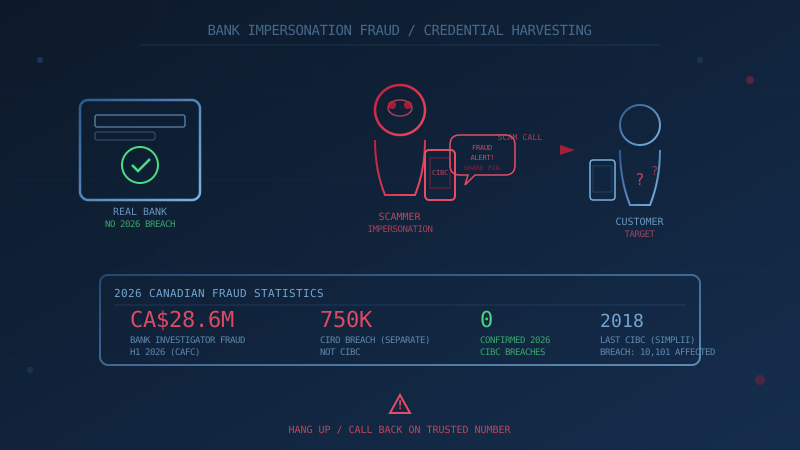
No confirmed 2026 CIBC data breach exists. The search traffic around "CIBC data breach 2026" appears driven by confusion with two separate events: an unverified dark web claim in late July 2026 alleging a handful of CIBC credentials for sale, and the unrelated 2026 CIRO data breach that exposed information on 750,000 Canadian investors. Neither indicates a breach of CIBC's systems.
What has surged in 2026, however, is CIBC impersonation fraud. The Canadian Anti-Fraud Centre reports that bank investigator scams caused approximately CA$28.6 million in reported losses in the first six months of 2026, already exceeding the roughly CA$28.3 million for all of 2025. If you are searching because you received a suspicious call or text claiming to be from CIBC, that is almost certainly the threat that matters to you.
Was There a 2026 CIBC Data Breach?
No. CIBC has not disclosed a data breach in 2026, and no credible security source has confirmed one.
The only 2026 CIBC-related claim is a July 28, 2026 posting on a dark web forum advertising "46 fresh CIBC accounts" for sale. This claim has not been independently verified, and even if the credentials are real, the source is almost certainly phishing or credential harvesting, not a breach of CIBC's infrastructure. Small batches of bank credentials sold on dark web forums typically come from infostealers, phishing pages, or credential reuse attacks against individual customers, not from intrusions into the bank itself.
Separately, researchers identified in June and July 2026 a cluster of CIBC phishing domains (such as cibcloginportal.com, cibcresetpin.com, and cibcdevicevalidation.com) registered to support active credential harvesting campaigns. These domains impersonate CIBC's login portal to steal usernames and passwords. They are a clear sign that criminals are targeting CIBC customers in 2026, but they are not evidence of a CIBC breach.
What Happened in the 2018 Simplii Financial Breach?
The most recent confirmed CIBC-related data breach occurred in May 2018 and affected Simplii Financial, a digital banking brand owned by CIBC.
According to CBC News and Ontario Superior Court filings from the subsequent class action settlement:
- Hackers contacted CIBC and BMO demanding a CA$1 million ransom on May 27, 2018, claiming to have customer data.
- CIBC's investigation confirmed that 10,101 Simplii Financial customers were affected (the hackers had initially claimed 40,000).
- Exposed data included names, dates of birth, Social Insurance Numbers (for some), and account numbers.
- Approximately 12% of affected clients had money stolen from their accounts. CIBC reimbursed all fraudulent withdrawals, totalling CA$1,786,517.
- The incident did not affect other CIBC customers, only Simplii Financial clients.
A class action was certified, and the Ontario Superior Court approved a CA$1,769,425 settlement in April 2021. All proceeds have since been paid out. If you were a Simplii Financial customer in May 2018 and did not receive notification at the time, you were not among the affected individuals.
Why Are People Searching "CIBC Data Breach 2026"?
The search interest appears to stem from three sources:
-
Confusion with the 2026 CIRO breach. In January 2026, the Canadian Investment Regulatory Organization (CIRO) confirmed that a phishing-based breach in August 2025 had exposed data on approximately 750,000 Canadian investors. CIRO is not CIBC; it is an independent regulatory body. The data involved includes dates of birth, Social Insurance Numbers, and investment account statements, but it was held by CIRO, not by individual banks.
-
Unverified dark web claims. The July 2026 posting mentioned above may have prompted speculation, but unverified credential sales are common and do not indicate a breach of the bank.
-
Active scam campaigns impersonating CIBC. The most likely reason for the search is that CIBC customers are receiving suspicious calls and texts and searching to see whether their bank has been compromised. The answer is that their bank has not been breached, but they are being targeted by sophisticated impersonation scams.
What CIBC Scams Are Active in 2026?
Bank impersonation fraud, sometimes called "bank investigator fraud," is the dominant threat facing CIBC customers in 2026. The pattern is consistent across reported cases:
- A victim receives a call or text, often with a spoofed caller ID showing a legitimate CIBC number.
- The caller claims to be from CIBC's fraud department and says suspicious transactions have been detected.
- The victim is pressured into providing their PIN, password, or a one-time verification code. In some cases, they are instructed to transfer money to a "safe" account or to place their debit card in an envelope for courier pickup.
- The scammer uses the stolen credentials to drain the account or make purchases.
According to the Canadian Anti-Fraud Centre, reported losses from bank investigator fraud reached CA$28.6 million in the first six months of 2026, already exceeding the CA$28.3 million reported for all of 2025. The CAFC estimates that only 5% to 10% of fraud is reported, so the true figure is likely far higher.
In June 2026, a Nanaimo couple lost CA$6,000 after receiving a phone call from scammers impersonating CIBC, according to NanaimoNewsNOW. The scammers used a legitimate CIBC security text alert to establish trust, then guided the victims into confirming account details and authorizing transfers. CIBC's fraud department attempted to reach the couple afterward, but the victims initially ignored the calls, believing they were another scam.
This is a common and heartbreaking pattern: legitimate fraud alerts are mistaken for scams, and scam calls are mistaken for legitimate alerts. The only reliable solution is to hang up and call back using a number you already trust.
How Do I Protect Myself from CIBC Impersonation Scams?
If you receive a call, text, or email claiming to be from CIBC:
- Hang up immediately if asked for your password, PIN, or one-time verification code. CIBC will never ask for these over the phone or by text.
- Do not use a phone number provided by the caller. Call CIBC back using the number on the back of your debit or credit card, or from a statement you already have on file.
- Never authorize a transfer or courier pickup at the request of an inbound caller. If the request sounds urgent, that is a warning sign.
- Check your account directly. Log in to CIBC's mobile app or online banking (using your usual bookmarked link or the official app, not a link from a text or email) to verify whether any suspicious activity has actually occurred.
If you have already shared credentials or authorized a transfer:
- Contact CIBC immediately at 1-800-465-2422 (the number on the back of your card).
- Report the incident to your local police and the Canadian Anti-Fraud Centre (1-888-495-8501 or antifraudcentre.ca).
- Place a fraud alert with Equifax Canada and TransUnion Canada. This requires creditors to take extra steps to verify your identity before opening new accounts.
For a broader look at the patterns scammers use, see our guide to how to recognize phishing emails and our breakdown of Canadian brand phishing playbooks.
What Should Canadian Businesses Take Away?
The CIBC impersonation campaign is part of a broader 2026 trend. Bank investigator fraud is not limited to any one institution; scammers rotate between banks based on timing and available target lists. If your business uses CIBC (or any Canadian bank) for payroll, vendor payments, or receivables, the same social engineering tactics that work on individuals can work on employees authorized to move money.
Practical steps:
- Train finance and HR staff on bank impersonation tactics and verify any urgent payment instructions through a second channel. Our post on what actually works in employee security awareness training covers this in more detail.
- Enable phishing-resistant MFA (such as FIDO2 security keys or passkeys) on all accounts with access to banking or financial systems. The Cybersecurity Canada Report 2026 found that phishing-resistant MFA blocks over 99% of identity attacks.
- Audit who has authority to initiate wire transfers or change payee banking details, and require dual authorization for changes above a threshold.
If your business has not recently assessed its security posture against Canada's 13 Baseline Cyber Security Controls, our free cybersecurity assessment takes under 30 minutes and produces a prioritized list of gaps to close.
The Bottom Line
There is no confirmed 2026 CIBC data breach. What exists is a well-documented, well-funded impersonation scam campaign that is extracting millions of dollars from Canadians by convincing them their bank has been compromised. If you received a suspicious call or text and searched to find out whether CIBC was breached: your bank was not breached, but you may be a target.
Hang up. Call back on a number you trust. Do not share your PIN, password, or verification codes with anyone who contacts you first.
How prepared is your business?
Find out where you stand against Canada's 13 Baseline Cyber Security Controls. The assessment takes under 30 minutes and your answers stay in your browser.
Check Your ScoreFrequently Asked Questions
Was there a CIBC data breach in 2026?
No confirmed CIBC data breach has been reported or disclosed in 2026. The only related 2026 claim is an unverified dark web posting in late July 2026 alleging 46 CIBC account credentials for sale. This does not indicate a breach of CIBC's systems; such credentials typically originate from phishing attacks or credential harvesting, not from a breach of the bank itself. The last confirmed CIBC-related breach was the 2018 Simplii Financial incident.
What happened in the 2018 Simplii Financial data breach?
In May 2018, hackers accessed the personal and account information of approximately 10,101 Simplii Financial customers. Simplii is a digital banking brand owned by CIBC. About 12% of affected clients had money stolen from their accounts, all of which CIBC reimbursed (totalling CA$1,786,517). A class action was settled in April 2021 for CA$1,769,425. The 2018 breach did not affect other CIBC customers, only Simplii clients.
What CIBC scams should I watch for in 2026?
Bank impersonation scams targeting CIBC customers are widespread in 2026. Scammers call or text pretending to be from CIBC's fraud department, often using spoofed caller IDs that display real CIBC phone numbers. They claim your account is compromised and pressure you into sharing your PIN, password, or one-time verification codes. In some cases, they instruct victims to transfer money to 'secure' it. These scams caused CA$28.6 million in reported losses in the first half of 2026 alone, already exceeding the full-year 2025 total.
How do I report a CIBC scam or suspicious activity?
Report suspicious emails or text messages to fraud@cibc.com. For other fraud concerns or unauthorized account activity, call 1-800-465-2422 (the number on the back of your CIBC card). You can also report fraud to the Canadian Anti-Fraud Centre at 1-888-495-8501 or online at antifraudcentre.ca.
How can I tell if a CIBC call or text is real or a scam?
CIBC (and any legitimate bank) will never call or text to ask for your password, PIN, or one-time verification code. If someone claiming to be from CIBC asks for this information, hang up immediately. Call CIBC back using the number on the back of your card or from a statement you already have. Do not use a phone number provided by the caller. If you have already shared credentials or authorized a transfer, contact CIBC immediately and report the incident to your local police and the Canadian Anti-Fraud Centre.
Is the 2026 CIRO data breach related to CIBC?
No. The 2026 CIRO (Canadian Investment Regulatory Organization) data breach, disclosed in January 2026 and affecting approximately 750,000 Canadian investors, is a separate incident that does not involve CIBC. CIRO is an independent regulatory body, and the breach affected investor registration data held by CIRO, not data held by banks.
Cite This Page
Suggested citation:
Cybersecurity Canada (2026). CIBC Data Breach 2026: What Canadians Actually Need to Know. Retrieved from https://cybersecuritycanada.ca/news/posts/cibc-data-breach-2026-what-canadians-need-to-know/
Permanent URL: https://cybersecuritycanada.ca/news/posts/cibc-data-breach-2026-what-canadians-need-to-know/ · Published October 17, 2026
Disclaimer: This article is intended for general informational purposes only and does not constitute professional cybersecurity, legal, IT, or compliance advice. While we strive to ensure accuracy, the cybersecurity landscape changes rapidly and information may become outdated. Organizations should consult with qualified cybersecurity professionals and legal counsel to assess their specific situation and develop appropriate security policies. Use of this information is at your own risk. See our Privacy Policy for more information.
Cybersecurity Canada is an independent resource and is not affiliated with, endorsed by, or connected to the Canadian Centre for Cyber Security, the Communications Security Establishment, or the Government of Canada.
How does your organization measure up?
Take our free cybersecurity assessment based on the Canadian Centre for Cyber Security's Baseline Controls. 50 questions, under 30 minutes, 100% confidential. Your answers never leave your browser.
Take the Free Assessment