Canvas Data Breach 2026: What the Instructure Hack Means for Canadian Universities and Businesses
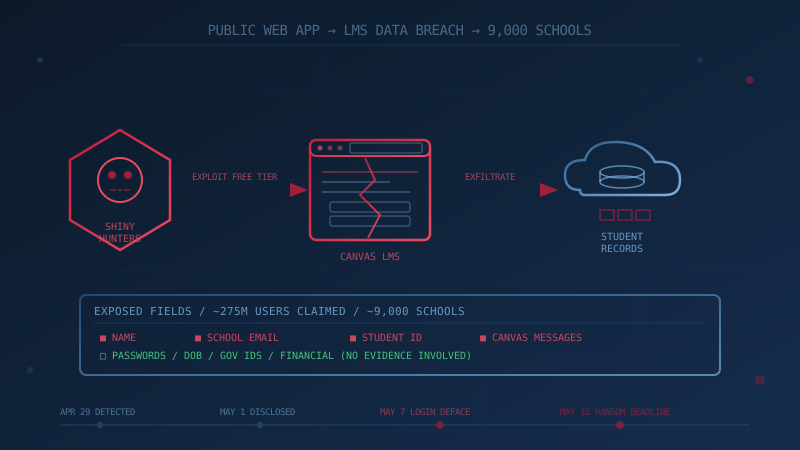
The Canvas data breach disclosed by Instructure on May 1, 2026 — and followed by a mass login-page defacement on May 7 that Instructure has tied to the same intrusion — has pulled in at least seven Canadian post-secondary institutions, including the University of British Columbia (UBC), Simon Fraser University (SFU), the University of Toronto, OCAD University, Western's Ivey Business School, Mohawk College and Ontario Tech University. The cyber-extortion group ShinyHunters has claimed it stole 3.65 terabytes of data covering roughly 275 million users across nearly 9,000 schools worldwide, with a public-leak deadline of May 12, 2026 unless Instructure negotiates.
Instructure has confirmed a narrower set of facts: an unauthorized actor exploited "an issue related to our Free-for-Teacher accounts," accessed certain identifying information — names, email addresses, student ID numbers and messages between Canvas users — and was detected and cut off in late April. The company says it has "found no evidence that passwords, dates of birth, government identifiers, or financial information were involved." The 275-million figure remains the attacker's unverified claim and should be read as an upper-bound marketing number, not a confirmed exposure count.
For Canadian students, the immediate worry is targeted phishing. For Canadian businesses watching from the sidelines, the more uncomfortable question is the same one raised by the Canada Life breach two weeks earlier: how a publicly exposed web application — wired into thousands of organizations — can be picked apart by a single criminal group, and what defensive playbook actually keeps you out of the next one.
What Happened in the Canvas Data Breach
According to Instructure, the company detected unauthorized activity in its Canvas environment on April 29, 2026 and revoked the intruder's access the same day. The incident was disclosed publicly on May 1. ShinyHunters posted a public leak threat naming Instructure in early May (sources cite dates between May 2 and May 5), and on May 7 the same actor defaced thousands of Canvas login portals — replacing institutional sign-in pages with a ransom note demanding Instructure "negotiate a settlement" before May 12. Instructure has stated the May 7 activity was tied to the same April 29 incident. Canvas, Canvas Beta and Canvas Test were placed into maintenance mode while the company investigated; service was restored later that day.
The verified facts, as of May 8, 2026:
- Vector: an issue tied to Instructure's Free-for-Teacher accounts (a free, self-serve tier of Canvas separate from the licensed instances most universities run). Free-for-Teacher accounts have been temporarily shut down.
- Detection date: April 29, 2026.
- Public disclosure: May 1, 2026.
- Confirmed data accessed: names, email addresses, student ID numbers, and Canvas messages between users at affected institutions.
- Confirmed not accessed (per Instructure): passwords, dates of birth, government identifiers, financial information.
- Threat actor: ShinyHunters — the same financially motivated extortion group linked to the Canada Life intrusion and a September 2025 social-engineering compromise of Instructure's Salesforce environment (which, per Instructure at the time, exposed business contact data rather than Canvas customer or product data).
- Attacker claims (unverified): ~275 million users and 3.65 TB of data across ~9,000 schools.
- Ransom deadline: end of day, May 12, 2026.
- Status: vulnerability remediated, third-party forensic firm engaged, law-enforcement notified, Canvas restored.
Attribution should be hedged in any active investigation, but ShinyHunters has publicly claimed the breach, named victim institutions on its leak infrastructure, and the pattern is consistent with the group's prior activity.
Which Canadian Universities Are Affected
At least seven Canadian post-secondary institutions have publicly confirmed they are in scope of the Canvas breach, and the list may grow as more schools complete their reviews. Confirmed so far:
- University of British Columbia (UBC)
- Simon Fraser University (SFU)
- University of Toronto (Quercus, U of T's Canvas-based learning platform, was taken offline)
- OCAD University
- Ontario Tech University
- Mohawk College
- Western University's Ivey Business School
U of T, OCAD and Ontario Tech have noted that winter terms were already complete, so coursework was not disrupted — but exposed account information is a year-round problem, not a term-end one. UBC and SFU advised students still logged in to log out and wait for an all-clear notice.
Because Canvas is the learning management system (LMS) of choice for a large share of Canadian universities and colleges, additional institutional disclosures are likely in the days ahead. If you are a Canadian student or employee at any school that uses Canvas, assume your name, school email and student ID may have been touched and act accordingly.
What Was Exposed and What It Means for Canadians
The data accessed in the Canvas breach is not, on its own, the kind that empties a bank account — but it is enough to fuel highly convincing phishing aimed at students, parents paying tuition, and faculty. Names tied to verified school email addresses and student ID numbers, plus the contents of in-platform messages, give attackers everything they need to impersonate registrars, financial-aid offices, professors, and student-services staff.
The realistic Canadian risks over the next several months include:
- Targeted "tuition" and "financial aid" phishing that references your real school, real student ID and real course context.
- Account-takeover attempts on services that share your school email, especially where students reuse passwords across personal accounts.
- Resume and job-offer scams aimed at students whose addresses have been confirmed at known institutions.
- Scholarship and grant fraud using real names, IDs and messages to add credibility.
- Smishing (text-message phishing) if mobile numbers were collected by attackers from previous breaches and matched to Canvas profiles.
Under PIPEDA and provincial privacy laws, affected institutions are expected to notify individuals where there is a real risk of significant harm. Watch for an official notice from your school — not from "Canvas," "Instructure," or a third party — and verify any communication by going to the school's website directly rather than clicking links in email.
What Affected Students and Staff Should Do This Week
If you have a Canvas account at one of the named Canadian institutions — or any school that uses Canvas — take these five steps now. They are quick, free, and they materially reduce the value of the stolen data to whoever ends up holding it.
- Change your school account password and any password that reuses the same string elsewhere. Use a unique password for every account; a password manager makes this practical.
- Turn on multi-factor authentication (MFA) on your school account and your personal email. If your institution offers a phishing-resistant option (passkey, security key), pick that. See our guide on multi-factor authentication.
- Be skeptical of any message referencing your school, course, professor, or student ID for the next several months — even when the details look legitimate. Verify by phoning the school directly or going to the official portal.
- Do not click links or attachments in unsolicited "Canvas," "Instructure," "Quercus," or registrar emails. Type the URL yourself.
- Watch for notices from your institution. They will use their own domain — not a free webmail address, not a .com lookalike. The patterns to recognize are covered in how to recognize phishing emails.
Why This Matters for Canadian Businesses
The Canvas breach is not just an education story. It is a clean illustration of a pattern Canadian businesses should expect to see repeatedly: a publicly accessible web application, used by thousands of organizations, picked at by a sophisticated extortion group until something gives way. The same pattern produced the Canada Life intrusion in April, the Instructure Salesforce compromise last September, and a long line of incidents before that.
Two structural realities make this worse, not better, in 2026:
- Anything reachable from the public internet will be probed. Login pages, API endpoints, file uploaders, password-reset flows, free or trial tiers — all of it. Free or low-friction account tiers (like Canvas's Free-for-Teacher) are particularly attractive because attackers can sign up themselves, study the platform from the inside, and look for issues that affect the paid product.
- Generative AI has lowered the cost of finding flaws. The same large language models defenders use are now being used by criminals to read source code, infer authentication logic, generate exploit prototypes, and write convincing phishing at scale. The reconnaissance and exploit-development work that used to take a skilled team a month can be done by one person in days. This is the same dynamic we wrote about in AI-powered phishing — except now it applies to web vulnerabilities, not just emails.
Put bluntly: if your business runs an internet-facing application, or relies on a vendor that does, it is being looked at. The defenders' job is to find the issues first.
Use the Same AI Tooling Attackers Are Using — Defensively
Canadian businesses can flip the AI advantage by adopting continuous, AI-assisted penetration testing and vulnerability assessment instead of the once-a-year audit model many SMBs still rely on. Modern AI-augmented security tooling can:
- Continuously scan public-facing assets for new exposures as code and configuration change.
- Re-test the same applications against newly disclosed vulnerability classes within days of publication.
- Generate proof-of-concept exploits in safe, scoped environments to confirm whether a finding is actually exploitable, rather than theoretical.
- Triage the resulting findings against your real architecture, prioritising the ones that map to a realistic attack path.
The objective is straightforward: find and patch the issue before an external attacker — increasingly one assisted by the same kind of AI — finds and exploits it. This is consistent with the 13 Baseline Cyber Security Controls published by the Canadian Centre for Cyber Security, particularly the controls covering patch management and web application security. It is also where federal critical-infrastructure obligations under Bill C-26 are heading: regulators will increasingly expect ongoing assurance, not annual snapshots.
A separate, equally important point: any AI tooling your business uses for security testing — or anything else — should sit inside a written AI usage policy that defines what data may and may not be sent to which models.
Treat Third-Party Code and Vendors as Part of Your Attack Surface
The Canvas incident also reinforces a point we made in our pieces on vendor and third-party risk and the Notepad++ supply-chain attack: your security perimeter now extends through every SaaS platform, open-source library, browser extension, and third-party script your business depends on. A vulnerability in any of them — including ones you didn't know you were running — can be the back door into your environment.
Practical actions for the next 30 days:
- Maintain an inventory of every SaaS platform and third-party library your business depends on, including transitive dependencies in any internally developed software.
- Subscribe to vendor security advisories and a CVE feed for the libraries on that list. Free options include cyber.gc.ca alerts and the U.S. CISA known exploited vulnerabilities catalog.
- Continuously scan dependencies for known vulnerabilities (software composition analysis), not just at release time.
- Question free or trial tiers of platforms that share infrastructure with your paid environment — confirm with the vendor that an issue in the free tier cannot reach your data.
- Rehearse a SaaS-vendor compromise scenario as part of your incident response plan — Canvas is a useful tabletop exercise this month.
What Could Have Prevented This — and What Should Happen Next
No public reporting yet describes the precise technical flaw in the Free-for-Teacher tier. What we can say from the disclosed facts is that the controls most likely to have changed the outcome are well-understood and well-documented:
- Continuous web application security testing of every internet-facing surface, including free or trial tiers, with a particular focus on authentication, multi-tenancy boundaries, and bulk-data endpoints.
- Strict tenancy isolation so that a vulnerability in a free or self-serve tier cannot reach licensed-customer data.
- Anomaly detection on bulk reads so that exfiltration of millions of records does not look like normal traffic to a monitoring system.
- Phishing-resistant MFA and help-desk hardening to defeat the social-engineering playbook ShinyHunters has used against Instructure's Salesforce environment in September 2025 and against many other SaaS customers since.
- Faster, more transparent disclosure timelines so that downstream institutions — including Canadian universities — can act on attacker claims before login pages are publicly defaced.
These are not exotic controls. They are the same items Canadian regulators, the Canadian Centre for Cyber Security, and frameworks like the CCCS Baseline reference repeatedly. The hard part is keeping them current against an attacker pool that now uses AI to find the gaps faster than human defenders can.
The Bigger Picture
Public-facing applications will keep getting probed. ShinyHunters and groups like it are not going away. AI is amplifying the attacker side of the equation, and any business that waits for an annual penetration test to find out how it stands is, in practical terms, hoping nothing changes between January and December. That is not a strategy.
The realistic posture for Canadian businesses in 2026 is continuous: continuous monitoring, continuous testing, continuous third-party assessment, and a written incident response plan that assumes a SaaS vendor — not your own server — will be the one in the headlines. The Canvas breach will not be the last of its kind this year.
If you are not sure where your business stands on web-application security, third-party risk, or incident readiness, our free Canadian cybersecurity assessment walks through the 13 Baseline Controls and gives you a clear, prioritised view of which gaps to close first — without collecting your data, and without a sales call attached.
Frequently Asked Questions
Which Canadian universities were affected by the Canvas data breach?
At least seven Canadian post-secondary institutions have publicly confirmed they are in scope: the University of British Columbia, Simon Fraser University, the University of Toronto (whose Canvas-based Quercus platform was taken offline), OCAD University, Ontario Tech University, Mohawk College, and Western University's Ivey Business School. Because Canvas is the learning management system used by a large share of Canadian universities and colleges, additional institutional disclosures are possible.
What data was exposed in the Canvas data breach?
Instructure has confirmed that an unauthorized actor accessed names, email addresses, student ID numbers, and messages between Canvas users. The company has stated it found no evidence that passwords, dates of birth, government identifiers, or financial information were involved. Names tied to verified school email addresses and student IDs are still enough to fuel convincing phishing that impersonates registrars, financial-aid offices, and faculty.
Were 275 million Canvas users really affected?
The 275 million user figure — along with claims of 3.65 terabytes of data across roughly 9,000 schools — comes from the extortion group ShinyHunters and remains unverified. It should be read as an attacker's upper-bound claim, not a confirmed exposure count. Instructure has confirmed a narrower set of facts: an issue related to its Free-for-Teacher accounts allowed access to certain identifying information.
When did the Canvas data breach happen?
Instructure detected unauthorized activity in its Canvas environment on April 29, 2026 and revoked the intruder's access the same day. The incident was disclosed publicly on May 1, 2026. On May 7, the same actor defaced thousands of Canvas login portals with a ransom note demanding Instructure negotiate before May 12, 2026; Instructure has stated the May 7 activity was tied to the same April 29 incident. Canvas was briefly placed in maintenance mode and restored later that day.
How did attackers get into Canvas?
Instructure has attributed the intrusion to an issue related to its Free-for-Teacher accounts — a free, self-serve tier of Canvas separate from the licensed instances most universities run. Free-for-Teacher accounts were temporarily shut down in response. The company says the vulnerability has been remediated, a third-party forensic firm has been engaged, and law enforcement has been notified.
What should students and staff at affected schools do?
Assume your name, school email address, and student ID may have been touched, and treat any message referencing your school, student ID, or course context with suspicion for the next several months. The realistic risks are targeted tuition and financial-aid phishing, account-takeover attempts on services sharing your school email, resume and job-offer scams, scholarship fraud, and text-message phishing. Use a unique password for your school account and enable multi-factor authentication wherever your institution offers it.
Cite This Page
Suggested citation:
Cybersecurity Canada (2026). Canvas Data Breach 2026: What the Instructure Hack Means for Canadian Universities and Businesses. Retrieved from https://cybersecuritycanada.ca/news/posts/canvas-data-breach-what-canadian-universities-and-businesses-need-to-know/
Permanent URL: https://cybersecuritycanada.ca/news/posts/canvas-data-breach-what-canadian-universities-and-businesses-need-to-know/ · Published May 8, 2026
Disclaimer: This article is intended for general informational purposes only and does not constitute professional cybersecurity, legal, IT, or compliance advice. While we strive to ensure accuracy, the cybersecurity landscape changes rapidly and information may become outdated. Organizations should consult with qualified cybersecurity professionals and legal counsel to assess their specific situation and develop appropriate security policies. Use of this information is at your own risk. See our Privacy Policy for more information.
Cybersecurity Canada is an independent resource and is not affiliated with, endorsed by, or connected to the Canadian Centre for Cyber Security, the Communications Security Establishment, or the Government of Canada.
How does your organization measure up?
Take our free cybersecurity assessment based on the Canadian Centre for Cyber Security's Baseline Controls. 50 questions, under 30 minutes, 100% confidential — your answers never leave your browser.
Take the Free Assessment