Canada Life Data Breach: What to Do Now

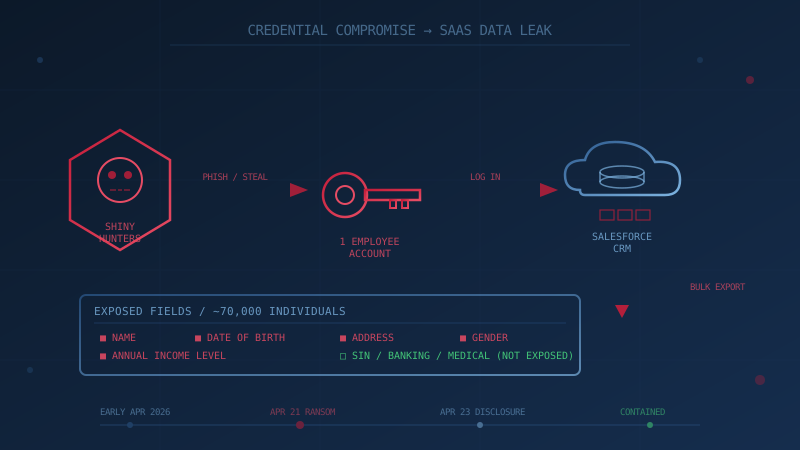
The Canada Life data breach disclosed publicly on April 23, 2026 exposed the personal information of up to 70,000 people — most of them customers of one large corporate group plan — after the criminal extortion group ShinyHunters used a single Canada Life employee's account to reach the insurer's Salesforce environment. Canada Life says the incident has been contained and is offering free credit monitoring to affected individuals.
The two numbers circulating in coverage do not contradict each other, but they answer different questions. 70,000 is Canada Life's verified count of individuals whose personal data was actually accessed. 5.6 million is the figure ShinyHunters has claimed for the records it could reach in the broader Salesforce environment — a number Canada Life has not confirmed and that should be treated as the attacker's unverified claim, not a confirmed exposure count. The verified figure is what affected Canadians and regulators will work from; the larger figure matters because it suggests how much one compromised account could potentially touch.
For Canadians, the practical question is: what was exposed, and what should you do? For Canadian businesses, the more uncomfortable question is how a single set of compromised credentials gave attackers that kind of reach into a customer database — and whether the same path exists in your own environment.
What Happened in the Canada Life Data Breach
Canada Life — one of the country's largest life and health insurers — identified a cyber incident in mid-April 2026 and disclosed it publicly on April 23. The company says attackers gained access through a single employee account and used it to query data held in Canada Life's Salesforce customer relationship management (CRM) system. ShinyHunters set a ransom deadline of April 21, 2026 with a "pay or leak" demand before public disclosure.
Key facts confirmed by Canada Life and reported across major Canadian news outlets:
- Up to 70,000 individuals had personal information accessed
- Less than 0.5% of Canada Life's total customer base
- The majority of affected accounts belong to one large corporate group customer
- Threat actor: ShinyHunters, a financially motivated extortion group
- Attack vector: a single compromised employee account used to access Salesforce
- ShinyHunters has claimed access to 5.6 million records; Canada Life's verified count is approximately 70,000
- The incident has been contained; operations and services continue normally
What Information Was Exposed
The data accessed in the Canada Life breach is the kind used to underwrite group benefits, not the kind that lets a criminal directly empty a bank account — but it is more than enough to support targeted phishing, identity verification fraud, and benefits-related social engineering. According to Canada Life's disclosure, the exposed fields include:
- Full name
- Date of birth
- Mailing address
- Gender
- Annual income level
Canada Life has stated that Social Insurance Numbers, banking details, and medical information were not part of the accessed data. That is meaningful — but a name, date of birth, address, and income level is still a strong starting point for identity fraud or impersonation, especially when paired with information that may already be available from previous unrelated breaches.
Who Is ShinyHunters and Why Salesforce
ShinyHunters is a long-running cybercriminal extortion group that has been linked to a series of 2025–2026 intrusions targeting cloud-hosted CRM and customer data platforms — Salesforce in particular. The group's pattern, reported across multiple incidents this spring, is to compromise an employee's credentials (commonly through phishing, credential reuse, or social engineering of help desks), authenticate to the company's Salesforce tenant, and bulk-export customer records before issuing a ransom demand.
This is not a flaw in Salesforce itself. The platform performs as designed when a legitimate user logs in with valid credentials. The weak point is the human account in front of it — and the absence of controls that would catch an unusual bulk export from one user's session.
Attribution should always be hedged in active investigations, but ShinyHunters has publicly claimed the Canada Life intrusion and posted the company on its leak-threat infrastructure with the April 21 deadline. Multiple security outlets have corroborated the claim.
What Canadians Affected by the Breach Should Do
If you are a Canada Life customer — particularly through a workplace group benefits or retirement plan — assume you may be in scope until you hear otherwise. Canada Life has said affected individuals will be contacted directly and offered free credit monitoring. While you wait, take these steps:
- Watch for the official notification. Canada Life is contacting affected people directly. Do not click links in emails claiming to be the breach notice — go to canadalife.com directly or call the number on a document you already have.
- Enrol in the offered credit monitoring. It is free and covers the kinds of fraud most likely to follow an income-and-address leak.
- Place a fraud alert with Equifax Canada and TransUnion Canada. Both bureaus offer free fraud alerts that require lenders to take extra steps to verify your identity.
- Be sceptical of "Canada Life" calls and emails for the next several months. Attackers know who was breached and what data they have. Expect targeted phishing that references your real address, birthday, or employer.
- Never give out a password, MFA code, or banking detail in response to an inbound call, even if the caller knows personal details about you. Hang up and call back on a verified number.
If you want a deeper checklist, our guide on how to recognize phishing emails covers the patterns most commonly used after a breach like this one.
Why This Matters for Canadian Businesses
The Canada Life breach is not just a consumer story. It is the same pattern that has hit a string of other large organizations through their Salesforce, Workday, and similar SaaS environments over the last twelve months. The lesson for Canadian businesses — particularly small and medium-sized ones that often assume they are too small to be of interest — is that the identity of one employee is now frequently the entire perimeter. If you are not certain whether your business has the identity and access controls in place to prevent a similar incident, our free cybersecurity assessment can help you find out in under 30 minutes.
One Account Should Not Be Able to Export 5.6 Million Records
Even if ShinyHunters' figure is inflated, the structural point stands: the attackers were able to query and pull a substantial volume of customer data using credentials belonging to a single user. That suggests the account had broad data access, no anomaly-based limits on bulk export, and no step-up authentication on sensitive operations. Most SaaS platforms — including Salesforce — offer controls to limit these exact behaviours, but they have to be configured.
Multi-Factor Authentication Is the Floor, Not the Ceiling
The Canadian Centre for Cyber Security's 13 Baseline Cyber Security Controls list multi-factor authentication (MFA) as a foundational requirement — and for good reason. ShinyHunters' typical playbook involves bypassing or stealing through MFA fatigue, phishing-resistant push prompts, or session token theft. Phishing-resistant MFA (such as FIDO2 security keys or platform passkeys) materially raises the bar. We covered this in detail in our piece on multi-factor authentication.
Your SaaS Vendors Are Your Attack Surface
If your business uses Salesforce, HubSpot, Microsoft 365, Google Workspace, or any SaaS platform that holds customer data, those platforms are part of your attack surface — even though you do not run them. This is the heart of what we wrote about in vendor and third-party risk. Your responsibility is not to operate the platform, but to configure access, identity, and monitoring within it as if it were your own data centre — because, for the data inside, it is.
What Canadian Businesses Should Do This Week
If the Canada Life breach has prompted a "could this happen to us?" question at your leadership table, these are the most practical steps to take in the next seven days.
1. Audit Who Can Bulk-Export from Your CRM
Run a report of which user accounts have permission to export, query, or download large volumes of customer records from your CRM and other SaaS systems. The list should be short, named, and reviewed quarterly. Most organizations are surprised by how long this list actually is.
2. Turn On Phishing-Resistant MFA for Privileged Accounts
For any account that can access sensitive customer data, push notifications and SMS codes are no longer adequate. Move privileged accounts to FIDO2 security keys or platform passkeys. Most SaaS platforms support this natively at no extra cost.
3. Enable Anomaly Alerts on Bulk Data Access
Salesforce, Microsoft 365, Google Workspace, and most major SaaS platforms can alert administrators when a user logs in from a new country, downloads an unusually large number of records, or behaves outside their normal pattern. Turn these on. Route them somewhere a human will read them.
4. Train the Help Desk Against Social Engineering
A common ShinyHunters technique is calling the help desk pretending to be a locked-out employee and asking for a password or MFA reset. Help-desk staff should require a verified callback or video confirmation before resetting credentials for any account with sensitive access. This belongs in your security awareness training program.
5. Confirm Your Incident Response Plan Covers SaaS Compromise
If the compromised system is a SaaS platform you do not host, your incident response steps are different — you need vendor contacts, log access procedures, and a way to revoke sessions you do not directly control. Walk through this scenario before you need it. Our guide on building an incident response plan covers the basics.
The Bigger Picture: Identity Is the New Perimeter
The Canada Life data breach is the latest in a clear pattern. ShinyHunters, Scattered Spider, and similar groups have shifted away from exploiting software vulnerabilities and toward exploiting people and their accounts because that is consistently the easier path. For ongoing coverage of threats facing Canadian businesses, see Cybersecurity Canada. The defensive response is also clear, even if it is not always easy:
- Treat every employee identity as a potential breach point
- Make MFA strong, and required, for everything that touches customer data
- Limit what any one account can do with that data
- Watch for the bulk-export, mass-query, and impossible-travel signals that almost always precede a leak
Canada's privacy regulators expect organizations to take reasonable security measures under PIPEDA, and federal critical-infrastructure obligations are tightening further under Bill C-26. The Canada Life incident is a reminder that "reasonable" now includes the way you configure the SaaS platforms you trust with your customers' data.
If you are not sure where your business stands on identity, access, and SaaS risk, our free Canadian cybersecurity assessment walks through the 13 Baseline Controls and gives you a clear picture of which gaps to close first — without collecting your data, and without a sales call attached.
Breaches like Canada Life's will keep happening as long as one stolen password is still enough. The point is to make sure that, in your business, it isn't.
How prepared is your business?
Find out where you stand against Canada's 13 Baseline Cyber Security Controls. The assessment takes under 30 minutes and your answers stay in your browser.
Check Your ScoreFrequently Asked Questions
How many people were affected by the Canada Life data breach?
Canada Life has verified that up to 70,000 individuals had personal information accessed — less than 0.5% of its total customer base, with the majority of affected accounts belonging to a single large corporate group plan customer. The extortion group ShinyHunters has separately claimed access to 5.6 million records in the broader Salesforce environment, but Canada Life has not confirmed that figure and it should be treated as an unverified attacker claim rather than a confirmed exposure count.
What information was exposed in the Canada Life data breach?
According to Canada Life's disclosure, the accessed data included full name, date of birth, mailing address, gender, and annual income level. Canada Life has stated that Social Insurance Numbers, banking details, and medical information were not part of the accessed data. That combination is not enough to directly drain a bank account, but it is sufficient to support targeted phishing, identity verification fraud, and benefits-related social engineering.
Who was behind the Canada Life breach and how did they get in?
ShinyHunters, a financially motivated criminal extortion group, has publicly claimed the intrusion, and multiple security outlets have corroborated the claim. Attribution should be hedged during an active investigation. Canada Life says attackers gained access through a single compromised employee account and used it to query customer data held in its Salesforce CRM environment. This was not a flaw in Salesforce itself — the platform behaved as designed for a legitimate authenticated user.
When was the Canada Life data breach disclosed?
Canada Life identified the cyber incident in mid-April 2026 and disclosed it publicly on April 23, 2026. ShinyHunters had set a ransom deadline of April 21, 2026 with a pay-or-leak demand ahead of public disclosure. Canada Life says the incident has been contained and that operations and services continue normally.
What should Canada Life customers do now?
Canada Life is contacting affected individuals directly and offering free credit monitoring. Watch for that official notification but do not click links in emails claiming to be the breach notice — navigate to canadalife.com directly or call a number from a document you already have. Enrol in the credit monitoring, place free fraud alerts with Equifax Canada and TransUnion Canada, and be sceptical of inbound Canada Life calls and emails for several months. Never provide a password, MFA code, or banking detail to an inbound caller, even one who knows personal details about you.
What should Canadian businesses learn from the Canada Life breach?
The breach shows that a single employee identity is now frequently the entire security perimeter. Five practical steps follow: audit which accounts can bulk-export records from your CRM and other SaaS platforms, move privileged accounts to phishing-resistant MFA such as FIDO2 security keys or passkeys, enable anomaly alerts on bulk data access and impossible-travel logins, train help-desk staff to require verified callbacks before resetting credentials, and confirm your incident response plan covers a SaaS compromise you do not host.
Cite This Page
Suggested citation:
Cybersecurity Canada (2026). Canada Life Data Breach: What to Do Now. Retrieved from https://cybersecuritycanada.ca/news/posts/canada-life-data-breach-what-canadians-need-to-know/
Permanent URL: https://cybersecuritycanada.ca/news/posts/canada-life-data-breach-what-canadians-need-to-know/ · Published April 26, 2026
Disclaimer: This article is intended for general informational purposes only and does not constitute professional cybersecurity, legal, IT, or compliance advice. While we strive to ensure accuracy, the cybersecurity landscape changes rapidly and information may become outdated. Organizations should consult with qualified cybersecurity professionals and legal counsel to assess their specific situation and develop appropriate security policies. Use of this information is at your own risk. See our Privacy Policy for more information.
Cybersecurity Canada is an independent resource and is not affiliated with, endorsed by, or connected to the Canadian Centre for Cyber Security, the Communications Security Establishment, or the Government of Canada.
How does your organization measure up?
Take our free cybersecurity assessment based on the Canadian Centre for Cyber Security's Baseline Controls. 50 questions, under 30 minutes, 100% confidential. Your answers never leave your browser.
Take the Free Assessment