Vendor and Third-Party Risk: How Your Suppliers Can Become Your Weakest Link
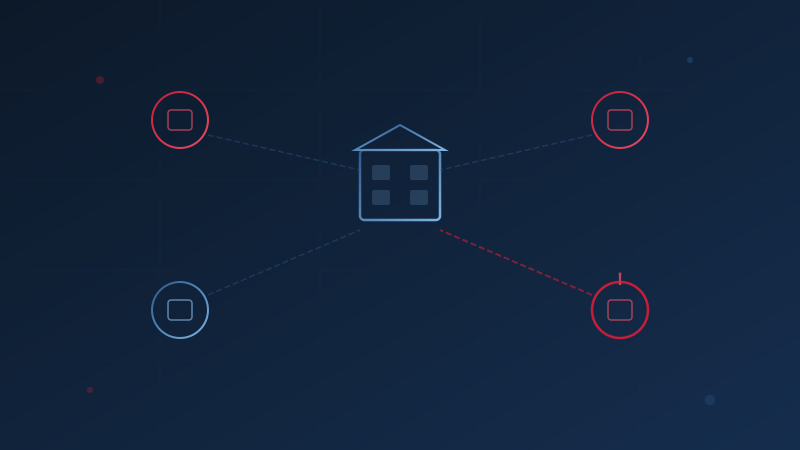
In 2023, a ransomware attack on Indigo Books & Music — Canada's largest bookstore chain — disrupted operations for weeks, took down the company's website, and compromised employee data. The incident illustrated a pattern that has become increasingly common: attackers target organizations through the technology and services those organizations depend on.
But you don't have to be a national retailer to face third-party risk. Every Canadian small business relies on external vendors — managed service providers, cloud platforms, accounting software, payment processors, HR systems, web hosting, and more. Each of these relationships creates a potential pathway for attackers.
The question isn't whether you use third-party services. It's whether you understand what access those vendors have and what happens when one of them gets compromised.
How Third-Party Breaches Affect Small Businesses
When a vendor is breached, the impact cascades to every customer they serve. Here's how this plays out for Canadian SMBs:
Your Data in Someone Else's Hands
Every time you use a cloud service, a SaaS platform, or a managed IT provider, you're entrusting some of your business data to a third party. If that vendor is breached, your data — customer records, financial information, employee details — can be exposed. Under PIPEDA, your organization remains responsible for personal information even when it's processed by a third party. The breach may be the vendor's fault, but the notification obligation and the reputational damage land on you.
Shared Access, Shared Risk
Many vendors require some level of access to your systems to deliver their services. Your managed service provider likely has administrative access to your network. Your accounting software connects to your bank accounts. Your web developer may have credentials to your hosting platform. Each of these access points is a potential entry vector if the vendor's own security is compromised.
Software Supply Chain
The software tools your business depends on are themselves a potential vector. The Notepad++ supply chain attack demonstrated how a compromised software update can deliver malware directly to organizations that trust the software source. If a vendor's software update mechanism is compromised, every customer who installs the update is affected.
The Scale of the Problem
The Canadian Centre for Cyber Security's 2023-2024 National Cyber Threat Assessment noted that supply chain compromises are a "growing and significant threat" to Canadian organizations. The assessment highlighted that state-sponsored actors and cybercriminals are increasingly targeting service providers and software vendors as a way to reach multiple victims through a single compromise.
Globally, research from SecurityScorecard found that 98% of organizations have a relationship with at least one third party that has experienced a breach. For small businesses with limited security resources, this exposure is particularly concerning because the breach vector is entirely outside their control.
Assessing Vendor Risk Without a Security Team
You don't need a formal vendor risk management program to start making better decisions. Here are practical steps for Canadian SMBs:
Know Who Has Access to What
Start with an inventory. List every vendor, service provider, and software tool that:
- Has access to your business network or systems
- Stores, processes, or transmits your business data
- Has credentials or accounts on your platforms
- Connects to your systems via API or integration
For each vendor, note what data they can access, what level of system access they have, and how critical they are to your operations. You may be surprised by how long this list becomes.
Ask the Right Questions
When evaluating a new vendor — or reassessing an existing one — you don't need a 200-question security questionnaire. Focus on the questions that matter most:
-
Do you use multi-factor authentication for accessing our data and systems? If a vendor managing your systems doesn't use MFA, your data is one stolen password away from exposure.
-
How do you handle data if we end the relationship? Understand whether they delete your data, return it, or retain it — and get the answer in writing.
-
Do you have cyber insurance? A vendor without insurance may not have the resources to respond effectively to their own breach, which directly affects you.
-
What happens to my data if you're breached? Will they notify you? How quickly? What support will they provide?
-
Where is my data stored? For PIPEDA compliance, knowing whether data is stored in Canada, the US, or elsewhere is relevant to your privacy obligations.
-
Do you have a written incident response plan? A vendor without an incident response plan is a vendor that will be slower to detect, contain, and communicate about a breach.
Review Contracts for Security Terms
Many vendor contracts include service-level agreements for uptime but say nothing about security. Look for — or negotiate the inclusion of — these terms:
- Breach notification timeline — The vendor should be required to notify you within a specific period (24-72 hours) of discovering a breach affecting your data
- Data handling and deletion — What happens to your data during and after the relationship
- Right to audit — The ability to ask about their security practices or request evidence of compliance
- Insurance requirements — Requiring vendors to maintain cyber insurance
- Subcontractor disclosure — Whether the vendor uses subcontractors who will also have access to your data
Apply the Principle of Least Privilege
Give vendors only the access they need to do their job — nothing more:
- If a vendor needs access to one system, don't give them access to your entire network
- Create dedicated vendor accounts rather than sharing employee credentials
- Use time-limited access where possible — if a vendor needs access for a specific project, revoke it when the project is complete
- Review vendor access quarterly and remove accounts that are no longer needed
- Require MFA on all vendor accounts
Managing Your Managed Service Provider
For many Canadian SMBs, the most critical third-party relationship is with their managed service provider (MSP) or IT support company. MSPs often have the highest level of access — including administrative privileges across your entire network.
This makes MSPs a high-value target for attackers. A compromised MSP gives an attacker access to every client the MSP manages. The Kaseya VSA attack in 2021 demonstrated this at scale — a single vulnerability in the MSP's remote management tool was used to deploy ransomware to approximately 1,500 businesses simultaneously.
For your MSP relationship:
- Understand their security practices. Ask the same questions you'd ask any vendor, but apply higher scrutiny given their level of access
- Require MFA on all remote access. Your MSP should be using MFA to access your systems — no exceptions
- Limit administrative access. Not every MSP technician needs domain admin access. Use role-based access and require elevation only when needed
- Get breach notification commitments in writing. Your MSP should notify you within hours — not days — of any security incident that could affect your environment
- Ask about their own incident response plan. If your MSP is breached, their response directly determines your exposure
The CyberSecure Canada Connection
The CyberSecure Canada certification program, operated by Innovation, Science and Economic Development Canada, includes vendor management as part of its certification requirements. Organizations pursuing certification must demonstrate that they assess and manage the cybersecurity risks associated with their suppliers and service providers.
While certification may not be practical for every small business, the framework provides a useful benchmark for evaluating your own vendor risk management maturity.
Starting Small
If vendor risk management feels overwhelming, start with these three actions:
-
List your top five most critical vendors — the ones with the most access to your data and systems. For most SMBs, this will include your MSP/IT provider, cloud email platform, accounting software, bank, and web host.
-
Send each one a simple email asking: "What security measures do you have in place to protect our data? Do you use MFA? Do you have cyber insurance? What is your breach notification process?"
-
Review the access each vendor has to your systems and revoke any access that is no longer needed.
These three steps take less than an hour and immediately improve your visibility into third-party risk.
The Baseline Controls Connection
Vendor and third-party risk management connects to multiple areas of the Canadian Centre for Cyber Security's Baseline Controls:
- BC.5 (Authentication) — Requiring MFA for all vendor access
- BC.10 (Cloud Services) — Evaluating cloud vendors' security practices
- BC.12 (Access Control) — Applying least-privilege access to vendor accounts
- BC.13 (Portable Media) — Including security requirements in vendor selection and contracts
Our free assessment evaluates your organization across all 13 Baseline Control areas, including procurement security and access management. It takes under 10 minutes and highlights where your vendor relationships may be introducing risk you haven't accounted for.
Disclaimer: This article is intended for general informational purposes only and does not constitute professional cybersecurity, legal, IT, or compliance advice. While we strive to ensure accuracy, the cybersecurity landscape changes rapidly and information may become outdated. Organizations should consult with qualified cybersecurity professionals and legal counsel to assess their specific situation and develop appropriate security policies. Use of this information is at your own risk. See our Privacy Policy for more information.
Cybersecurity Canada is an independent resource and is not affiliated with, endorsed by, or connected to the Canadian Centre for Cyber Security, the Communications Security Establishment, or the Government of Canada.
How does your organization measure up?
Take our free cybersecurity assessment based on the Canadian Centre for Cyber Security's Baseline Controls. 50 questions, under 30 minutes, 100% confidential — your answers never leave your browser.
Take the Free Assessment