The Hidden Cost of Assuming Your Business Is Too Small to Attack
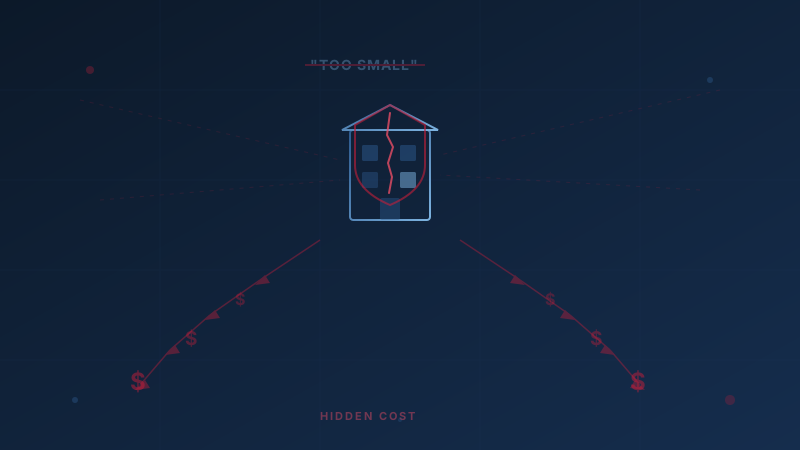
"We're too small. No one's going to come after us."
It's the most common thing Canadian business owners say when cybersecurity comes up — and it's the single most expensive assumption they make. Not because attackers specifically hunt down small businesses by name, but because that one belief quietly shapes every security decision (or non-decision) that follows.
The Gap Between Perception and Reality
Despite years of headline-making breaches, the disconnect between perceived and actual risk among Canadian SMBs remains staggering. Research from the Business Development Bank of Canada found that 73% of small businesses have experienced a cybersecurity incident — yet a separate survey by the Insurance Bureau of Canada found that only 6% of SME owners strongly agree their business is at risk.
That gap is not just a survey finding. It's a business risk multiplier.
When leadership believes the business won't be targeted, everything downstream reflects that belief: security training gets skipped, software updates get postponed, backup strategies go untested, and password policies stay stuck in 2015.
Modern Attacks Don't Filter by Company Size
The "too small" assumption rests on a misunderstanding of how cyberattacks actually work. Most attacks against small businesses aren't personally targeted — they're automated and indiscriminate.
The Canadian Centre for Cyber Security's National Cyber Threat Assessment 2025-2026 highlights the rise of Cybercrime-as-a-Service (CaaS), where attackers rent or buy pre-built attack tools without needing deep technical skills. These tools scan thousands of networks simultaneously, probing for known vulnerabilities, weak passwords, and unpatched software. They don't check your annual revenue first.
The data confirms this. According to recent industry research, 82% of ransomware attacks target organizations with fewer than 1,000 employees, and over a third strike businesses with fewer than 100 staff. Globally, an estimated 43% of cyberattacks are aimed at small and medium businesses.
For cybercriminals, the math is simple: demanding $50,000 from 20 poorly defended small businesses is far more reliable than trying to breach a single well-funded enterprise.
What This Assumption Actually Costs Canadian Businesses
When a business that assumed it wouldn't be attacked actually gets hit, the costs compound in ways that were never planned for.
Direct Financial Damage
A cyberattack on a Canadian SMB typically costs around $254,000, with more serious breaches running into the millions. IBM's 2025 Cost of a Data Breach report puts the Canadian average at CA$6.98 million per incident. Small businesses pay less in absolute terms but absorb proportionally more damage relative to their revenue — often enough to threaten their survival.
Operational Shutdown
More than half of Canadian SMBs report system outages lasting 8 to 24 hours following an attack. For businesses without tested recovery procedures, getting back to normal takes days or weeks, not hours. Three-quarters of surveyed SMBs say they could not continue operating if struck by a serious incident.
Regulatory Consequences
Under PIPEDA, if a breach involves personal information with a real risk of significant harm, you must report it to the Privacy Commissioner of Canada, notify affected individuals, and maintain records. Non-compliance can lead to fines of up to $100,000 per violation — and proposed federal privacy legislation could significantly increase these penalties.
The National Recovery Bill
Across Canada, businesses spent $1.2 billion recovering from cyber incidents in 2023 — double the $600 million spent just two years earlier. Prevention and detection spending rose to $11 billion over the same period. The organizations that avoided the worst outcomes were the ones that invested before an incident occurred, not after.
How One Assumption Creates a Chain Reaction
What makes the "too small" belief so damaging is that it doesn't produce a single bad outcome — it triggers a cascade of underinvestment that leaves the business exposed at every layer:
- No budget allocated — "We're not a target, so why spend money on this?"
- No training provided — Employees never learn to spot phishing emails or social engineering attempts
- No policies written — No incident response plan, no AI usage guidelines, no acceptable use standards
- No detection in place — Breaches go unnoticed for weeks or months
- No recovery plan tested — When an incident hits, the business improvises under pressure
- Maximum impact — Costs spiral because every layer of defence was missing
Each of these gaps is individually manageable and inexpensive to address. Together, they create the conditions for an incident that can permanently close a business.
Proportional Security Is Not Enterprise Security
One reason the "too small" myth persists is the belief that cybersecurity requires enterprise-scale spending. It doesn't.
The Canadian Centre for Cyber Security's Baseline Cyber Security Controls were built specifically for small and medium organizations. They define 13 practical control areas — from software inventory to incident response — that any business can implement at a scale appropriate to its size.
The highest-impact steps cost little or nothing:
- Multi-factor authentication — Free on most platforms and prevents the majority of credential-based attacks
- Automatic software updates — Built into every modern operating system
- Tested backups — Affordable cloud backup options exist at every price point
- Employee awareness training — Free resources available through Get Cyber Safe and the Canadian Centre for Cyber Security
- A written incident response plan — The time to create one is before you need it
In 2024, the Cyber Centre issued 336 pre-ransomware notifications to Canadian organizations, generating an estimated $6 to $18 million in economic savings. Basic preparedness and early detection deliver measurable returns.
Replace the Assumption with Evidence
The question has never been whether your business is too small to be attacked. The real question is whether your security decisions are based on evidence or on a comfortable assumption.
Canadian businesses that honestly assess their security posture — and act on the findings — consistently spend less, recover faster, and avoid the worst outcomes. Those that wait until after a breach spend dramatically more and recover slower, if they recover at all.
Our free assessment evaluates your organization across all 13 Baseline Control areas from the Canadian Centre for Cyber Security. It takes under 10 minutes and shows you exactly where your business stands — and where to start.
Disclaimer: This article is intended for general informational purposes only and does not constitute professional cybersecurity, legal, IT, or compliance advice. While we strive to ensure accuracy, the cybersecurity landscape changes rapidly and information may become outdated. Organizations should consult with qualified cybersecurity professionals and legal counsel to assess their specific situation and develop appropriate security policies. Use of this information is at your own risk. See our Privacy Policy for more information.
Cybersecurity Canada is an independent resource and is not affiliated with, endorsed by, or connected to the Canadian Centre for Cyber Security, the Communications Security Establishment, or the Government of Canada.
How does your organization measure up?
Take our free cybersecurity assessment based on the Canadian Centre for Cyber Security's Baseline Controls. 50 questions, under 30 minutes, 100% confidential — your answers never leave your browser.
Take the Free Assessment